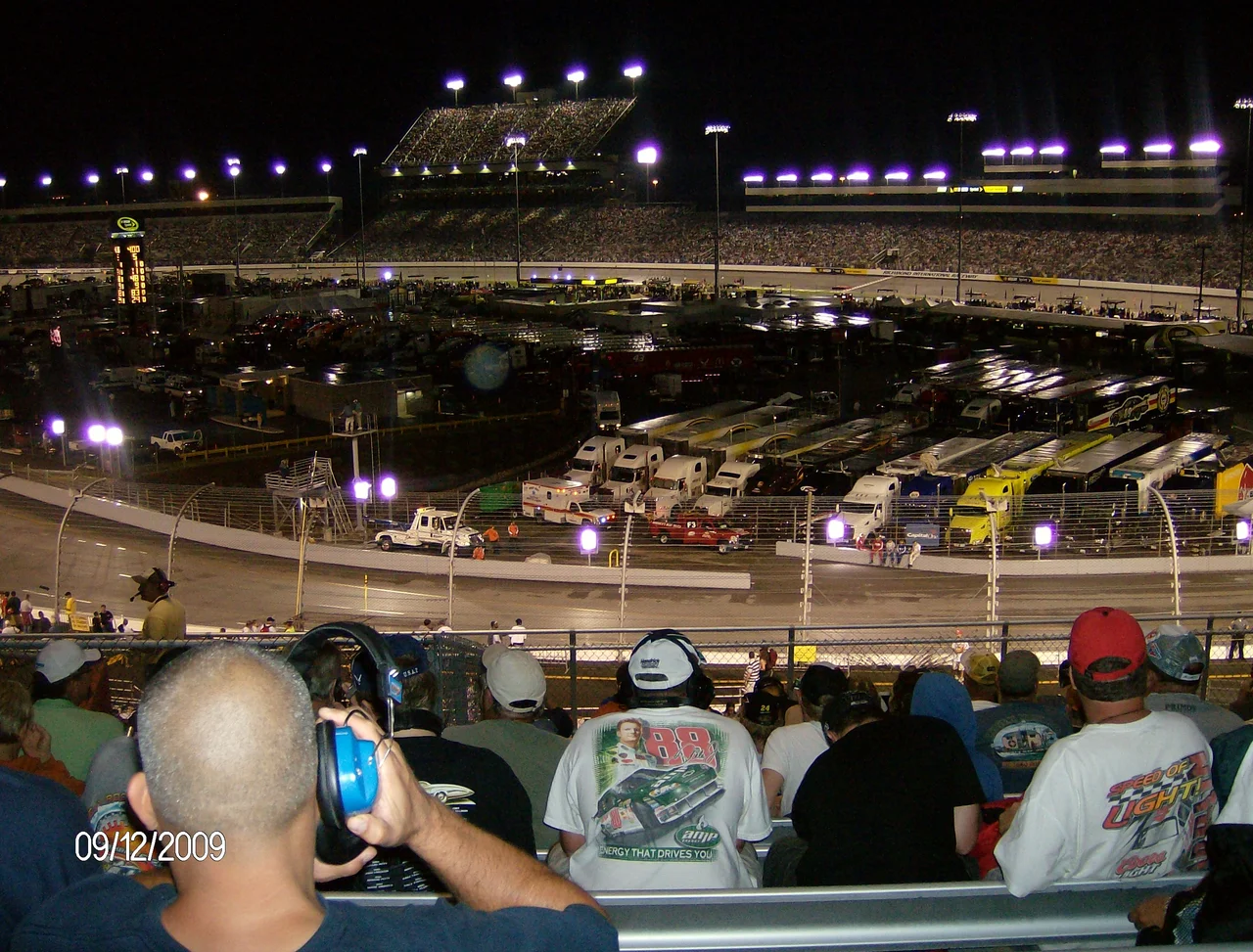

Richmond Raceway
In October 1946, the inaugural Atlantic Rural Exposition opened on a former Strawberry Hill farm just north of Richmond, with a brand-new dirt oval included in the budget for the agreeable sum of $10,000. The first race went to a horse named Empire Grattan. The first automobile race, run the next day, went to Ted Horn. Almost eighty years later, that same patch of Henrico County dirt - now paved, banked, lit, and shaped into a D - has been called by drivers some of the best short-track racing in NASCAR. The track has been three names, four configurations, and the property of three different ownership groups. It has been expanded to seat 112,000 fans, then deliberately shrunk back below 50,000. Most of that story is the story of one man.
The Promoter Who Would Not Leave
Paul Sawyer started promoting races at Richmond's fairgrounds track in 1955, working alongside the driver Joe Weatherly. A year later he bought out Weatherly's promotion share for $5,000. From that moment until he sold the track to International Speedway Corporation in 1999, Sawyer was Richmond Raceway. He fought for it through three failed replacement schemes - a Colonial-America Raceway in Prince George County, a Dinwiddie County track, an Isle of Wight County track - each one a plan to abandon the cramped, aging fairgrounds for something modern. None of them happened. Each time the financing collapsed, or NASCAR refused a long-term sanction, or the partners ran into legal trouble. By 1987, after three failures, Sawyer simply turned around and rebuilt the fairgrounds itself.
The 1988 Reinvention
The remodeling was radical. Sawyer converted the true half-mile oval into a D-shaped 0.75-mile track, with 14 degrees of banking in the turns, 8 on the frontstretch, and 2 on the backstretch. The dirt was long gone - the track had been paved in 1968 - but everything else changed. The grandstands grew to nearly 30,000 seats during construction. The cost climbed from $2.5 million to $5 million. The Fairgrounds Raceway was renamed Richmond International Raceway. The first race on the new layout, the Miller High Life 400 on September 11, 1988, was won by Davey Allison. The configuration immediately became one of NASCAR's most beloved - short enough for short-track contact, fast enough for genuine speed, banked enough to let drivers run multiple grooves. Drivers still talk about Richmond as one of the best races on the calendar.
The Expansion Years
From 1988 through the early 2000s, Richmond grew almost continuously. Permanent lights arrived in 1995, making it one of the early Cup Series night-race venues. Capacity climbed past 70,000, then 83,000, then 96,000. In 1999 Sawyer sold the property to ISC, the France-family-owned company that ran most of the big NASCAR tracks, for $215 million. By 2007 the track held 112,029 fans. Tickets sold out 33 races in a row, a streak that ended at the 2008 Chevy Rock & Roll 400. Then attendance softened, and the strategy reversed.
The Quiet Shrinking
After 2011, Richmond began removing seats. First the capacity slid to 94,000. Then 75,000 when the third-turn grandstands came down. Then 69,000 after a seat-widening project. Then 60,000 in 2016 when the entire backstretch was demolished. A $30 million renovation in 2017 added a fourth-turn party deck and a specialized RV parking area, rebranded the facility as Richmond Raceway, and demolished the third- and fourth-turn grandstands - dropping capacity to 51,000. In 2019 NASCAR acquired ISC and the track came under the sanctioning body's direct ownership. The 2024 Times-Dispatch reported capacity as 'under 50,000.' The races kept selling, and the racing kept being good. The seats just stopped being the point.
What Still Runs
Richmond Raceway hosts one NASCAR weekend a year now, headlined by the Cup Series Cook Out 400. The spring date - last known as the Toyota Owners 400 - ran from 1959 through 2024 before being moved off the calendar. The IndyCar Series ran here from 2001 to 2009 and was announced to return in 2020, but the COVID-19 pandemic canceled that race and it was never rescheduled. Beyond the headline events, the track has hosted USAC Silver Crown, USAC Midget, and IROC races. It served as a filming location for the 1960 stock car movie Thunder in Carolina and the 1977 documentary Stockcars! What started as a horse track at a state fair is still, three-quarters of a century later, one of the most respected short tracks in American auto racing - shrunk back to roughly the size it grew to in the 1990s, but still on the schedule, still under the lights.
From the Air
Richmond Raceway sits at 37.5917 N, 77.4209 W, in Henrico County just north of downtown Richmond. From the air, look for the distinctive D-shape of the 0.75-mile oval, with the State Fairgrounds property surrounding it. The nearest major airport is Richmond International (KRIC), about 4 nm to the south-southeast. Recommended viewing altitude is 1,500-3,000 ft AGL to see the track layout and the I-95 / Laburnum Avenue interchange that funnels race traffic.
Nearby Stories
- Kings Dominion 8.4 km away
- Battle of Hatcher's Run 9.7 km away
- Francisco's Fight 14 km away
- Piney Grove at Southall's Plantation 17 km away
- Jamestown Settlement 19 km away
- Battle of Amelia Springs 22 km away
- Menokin 29 km away
- Highland (James Monroe House) 42 km away