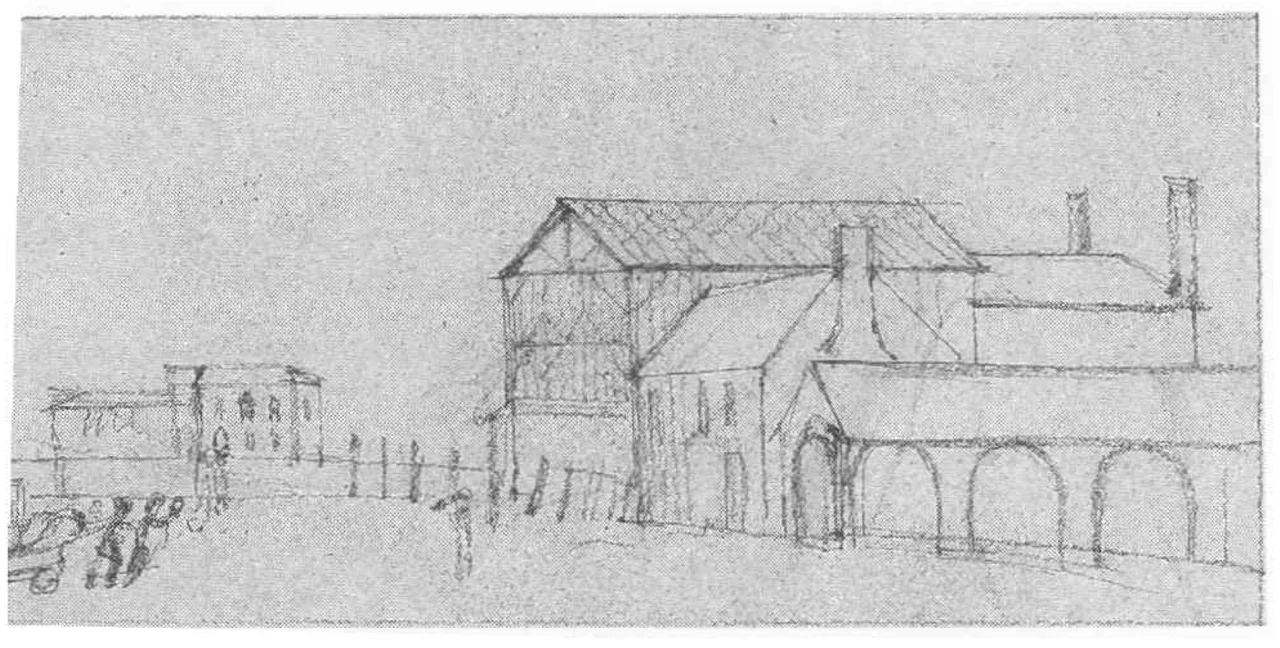

Richmond Theatre (Richmond, Virginia)
On the night after Christmas in 1811, more than six hundred people packed the brick Richmond Theatre at Seventh and Broad streets to see a touring company perform Diderot's The Father, or Family Feuds, followed by Matthew Lewis's gothic melodrama Raymond and Agnes; or, the Bleeding Nun. The Christmas season audience included Virginia's sitting governor, George William Smith. Between acts of the second play, a stagehand raised a chandelier of lit candles toward the rafters. It swung. It caught the paper backdrop. Within ten minutes, the wooden building was a roaring oven, and three exits choked with panicked crowds were the only way out. By morning at least seventy-two people were dead, the governor among them - and the United States had a new worst urban disaster. The Richmond Theatre was the name of four theatres on or near that site. This is the story of all of them.
Quesnay's Academy, 1786-1798
The first Richmond Theatre was not originally a theatre at all. The French scholar and Revolutionary War soldier Chevalier Alexandre-Marie Quesnay de Beaurepaire came to America in 1777 to fight, then spent nearly a decade trying to found an American academy modeled on the French Academy of Sciences. Land was finally secured on Shockoe Hill, with the road extended at the seller's expense to reach it, and the building opened October 10, 1786. James Madison, John Marshall, James Monroe, George Wythe, Edmund Randolph, George Mason, Richard Henry Lee, and Patrick Henry all attended performances there in its first seasons. After Quesnay's academy plans collapsed, the building was leased to theatre managers Thomas Wade West and John Bignall, who renamed it the Richmond Theatre. It burned to the ground on January 23, 1798.
December 26, 1811
The second Richmond Theatre, built of brick and three stories tall, opened in 1806 on the same site. Chief Justice John Marshall had worked to get it built. For five financially successful years it was Richmond's main stage, drawing touring companies from Philadelphia, Charleston, and the West Indies. Then came the fire. The audience that night totaled more than six hundred. The three exits could not handle a panicked rush. People jumped from upper windows. Some were saved by Gilbert Hunt, an enslaved Richmond blacksmith who stood outside and caught women dropped from the second story until the wall above him began to collapse. The known dead included Governor George William Smith; former U.S. Senator Abraham B. Venable; Mary Clay, daughter of Congressman Matthew Clay; and at least sixty-nine others whose names fill the crypt at Monumental Church, which was built between 1812 and 1814 on the theatre's ashes. Seventy-two of the dead are buried beneath the church floor.
Seven Years of Silence, Then a New Theatre
In the immediate aftermath of the fire, a wave of opposition against theatres swept the country. Plays were associated with sin, frivolity, and the deaths of the prominent. Richmond, the city most directly wounded, would not authorize a new theatre for seven years. The third Richmond Theatre finally opened on June 11, 1819, at the corner of Seventh and Broad - a different lot than the burned ones. It was financed as a stock company with 104 investors, most of them local; Governor William H. Cabell, Chief Justice John Marshall, journalist Thomas Ritchie, and banker James Rawlings were among them. The first lessee was Charles Gilfert, whose company University of North Texas scholar Martin Staples Shockley would later call 'perhaps the best theatre company in America during that time.' Between 1818 and 1838, more than ten different companies put on more than three hundred plays across some eight hundred performances. The English actor Junius Brutus Booth made his American debut here on July 6, 1821, as Richard III. Future First Lady Priscilla Cooper Tyler acted on its stage.
The Marshall Theatre, Wartime Stage
By 1838 the third theatre had fallen into disrepair. It was remodeled and renamed the Marshall Theatre, after the Chief Justice who had helped build the 1806 building. For two decades it slid downmarket - minstrels, variety acts, the occasional star turn from Jenny Lind, who performed there in 1850. John Wilkes Booth, who would later assassinate Abraham Lincoln, joined the Marshall's permanent company in 1858 and stayed through 1860, often performing in Shakespeare alongside his older brother Edwin. The theatre burned again on January 2, 1862, with manager John Hill Hewitt and actor Richard D'Orsey Ogden asleep inside; both survived with severe burns. Rebuilt the same year as the New Richmond Theatre, it became the cultural center of the Confederate capital - presenting wartime plays like James D. McCabe's The Guerrillas, hosting the songwriter Harry McCarthy and his hit 'The Bonnie Blue Flag.' When Richmond fell on April 2, 1865, the theatre was hosting Budd and Buckley's Minstrels. It survived the fire that destroyed much of downtown, and it survived until 1896, when it was sold to a clothing manufacturer and demolished.
Monumental Church Still Stands
What remains of the original theatre is not a theatre at all. Monumental Church, designed by Robert Mills and finished in 1814, was built directly on the foundation of the 1811 building, with a crypt holding the seventy-two victims who could not be identified individually after the fire. The names of the dead are inscribed on a memorial inside. Mills's church is one of the earliest octagonal Greek Revival buildings in America and a National Historic Landmark. It still stands at 1224 East Broad Street, two blocks east of Capitol Square. Visitors stand on the spot where the dancing stopped, where Gilbert Hunt caught women in his arms, where a state lost its governor on the night after Christmas. The fire shaped American building codes for generations after. The church was the city's apology, made in stone, and it has outlasted every Richmond Theatre that came after it.
From the Air
The four Richmond Theatre sites cluster around the historic core of downtown Richmond, with Monumental Church at 1224 East Broad Street (37.541 N, 77.432 W) marking the 1811 disaster. From the air, look for the octagonal dome of the church just east of Capitol Square, surrounded by the VCU Medical Center campus. The nearest major airport is Richmond International (KRIC), about 6 nm to the east. Recommended viewing altitude is 1,500-2,500 ft AGL to see the church, Capitol Square, and the dense old grid of downtown together.
Nearby Stories
- Kings Dominion 8.4 km away
- Battle of Hatcher's Run 9.7 km away
- Francisco's Fight 14 km away
- Piney Grove at Southall's Plantation 17 km away
- Jamestown Settlement 19 km away
- Battle of Amelia Springs 22 km away
- Menokin 29 km away
- Highland (James Monroe House) 42 km away