
River Tay
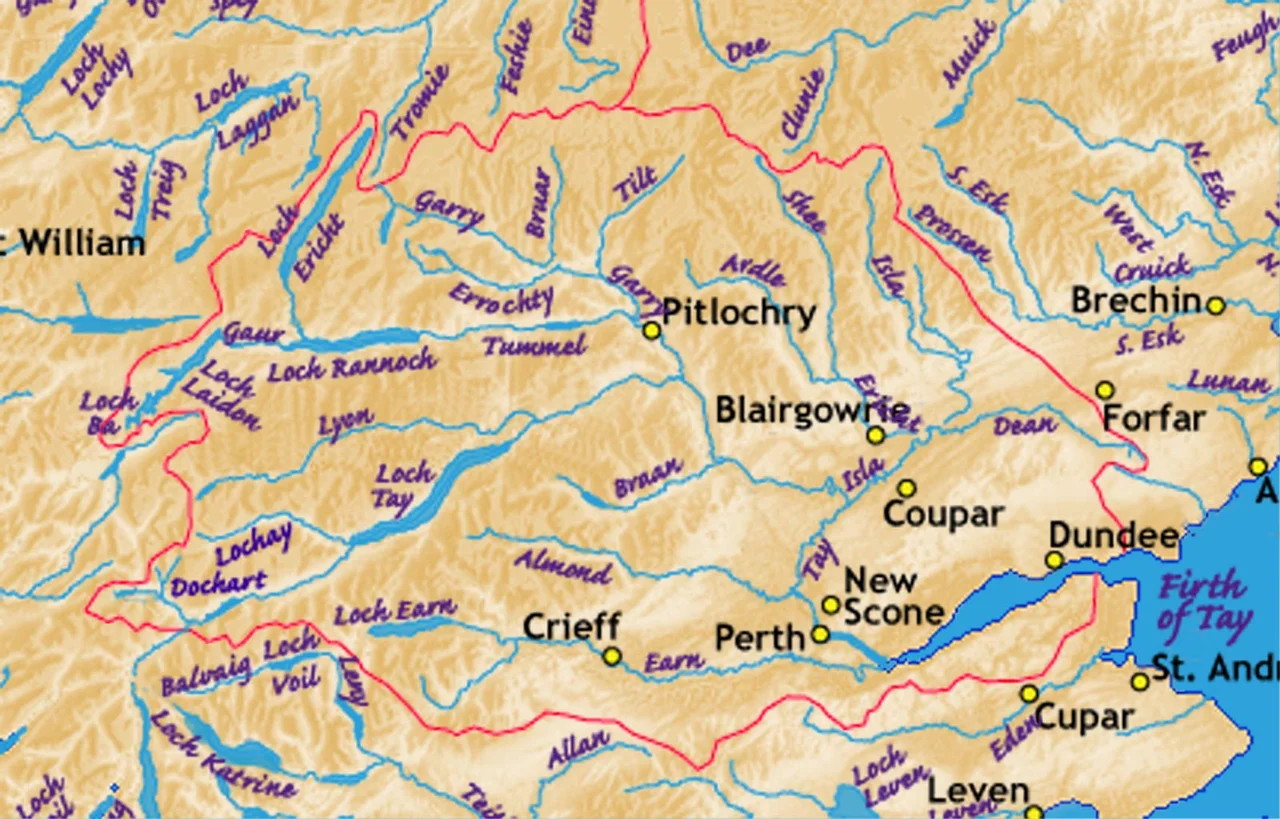
By volume of water, no other river in the United Kingdom comes close. The Tay discharges more water into the sea than the Thames or the Severn, draining a catchment of 2,000 square miles - half again as much as the Tweed. It is also the longest river in Scotland, running 120 miles from Ben Lui in the western Highlands to the North Sea south of Dundee. Its Brythonic name, Tausa, may mean the silent one, or the strong one, or simply the flowing. All three descriptions hold. Stand on Tay Street in Perth on a quiet evening and the strength is what you feel - a vast, smooth body of water sliding past, more water than a Lowland river should be carrying.
Five Names Before Loch Tay
The Tay's headwaters work through an extraordinary series of name changes before settling. The river begins on the slopes of Ben Lui - Beinn Laoigh in Gaelic - about twenty-five miles inland from Oban. There it is called the River Cononish. Then the River Fillan. Then the River Dochart. It flows into Loch Tay at Killin, then re-emerges from the other end at Kenmore, by which time it has finally taken the name that will see it the rest of the way to the sea. From Kenmore the river runs east through Strathtay, then turns south-east toward Perth. At Perth it becomes tidal and broadens out, soon afterwards entering the Firth of Tay, which carries the largest city on the river - Dundee - on its northern bank.
A River of Salmon and Pearls
The Tay is one of the great salmon rivers of Western Europe. The lowest ten miles, with beats like Taymount and Islamouth, hold most of the cream of the fishing. The British rod-caught record was set here in 1922, when Georgina Ballantine landed a 64-pound salmon - a record that still stands more than a century later. The river also supports otters, three species of lamprey, and a flagship population of freshwater pearl mussel, all of which earned it Special Area of Conservation status. Salmon catches have dwindled since 2009, and the Tay District Salmon Fisheries Board introduced a catch-and-release rule for females all season. The North Atlantic Salmon Conservation Organisation thinks marine mortality has doubled or trebled in twenty years, possibly from overfishing in the sea where the fish spend two years before returning to spawn.
The Beavers Came Back
Eurasian beavers, absent from Scotland for more than 400 years, returned to the Tay catchment as early as 2001. By 2011 there were somewhere between twenty and a hundred of them, spread across the catchment. They had not been officially reintroduced - they were thought to be escapees, or descendants of escapees, from private collections. In December 2010 Scottish Natural Heritage trapped the first of the wild Tayside beavers on the River Ericht at Blairgowrie and held it at Edinburgh Zoo, where it died within months. The public outcry was sharp. In March 2012 the Scottish Government reversed course and let the Tay beavers stay, pending the outcome of a parallel reintroduction trial at Knapdale in Argyll. They are still there, building their lodges along quiet stretches of the Ericht and the Almond, the first wild beavers in Scotland in living memory.
The Tay Bridge Disaster
On the evening of 28 December 1879, the Tay Rail Bridge collapsed in a winter storm as a train was crossing it. The entire train fell into the firth. Seventy-five passengers and crew died. The bridge, designed by Sir Thomas Bouch, had been celebrated as a wonder of British engineering only months before. The Scottish poet William McGonagall - famous for his ineptitude - had written two earlier poems praising its strength and certain immortality, then a third, The Tay Bridge Disaster, lamenting its fall. The German writer Theodor Fontane wrote a much better poem on the same subject, Die Bruck am Tay, that took it as a parable of human hubris. The bridge was rebuilt and reopened in 1887. The stumps of the original piers still stand in the firth beside the replacement, a quietly haunting line of weathered iron at low tide.
From the Ferries to the Bridges
Before the Tay Road Bridge opened on 18 August 1966, getting a car across the firth at Dundee meant taking one of the Fifies - the ferries between Craig Pier in Dundee and Newport-on-Tay in Fife. The last two, MVs Abercraig and Scotscraig, used Voith Schneider Propellers that let them manoeuvre in any direction without turning. The bridge took over their work and the ferries went into history. Further upstream, the Jubilee Bridge carries the A9 over the Tay near Dunkeld and will be doubled by 2028 as part of the long-running A9 dualling project. The Rolls-Royce Tay turbofan engine, used on later generations of regional jets, takes its name from this river, in keeping with the company tradition of naming civil aero engines after British rivers.
From the Air
The River Tay flows 120 miles east-south-east from Ben Lui (56.40N, 4.81W) to the Firth of Tay south of Dundee (56.40N, 2.70W). Best followed at 2,000-4,000 ft AGL; the river is unmistakable from the air, particularly the broad tidal section below Perth and the sweep into the Firth at Dundee. Key ICAO airports along its course: Perth (EGPT) on the middle river, Dundee (EGPN) at the firth, Edinburgh (EGPH) 22 nm south of Perth. The Tay Road Bridge and the Tay Rail Bridge at Dundee are obvious visual waypoints.
Nearby Stories
- Drummond Castle 0.4 km away
- St Andrews 0.8 km away
- Aberfeldy 2.2 km away
- Yellowcraig 2.7 km away
- Fordell Castle 3 km away
- Battle of Sauchieburn 3.2 km away
- Battle of Dun Nechtain 3.3 km away
- Airlie Castle 13 km away