
Robert E. Lee Monument (Charlottesville, Virginia)
On the morning of July 10, 2021, a flatbed truck rolled into Market Street Park in downtown Charlottesville and carried away a thirteen-ton bronze man on a thirteen-ton bronze horse. The statue had stood on that square for ninety-seven years. The fight over whether it should stay had run for nearly a decade, killed a woman named Heather Heyer in August 2017, sparked a Virginia Supreme Court ruling, and finally ended in a foundry in October 2023, when the bronze was cut into pieces and fed to a furnace. What survives now sits in storage as a stack of ingots.
The Statue That Stood Here
Paul Goodloe McIntire was a Charlottesville stockbroker who returned home wealthy and wanted to leave his mark on his city. In 1917 he commissioned an equestrian statue of Robert E. Lee, Confederate general, mounted on his horse Traveller, from the sculptor Henry Shrady. McIntire bought an entire city block, tore down the buildings on it, and laid out a formal landscaped square to hold the work. Shrady died in 1922 before finishing; the Italian American sculptor Leo Lentelli completed it. The monument was dedicated in 1924 - nearly sixty years after the Civil War ended, in the same wave of Confederate memorial-building that spread across the South during the Jim Crow era. McIntire's park, named Lee Park, became the first of four parks he gave to Charlottesville. In 1997 the statue was added to the National Register of Historic Places.
The Vote and the Lawsuits
In March 2016, Charlottesville Vice Mayor Wes Bellamy publicly called for the statue's removal, saying it disrespected parts of the community and that some residents refused to set foot in the park. The City Council appointed a Blue Ribbon Commission on Race, Monuments and Public Spaces. The commission voted 7-2 in November 2016 to move the Lee statue to McIntire Park. The next April the council voted 3-2 to remove and sell it outright. A coalition of plaintiffs, including the Monument Fund, the Sons of Confederate Veterans, and descendants of McIntire and Shrady, sued. A Charlottesville circuit judge issued a temporary injunction. The case ground on for four years. On April 1, 2021, the Virginia Supreme Court lifted the injunction and ruled that the state law protecting war memorials did not apply to monuments erected before the law was extended to cities in 1997. The statue's fate was sealed.
August 12, 2017
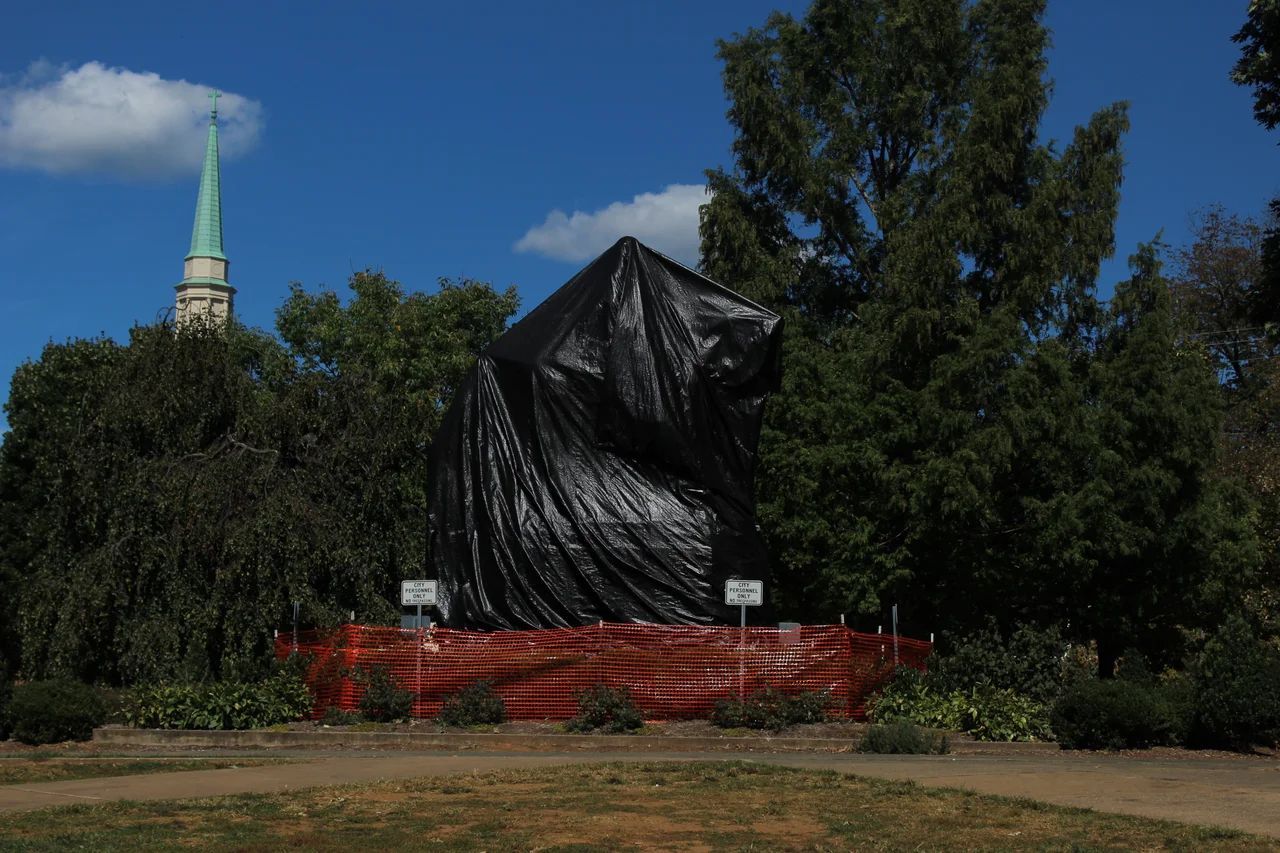
Long before the courts ruled, the debate over the Lee statue had drawn the country's attention. On May 13, 2017, the white nationalist Richard Spencer led a torch-lit rally in the park, chanting against removal. Three months later, on August 12, 2017, a much larger gathering called the Unite the Right rally marched into Charlottesville carrying Confederate, American, and Revolutionary flags and chanting antisemitic slogans. Counter-protesters confronted them. The clashes turned violent. A 32-year-old paralegal named Heather Heyer was killed when a man drove a car into a crowd of counter-protesters; thirty-five others were injured. The statue at the center of the dispute was draped in black eight days later. A judge ordered the shroud removed in February 2018. By then the Lee Monument was no longer a piece of municipal sculpture. It was the most famous Confederate statue in America, and the question it raised was no longer abstract.
Removal and the Furnace
When the city announced on July 9, 2021, that the Lee Monument would be lifted the next morning, crowds gathered in the park. Cheers rose as the bronze figure was hoisted free of the pedestal Henry Shrady had designed. Both the Lee and the nearby Stonewall Jackson statues came down the same day. In December 2021 the City Council voted to melt the Lee statue down and repurpose the metal as new public art - a project led by the Jefferson School African American Heritage Center under the title Swords Into Plowshares. A second lawsuit tried to stop the melting. It failed. In October 2023 the bronze was cut into pieces and fed into a foundry crucible. A reporter watching wrote that for a moment, as the face sagged in the heat, the statue looked like it was crying. In 2025 the bronze ingots were included in Monuments, a show at the Los Angeles Museum of Contemporary Art co-curated by artist Kara Walker and others, which also featured Walker's new sculpture made from the Stonewall Jackson bronze. The new artwork they will become has not yet been made.
What the Park Holds Now
Market Street Park is a city block of grass, paths, and shade trees in downtown Charlottesville, two blocks from the historic Court Square. The stone pedestal where Lee and Traveller once stood was removed after the statue. From the air the park reads as a green rectangle inserted into the brick grid of downtown, just north of the pedestrian Downtown Mall. The names have changed three times. It was Lee Park when McIntire gave it. The City Council renamed it Emancipation Park in 2017 and then Market Street Park in 2018. The University of Virginia Lawn sits less than two miles to the southwest. Monticello rises five miles to the southeast. The history that meets in Charlottesville's small grid of streets - Jefferson's, Lee's, Heyer's - is still being argued, but the bronze that triggered the most recent argument is gone.
From the Air
Market Street Park, the former site of the Robert E. Lee Monument, sits in downtown Charlottesville at 38.0317 N, 78.4806 W, just north of the pedestrian Downtown Mall and west of the historic Court Square. Recommended viewing altitude is 2,000 to 3,000 feet AGL for the best look at the small green city-block park within the surrounding brick downtown grid. The nearest airport is Charlottesville-Albemarle (KCHO), about 5 nautical miles to the north. Monticello lies 3 nm to the southeast and the University of Virginia Lawn 1 to 2 nm to the southwest - the three sites form a tight triangle within Charlottesville's footprint. Class E airspace covers most of the area; expect light GA traffic in the pattern at KCHO. Afternoon mountain wave from the Blue Ridge to the west can produce moderate turbulence.
Nearby Stories
- Augusta County Training School 10 km away
- A. P. Hill Boyhood Home 18 km away
- Reddish Knob 20 km away
- Amherst County, Virginia 21 km away
- Appalachian Trail 21 km away
- Fork Union Military Academy 28 km away
- Huguenot Memorial Chapel and Monument 39 km away