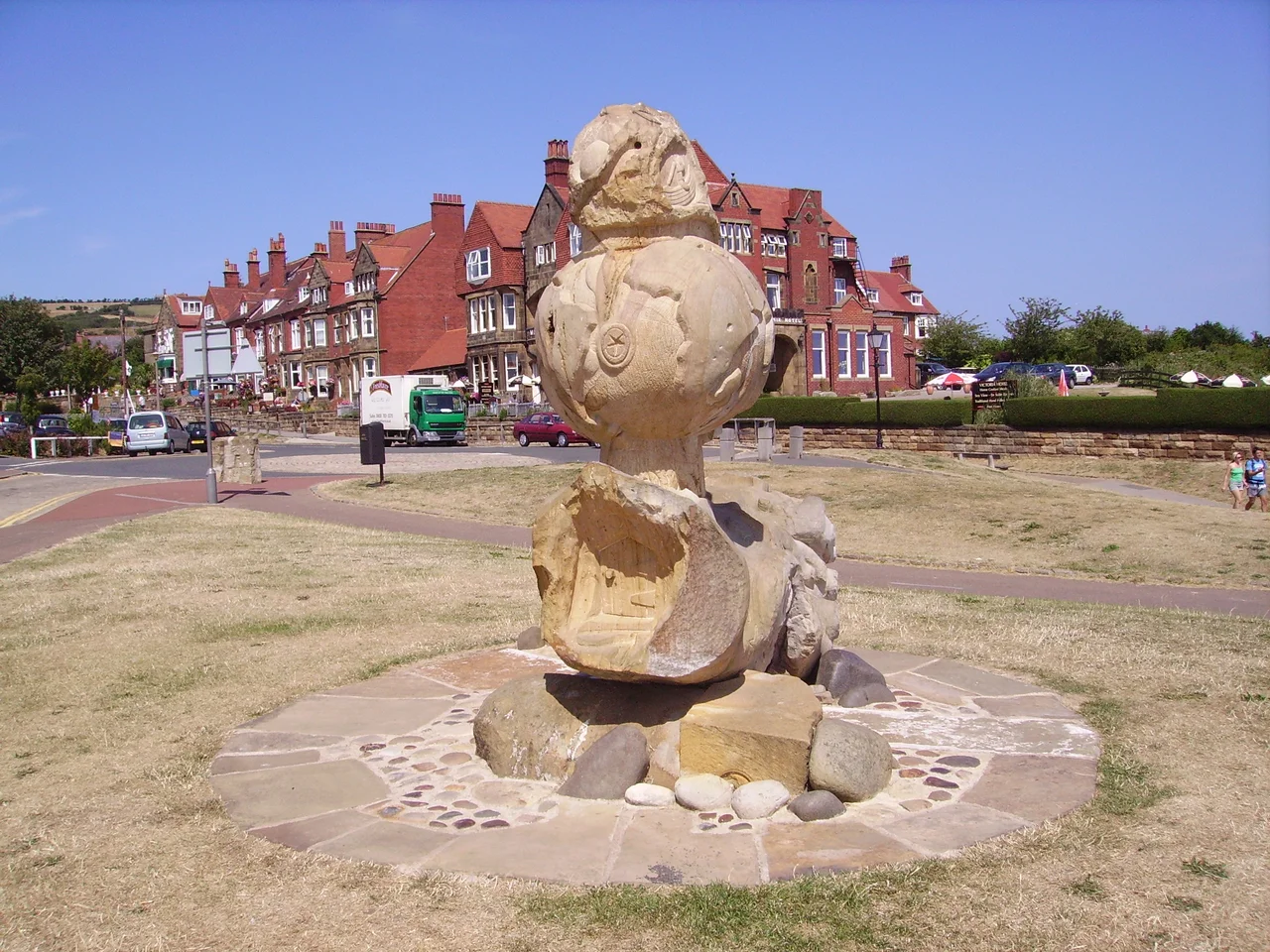

Robin Hood's Bay
Local legend insists that during the great smuggling years on the Yorkshire coast, a bolt of silk could be landed on the beach at Robin Hood's Bay and arrive at the top of the village without ever once seeing daylight - passed hand to hand through a network of subterranean passages, secret doors, and tunnels cut between the cellars of houses jammed together up the cliff. The story may be slightly embellished. The village's tangle of alleys, vertical streets, and houses leaning shoulder to shoulder above the bay makes it sound entirely possible. Whether smugglers ever used such a network or not, they certainly used the village. In the late eighteenth century, the small port was a kingdom of contraband.
The Smuggling Trade
Tea, gin, rum, brandy, and tobacco arrived from the Netherlands and France, slipped ashore to avoid duty, and disappeared up the cliff into the village's maze. The trade was financed by syndicates ashore, who pocketed the profits while the seamen and villagers took the risks. The Crown's response was the excise cutter, and in 1773 the cutters Mermaid and Eagle tried to make a stand in the bay. Three smuggling vessels - a schooner and two shallops - outgunned them, and the excisemen were chased back out to sea. The contraband landed unhindered. By the time the excise service finally got a grip on the coast in the early nineteenth century, the village had built two generations of fortunes on goods that the law said belonged to the king.
The Visiter and the Lifeboat
On 18 January 1881 a violent storm drove the brig Visiter aground in Robin Hood's Bay. The village's own lifeboat could not be launched. The lifeboat at Whitby, six miles away by road, was the only hope. What happened next is recorded on a plaque in the village. Eighteen horses dragged the lifeboat overland through snowdrifts seven feet deep. Two hundred men went ahead clearing the way - shovelling snow, demolishing garden walls, uprooting bushes - because the road down to the sea through the village was too narrow for the lifeboat carriage. The crew launched two hours after leaving Whitby. They failed on the first attempt and rescued the brig's crew on the second. The Visiter rescue stands as one of the most celebrated lifeboat actions of the Victorian era, and it required a road that had to be invented as it was used.
Ammonites and the Pliensbachian
Robin Hood's Bay sits in a fissure between two steep cliffs of Upper Lias shale, capped by Dogger sandstone and Lower Oolite shales. The beach is famous among fossil hunters for the ammonites - coiled, fluted shells of long-extinct cephalopods - that emerge from the foreshore rocks after every winter storm. Just south of the village, the Wine Haven Profile is the global reference point for the Pliensbachian stage of the Early Jurassic, dated 183 to 189 million years ago. That makes this stretch of beach one of the official type localities for a slice of deep time. The professional geologists call it a Global Stratotype Section and Point, or GSSP. To everyone else, it is a cliff full of seashells that swam in the warm Jurassic sea before the dinosaurs reached their peak.
The Bramblewick Coast
The novelist Leo Walmsley, born in 1892, was educated in the schoolroom of the village's old Wesleyan Chapel. He renamed Robin Hood's Bay as Bramblewick in his novels - Three Fevers, Phantom Lobster, Foreigners - and the 1935 film adaptation Turn of the Tide was shot on its streets. In 1948 LIFE magazine sent a reporter to investigate a long-running mystery: someone had been sending spiteful anonymous letters to villagers since 1928, and nobody knew who. The case became known nationally as the Robin Hood's Bay Poison Penman. The 2017 film Phantom Thread, starring Daniel Day-Lewis, used the Victoria Hotel and the clifftops as locations. Today the village is the eastern terminus of Wainwright's Coast-to-Coast Walk, which crosses 192 miles from St Bees Head on the Cumbrian coast. Walkers reach the slipway, walk into the sea up to their boots in the traditional ritual, and look back at a village that has been performing some version of itself - smuggler, fisherman, novelist, film star - for the better part of five hundred years.
From the Air
Coordinates 54.4345°N, 0.5344°W. Robin Hood's Bay sits on the North Yorkshire coast about 5 nm south-southeast of Whitby, on the cliffs between Ness Point (North Cheek) and Old Peak (South Cheek). From the air the village appears as a compact cluster of red-tiled roofs tumbling down a steep cleft to the beach - immediately identifiable. RAF Fylingdales pyramid sits about 4 nm inland to the west. Best viewed 1,500-3,000 ft in clear conditions; the cliffs and surf line make for dramatic photography. Nearest airports: Durham Tees Valley (EGNV) about 35 nm north-northwest, Newcastle (EGNT) about 55 nm north-northwest, Humberside (EGNJ) about 45 nm south.
Nearby Stories
- Sledmere House 8.6 km away
- Hartlepool 10 km away
- RAF Linton-on-Ouse 17 km away
- Middlesbrough Cathedral 17 km away
- SM UC-75 23 km away
- Arctic Viking (H452) 26 km away
- Breagh Gas Field 28 km away
- German submarine U-2367 50 km away