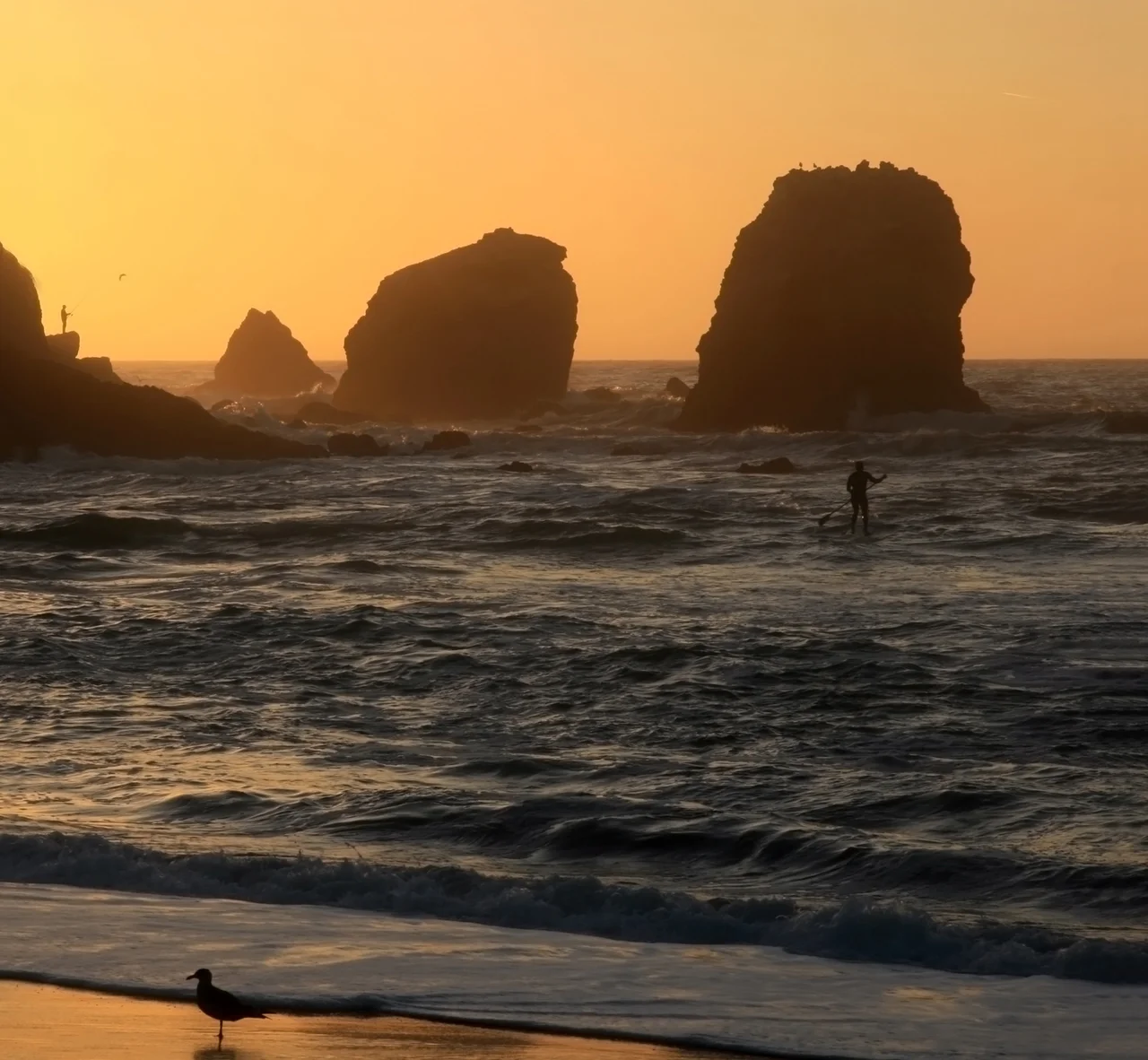

Rockaway Beach, Pacifica, California
The limestone came first. As early as 1776, rock quarried from the pits behind Rockaway Beach was used to whitewash the newly built Presidio of San Francisco. Two and a half centuries later, the quarry is closed, the railroad that once shipped its stone is bankrupt, and three endangered species -- the San Francisco garter snake, the San Bruno elfin butterfly, and the California red-legged frog -- have made the abandoned quarry their home. Rockaway Beach keeps recycling itself, finding new purposes for old geology.
From Timigtac to the Ocean Shore Railroad
The Ohlone village of Timigtac stood about half a mile from Rockaway Beach on Calera Creek, though no prehistoric remains have been found on the beach itself. The Spanish Portola expedition passed through in 1769, credited with the European discovery of San Francisco Bay. The quarry became a commercial operation in 1907 under the Stone Brothers, and that same year the Ocean Shore Railroad arrived. Limestone from Rockaway helped rebuild San Francisco after the devastating 1906 earthquake, and quarry materials served as ballast for the railroad's trackbed. With rail service, Rockaway Beach briefly became a suburb of San Francisco -- until landslide-related legal costs drove the railroad into bankruptcy in 1921.
Headlands, Wildflowers, and Endangered Neighbors
The coastal bluffs pitch at angles as steep as 60 percent, while some quarry faces are completely vertical. The beach and headlands support California coastal prairie and northern coastal scrub, with California poppies, sand verbena, and bush lupines coloring the slopes in spring. The headland cliffs provide nesting sites for bank swallows, pelagic cormorants, and Brandt's cormorants. But it is the abandoned quarry that holds the most ecological surprise. The California red-legged frog, a federally listed species, breeds there and serves as a critical food source for the San Francisco garter snake, one of the most endangered reptiles in North America, known to exist on the Mori Point property immediately to the north.
Nick's, the Moonraker, and the Enduring Shore
At the center of Rockaway Beach, a cluster of restaurants and shops hugs the coast. Nick's Seafood Restaurant is a Pacifica landmark, the oldest establishment in the cluster. The Moonraker, historically a romantic destination, offers nighttime views of illuminated waves crashing against the restaurant's foundation bulwarks. Highway 1 was completed from Montara to Rockaway Beach in 1937, reopening northern access after the railroad's demise. Today the beach remains one of the cleanest in the San Francisco Bay Area, though erosion continues to reduce its size. The quarry, closed since 1987, is being stabilized and restored. Like the beach it borders, it is a place where industrial damage and natural resilience exist in the same frame.
From the Air
Located at 37.61°N, 122.50°W in southern Pacifica. The beach is visible as a curving embayment along Highway 1, with the quarry area visible inland. San Francisco International (KSFO) is approximately 8 nm east-northeast. Half Moon Bay Airport (KHAF) is 8 nm south.
Nearby Stories
- Point Bonita Lighthouse 2.7 km away
- Alviso, San Jose 11 km away
- Black Diamond Mines Regional Preserve 21 km away
- Cordell Bank: The Invisible Island 41 km away
- South Pacific Coast Railroad 49 km away
- Salinas and Steinbeck Country 72 km away
- The Hole in the Head 86 km away
- ʻAkaka Falls State Park 3657 km away