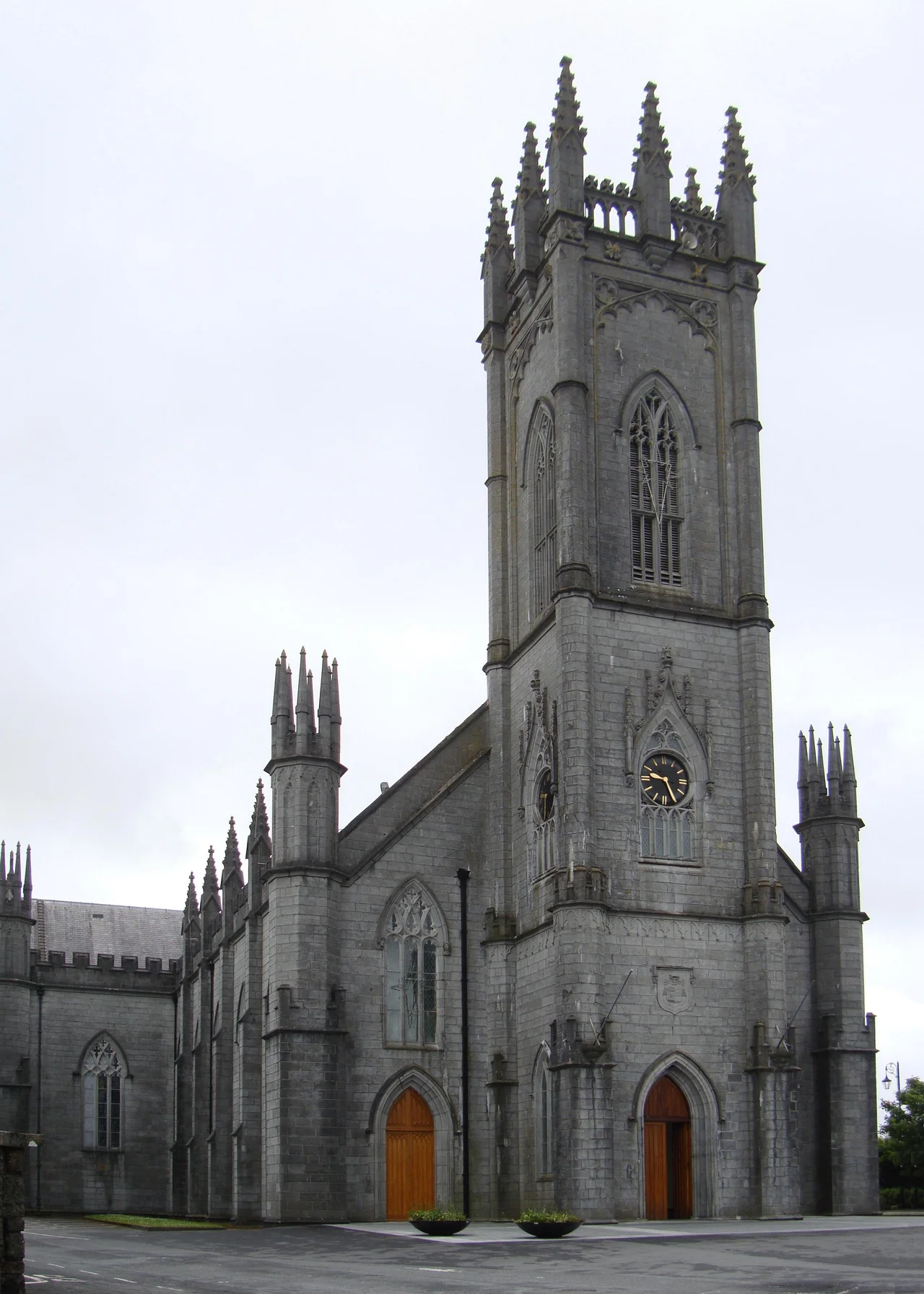

Roman Catholic Archdiocese of Tuam
Pull back from Tuam and draw a line west to the Atlantic cliffs of Achill Island, then east to the green banks of the River Shannon, and you have traced the geographic span of the Roman Catholic Archdiocese of Tuam - 193 kilometres of road, lake, mountain, and pasture, the largest archdiocese in Ireland. According to tradition it began in the 6th century with a single Irish monk named Jarlath, whose chariot wheel broke in this patch of east Galway and who decided, for that reason or for the better one that there was already a settlement nearby, to plant a monastery on the spot.
From Wheel to Cathedral
The story of the broken wheel survives as the town's heraldic device. The harder history is that Tuam's importance grew because the O'Connors, kings of Connacht and eventually High Kings of Ireland, made it their seat in the 11th century. At the Synod of Kells in 1152 the Irish church was reorganised into four provinces, and Tuam was elevated to an archbishopric. The first archbishop, Aed Ua hOissin, took office shortly afterward. The province he led - roughly coterminous with the secular province of Connacht - has carried his title ever since.
The Geography of Faith
The archdiocese sprawls across parts of three modern counties: Mayo, Galway, and Roscommon. It contains Achill Island and the Aran Islands. It includes the towns of Westport, Castlebar, Ballinrobe, Clifden, Claremorris, Athenry, and Tuam itself. It has pastoral charge of the largest Gaeltacht in Ireland, the Irish-speaking communities of west Galway and west Mayo. Six island parishes sit within its boundaries. The lakes Mask and Corrib split it north and south. And tucked into the patchwork are the kinds of administrative oddities that medieval Europe specialised in: a parish in one diocese surrounded by another, an exclave inside an exclave, the residue of centuries of monastic outreach and royal favour.
Two Pilgrimage Mountains
Two of Ireland's most powerful sacred sites sit within Tuam's bounds. Knock Shrine in County Mayo - born from the 1879 Marian apparition - draws close to a million pilgrims a year, the largest pilgrimage centre in Ireland. Croagh Patrick, the conical mountain on the south shore of Clew Bay, has been climbed by penitents for at least a thousand years and probably much longer; the documentary trail linking it to Saint Patrick's forty days of fasting goes back to the 7th century. Every July, on Reek Sunday, thousands still climb the loose scree of its summit cone, some of them barefoot. Ballintubber Abbey in Mayo, founded in 1216, is the oldest medieval parish church in Ireland still in continuous use.
The Penal Years and the Catching Up
For two centuries after the Reformation, Catholic worship in Connacht was tolerated only intermittently and often persecuted. By 1825 the archbishop testified to a House of Commons committee that out of 107 places of worship in the diocese, only eighteen had slated roofs. The rest were thatched and wretched, often used as schoolrooms on weekdays, sometimes simply too small for the congregation, so that Mass was celebrated out in the open. Then came a building boom. Twenty churches went up during the Famine years of 1840 to 1850 alone. Of the 135 existing churches in the diocese today, only two - the abbeys of Ballyhaunis and Ballintubber - predate 1800. Almost everything else was built in the long Catholic recovery of the 19th century.
A Quieter Present
The numbers tell a now-familiar story of contraction. Around 1800 there were a hundred priests in the archdiocese; by 1968 there were 170. As of 2016 there were 103, with 69 over the age of 60 and 20 over 80. Mass attendance has fallen by roughly a tenth from the very high participation rate of 1986. The pattern of out-migration that has emptied the west of Ireland for two centuries continues to drain people eastward toward Dublin. Yet the calendar of pilgrimages still runs through the year: Lady's well at Athenry on the 15th of August since 1249, the Tochar Phadraig walking route from Ballintubber to Croagh Patrick restored in 1989, Saint Bernard's well at Abbeyknockmoy in late summer. The diocese has changed shape many times in nine centuries. It has not yet stopped.
From the Air
The archdiocesan seat, Tuam Cathedral, lies at approximately 53.515 N, 8.848 W. The full territory of the archdiocese extends from Achill Island on the Atlantic (54.0 N, 10.1 W) east to Moore parish on the Shannon (53.4 N, 8.0 W), a span of about 193 km. Useful nearby airports: Ireland West Airport Knock (EIKN) sits inside the archdiocese, roughly 50 km north of Tuam; Galway (EICM) lies 30 km south. From cruise altitude in clear weather, look for Lough Corrib and Lough Mask as the two great inland markers; the great pilgrimage mountain Croagh Patrick rises 764 metres above the south shore of Clew Bay.
Nearby Stories
- Marine Institute Ireland 1.8 km away
- Westport 2.9 km away
- Knock, County Mayo 3 km away
- Bellanagare Bog 4.3 km away
- Ballygar 7.4 km away
- Connemara Railway 8.1 km away
- Ardgraigue Bog 16 km away
- Inishmaan 21 km away