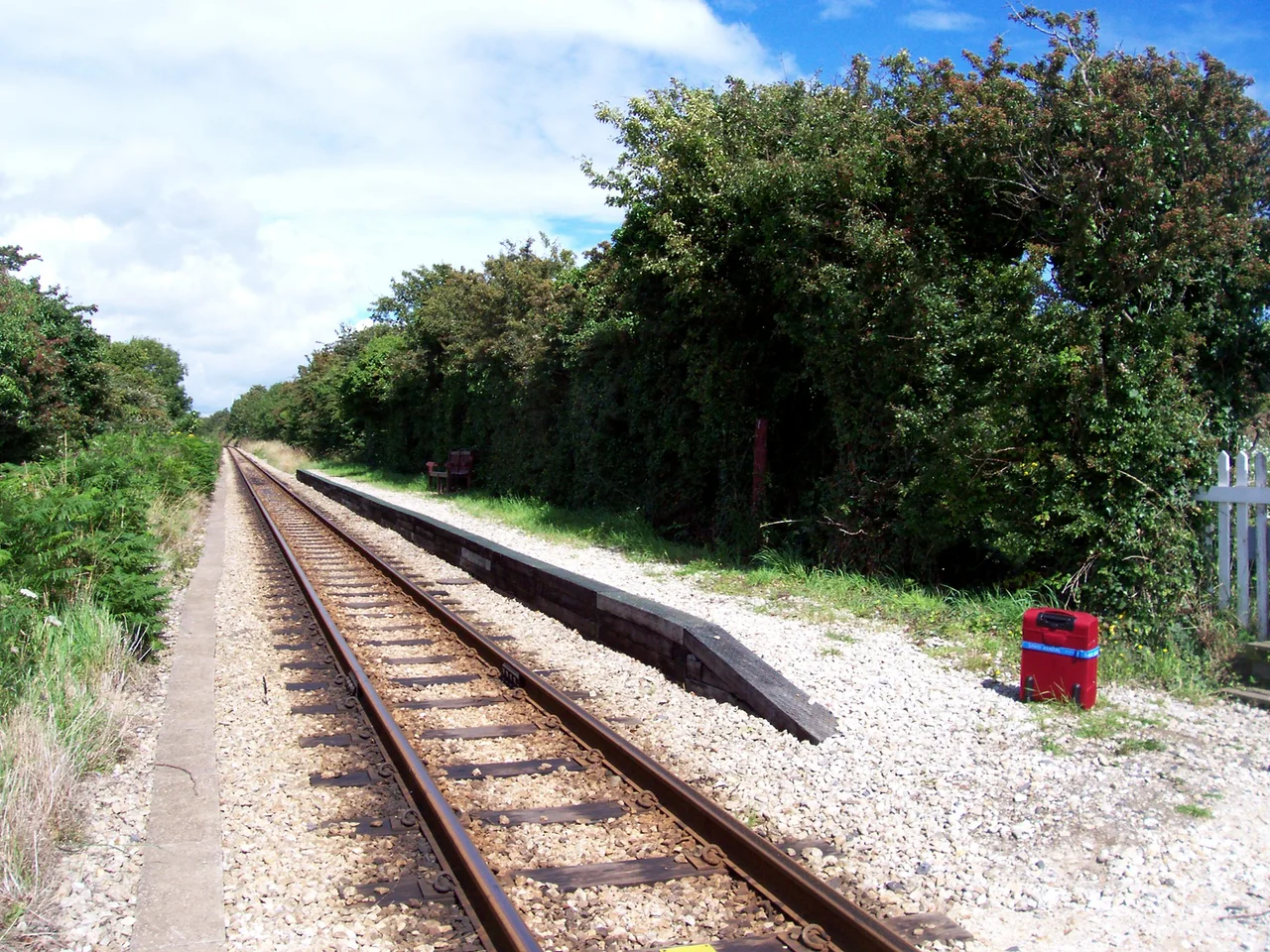

Ronaldsway Railway Station
If you do not flag down the driver, the train will roll right past. Ronaldsway Halt has no ticket window, no shelter worth the name, and no commitment to appearing in the timetable. What it has is a built-up platform of railway sleepers, a bilingual nameboard reading Staad Roonysvie, and a footpath leading roughly ten minutes' walk to the terminal building of Isle of Man Airport. For passengers arriving on a Manchester or Liverpool flight in summer who would rather travel the eight miles to Douglas on a Victorian steam train than in a taxi, this hidden halt is the gateway to one of the most peculiar transport experiences in the British Isles.
A Halt Made for Air Travellers
The Isle of Man Railway opened its Douglas-to-Port Erin line in 1874 and ran for nearly a century before anybody thought to add a stop at Ronaldsway. The airport began commercial operations on the same flat coastal land in the 1930s, but the train just whistled past. By 1967 the railway was losing airport passengers to buses and taxis at a rate it could not afford. The solution that year was minimal: a simple white nameboard with red lettering, a clearing in the brambles behind the new Ronaldsway Industrial Estate, and an entry - sometimes - in the summer timetable. Air passengers willing to walk got a train; those who were not got a bus. The halt has been working in exactly that fashion ever since, and the small effort it takes to use it remains, for the right traveller, the point of using it.
The Field of the Battle
The flat meadow on the west side of the line - known still as the Great Meadow - was once a horse racing track and later the venue for the southern agricultural show, with special trains laid on for both. It is also the site of something much older and far more consequential. In 1275 the Battle of Ronaldsway was fought on this ground when a Galloway nobleman named John de Vesci landed Scottish forces here to put down a Manx rebellion against Alexander III, King of Scotland. The Manx had taken the field on behalf of Godred, son of the defeated King Magnus. The morning before sunrise, battle was joined. By the end of the day the Manx were broken, the rebellion was over, and the Isle of Man's brief flirtation with self-rule under the Norse-Gaelic kings had ended. Archaeologists later excavated keeills - small Celtic prayer cells - in the surrounding fields. They now form displays at the Story of Mann in Douglas, an hour's train ride to the north.
Built of Sleepers
The 2001 all-island sewerage works gave Ronaldsway its first proper platform. The entire railway permanent way was relaid that year because a sewer pipeline needed to run beneath it, and the engineers took the opportunity to build a low platform here out of stacked sleepers - the cheap, characteristic timber from which the rest of the line is constructed. It accommodates four bogie carriages. There is no shelter beyond what the trees give. Passengers wishing to board signal the driver with a raised hand as the train approaches; passengers wishing to alight must tell the guard at the previous station. The system runs on courtesy and visibility, and works because the line is short enough and the trains slow enough that everyone learns who is going where.
Names and the Seasons
Ronaldsway took its name from the airport, which took its name from the surrounding district, which took its name from the Norse-Gaelic Rögnvaldrsvágr - Ronald's bay. For the 1971 and 1972 seasons the railway renamed the halt Great Meadow Halt, hoping to tap into traffic from the still-operational racecourse next door. The race meeting did well, the railway gained some trade, and then both the racecourse and the renaming faded - the original name returning by 1973. Since 2008 the running-in board has carried both English and Manx Gaelic in the bilingual style adopted across the line - Ronaldsway / Staad Roonysvie. The halt closed during the pandemic when commercial flights to the island ceased; the signs stayed in place with closure notices added, and since the start of the 2022 season trains have stopped here again whenever passengers ask. The halt still does not appear in the printed timetable.
Walkers and Quiet Days
Air passengers are not the only users. The Millennium Way long-distance footpath, established in 1979 to mark a thousand years of Tynwald, the Manx parliament, comes close enough to Ronaldsway that walkers regularly use the halt as a starting point or end point for day sections of the trail. On most summer days, however, the halt is empty. Ronaldsway is the kind of station where the absence of facilities is itself the point - a Victorian railway flagging down a steam train for a single passenger emerging from an industrial estate gate at the request of nobody in particular, a few hundred yards from a runway where a Boeing 737 from Manchester is preparing for departure.
From the Air
Ronaldsway Halt sits at 54.088N, 4.643W on the south coast of the Isle of Man, immediately behind the Ronaldsway Industrial Estate and the Silverburn River, midway between Castletown and Ballasalla stations. From the air, look for the narrow-gauge railway running roughly parallel to the runway of Isle of Man Airport (Ronaldsway, EGNS), which is the nearest commercial airport at less than 1 nm to the south. Cruising altitude 2,000-3,000 ft works for sightseeing; consult Ronaldsway tower for any approach paths that may overlap with the rail corridor.
Nearby Stories
- RAF Jurby Head 14 km away
- German submarine U-246 16 km away
- German submarine U-1051 17 km away
- Kilclief Castle 18 km away
- Ardglass 31 km away
- St Bees Lighthouse 44 km away
- Trwyn Du Lighthouse 54 km away
- Seascale Lifeboat Station 61 km away