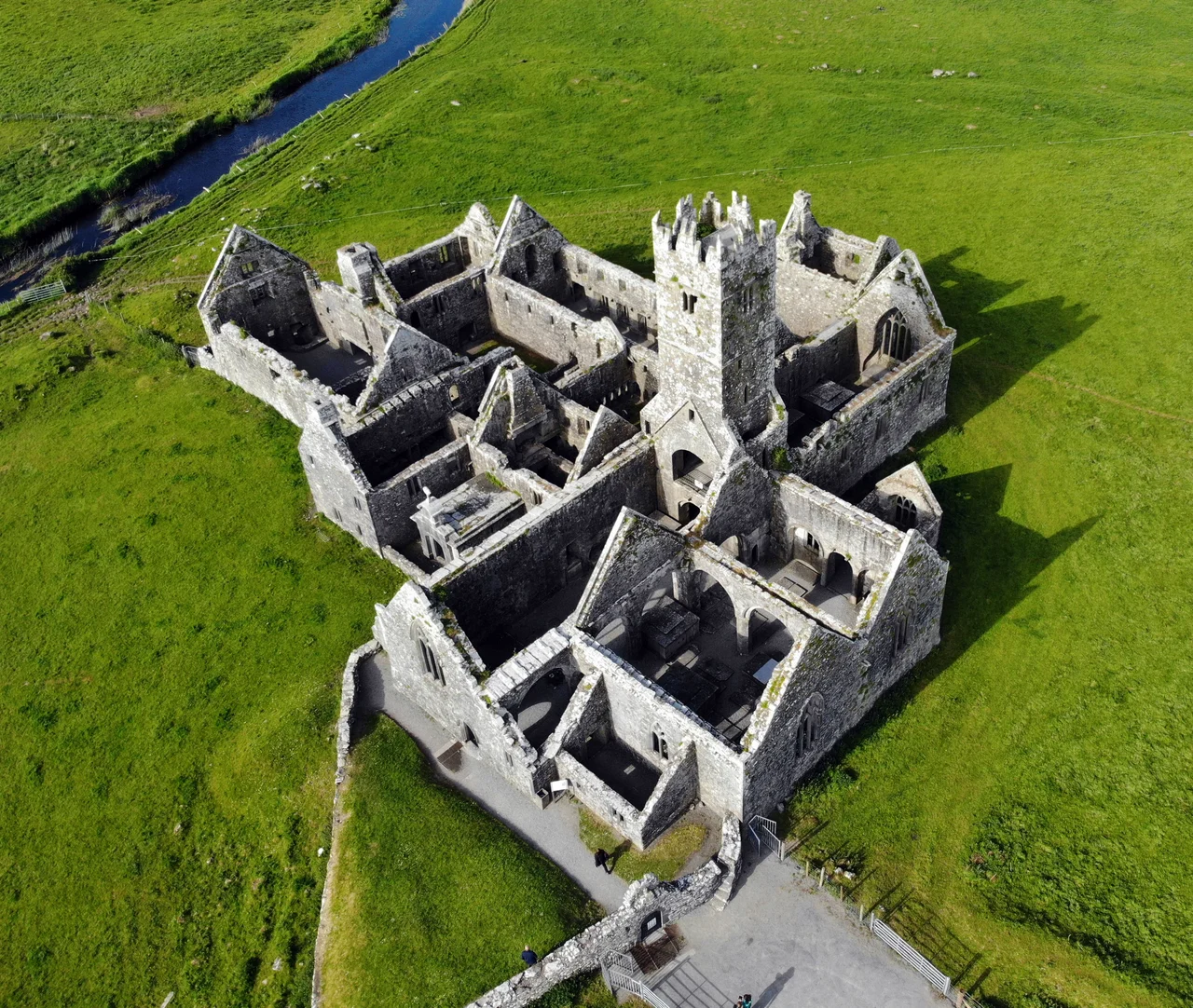

Ross Errilly Friary
There is a stone tank inside the kitchen wall at Ross Errilly, fed once by the nearby Black River, where the friars kept their fish alive until needed. Eat fish on Fridays, the rule said; eat fish on fast days. So the kitchen had its own aquarium. Five hundred years later the tank is still there, dry now, with the kitchen open to the sky and the bake-oven beside it crumbling at its mouth. A mile from Headford in County Galway, Ross Errilly is among the best-preserved medieval Franciscan friaries in Ireland - and among the longest-haunted, with a community that was expelled seven separate times and somehow kept coming back.
When It Was Founded
The Four Masters and the Franciscan historian Luke Wadding gave the founding date as 1351, and that is the figure carved into many older sources. Modern historians, looking at the architecture, doubt them. The buildings as they stand are 15th-century work, probably around 1460. The earliest hard documentary trace is a bequest of 40 pence to the friary in the will of John Blake of Galway, dated 1469. Whatever was on the site before, the great expansion - the church, the bell tower, the cloister, the kitchen with its fish tank - was a 15th-century project, paid for in good part by the de Burgh family, the Earls of Clanrickarde, who would later return again and again to protect what they had helped build.
Seven Expulsions
In 1538, two years after Henry VIII broke with Rome, English authorities imprisoned two hundred Franciscan friars in Ireland and killed or exiled an unknown number more. At Ross Errilly, the persecutions came in waves. Under Elizabeth I the friary was confiscated and given to Richard Burgh, the 2nd Earl of Clanrickarde, who quietly handed it back to the friars. Confiscated again in 1584, repurchased and returned by the Earl in 1586. Converted to an English garrison during the Nine Years' War. Restored in 1604, expelled again in 1612 on the order of the Lord Deputy. Each time the community reassembled, the chant resumed in the choir, the cloister filled again with the soft scrape of sandals. Seven times the friars were driven out. Seven times they returned.
Cromwell's Soldiers and the Lost Bell
On 10 August 1656, Cromwellian forces reached the friary. The 140 friars then in residence had fled hours earlier, but the soldiers ransacked the grounds, smashed crosses, and defiled the tombs in search of loot. The local tradition holds that as the friars left, they took the bell down from the tower and sank it in the Black River. It is supposed to be there still. After the Restoration of 1660, the friars came back one more time. The Glorious Revolution of 1688 and the Popery Act of 1698 put a bounty on Catholic clergy, and they were driven out again - but they kept returning until 1753, when Lord St. George, who had secretly been patronising the friary in defiance of the penal laws, was reported by a vengeful neighbour. Before the authorities arrived, St. George whitewashed the friary's interior and installed weavers and looms inside to make it look like a textile workshop. The inquiry came to nothing. But the friars never lived inside the walls again.
Friars Island
Driven from the friary itself, the small remnant community built cabins of wood and stone on a tiny island in the Black River, a mile downstream. Friars Island, the locals called it. It no longer exists - the river took it. For 36 years, the friars continued to walk back along the bank each Sunday to celebrate Mass in the roofless, deteriorating church. In 1789 a Henry Lynch of Ballycurrin leased them 16 acres at the foot of a hill in nearby Kilroe, and Mass was said there until 1804. By 1801 there were only three friars left. The community was finally closed in 1832, with three of them still alive.
Bones in the Cloister
After the friars went, the ruin became a public burial ground, as so many abandoned Christian sites in Ireland did. By 1835 an English tourist named John Barrow described the abbey as a remarkably fine old ruin in a disgracefully neglected state, with moss-grown skulls and human thigh-bones strewed about so plentifully that not a step can be taken without encountering them. William Wilde - father of Oscar - visited in 1866 and described much the same. Sheep and cattle wandered through what had been the nave. Today the Office of Public Works maintains the site and it is open free of charge. You can walk through the cloister, climb to the top of the tower, find the stone fish tank in the kitchen, and look out over the same fields the friars looked out over. John Ford's crew set up cameras here in 1952 for a few seconds of The Quiet Man. Other films have followed. None of them stays long. The friary outlasts them all.
From the Air
Ross Errilly Friary stands at 53.480 N, 9.131 W, about 2 km northwest of Headford, County Galway, on a low water meadow beside the Black River as it descends toward Lough Corrib. Ireland West Airport Knock (EIKN) lies roughly 70 km northeast; Galway (EICM) about 30 km south. Best viewed at low altitude in clear conditions: from a thousand feet the cruciform church, the central cloister, and the second courtyard make a clear pattern against the green river meadows, with the silver thread of Lough Corrib filling the horizon to the west.
Nearby Stories
- Marine Institute Ireland 1.8 km away
- Westport 2.9 km away
- Knock, County Mayo 3 km away
- Bellanagare Bog 4.3 km away
- Ballygar 7.4 km away
- Connemara Railway 8.1 km away
- Ardgraigue Bog 16 km away
- Inishmaan 21 km away