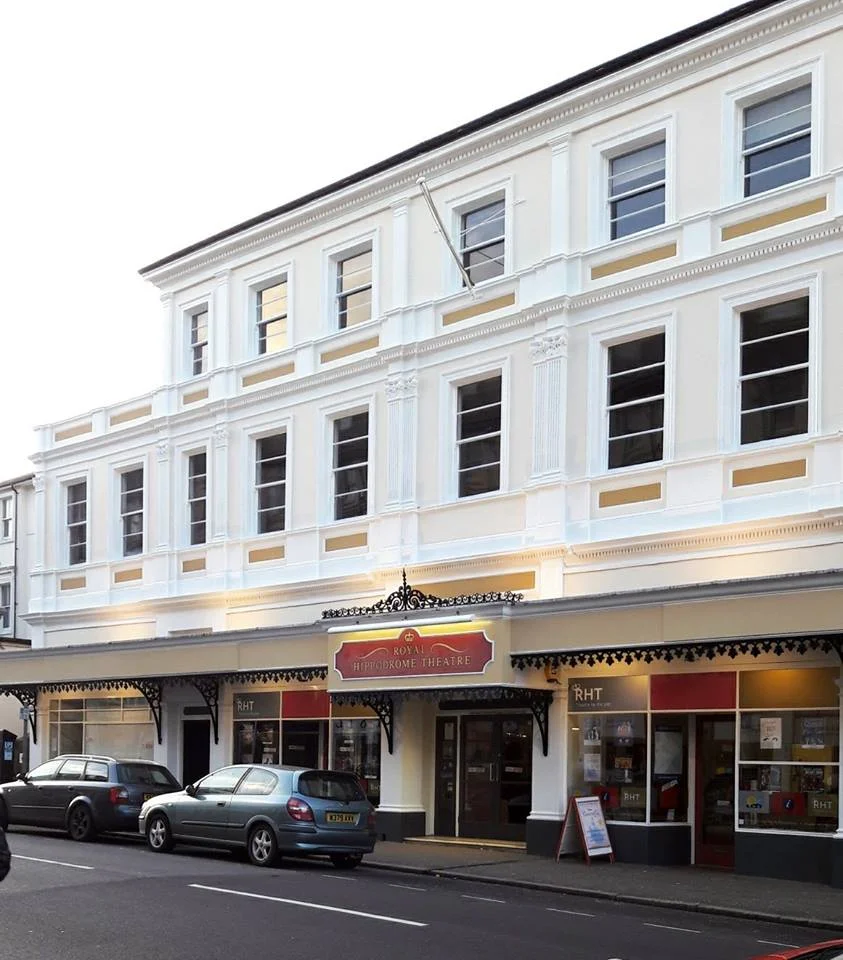

Royal Hippodrome Theatre
Eastbourne in 1883 was a town being invented. The Duke of Devonshire's seafront grid had only existed for about thirty years, the Prince of Wales had started dropping in for the summer, and a theatre architect named Charles John Phipps - the most prolific theatre architect in late-Victorian Britain - was hired by an impresario named George Beaumont Loveday to put a playhouse in the streets behind the front. They built it at the unfashionable end of town, on Seaside Road, where the family hotels and boarding houses sat rather than the grand seafront hotels. The Theatre Royal and Opera House opened on Thursday 2 August 1883. It is still there. It still has its original 1883 auditorium, and it still runs one of the longest summer seasons of any theatre in the country.
Phipps Builds in Eastbourne
Charles John Phipps was the architect of his age. By the time he reached Eastbourne in the early 1880s he had already built or rebuilt the Theatre Royal Glasgow, the Lyceum Theatre Edinburgh, the Theatre Royal Newcastle, the Savoy in London for Gilbert and Sullivan, and a network of provincial playhouses that had given Britain a recognisable late-Victorian theatre style. His Eastbourne commission was small by his usual standards - a 1,000-seat house rather than a 2,000-seat metropolitan opera theatre - but he gave it the full Phipps treatment: a horseshoe-shaped auditorium with two curved balconies, an ornate proscenium arch, plasterwork picked out in gilt and cream, and a backstage geometry sized for proper touring productions. The original name, Theatre Royal and Opera House, stuck for about twenty years. By around 1904 the management had changed the name to the Royal Hippodrome - a reflection of a shift away from straight drama and light opera toward the music hall and variety bills the building's intimate scale suited best.
Houdini at Eastbourne
The roster of names that played the Royal Hippodrome through the music-hall era reads like a catalogue of British popular entertainment. The cross-dressing male impersonator Vesta Tilley appeared in May 1903. Marie Lloyd, the great cockney songstress, played the same bill. Harry Houdini, then on a UK tour that included the bigger Eastbourne venues as well, gave performances of his escape acts here. The tiny comedian Little Tich played his oversized-boot routines. Albert Chevalier sang his coster songs. Charlie Chaplin, before Hollywood, appeared on a touring variety bill. Gracie Fields, Harry Lauder, George Robey, Flanagan and Allen, and the great front-cloth comedian Max Miller all played the Hippodrome. From 1933 the theatre settled into a long pattern of summer repertory: the Eastbourne Players as a resident stock company, a thirteen-piece orchestra under bandleader Alfred Brocklebank, and a permanent backstage staff of forty. The shape of the building made it ideal for the rapid turnover of variety - small enough to fill, large enough to be worth a star turn.
Hellfire Corner
The theatre closed for part of the Second World War, though not before a young Hylda Baker - later famous for the catchphrase 'she knows you know' on British TV - had trodden its boards in early 1942. The streets immediately east of the Hippodrome became known locally as 'Hellfire Corner', heavily targeted by Luftwaffe tip-and-run raids because of their proximity to the south coast. The theatre itself escaped a direct hit, almost miraculously, since The Lion pub and Caffyn's motor garage only yards away were obliterated. The blast damage was significant enough that much of the theatre's original ornate plasterwork was damaged beyond repair and had to be removed. What you see in the auditorium today is the 1883 horseshoe with simplified post-war replacement detail in some of the surrounds - close enough to the original to feel right, but not quite the same surface.
Forsyth, Wisdom, McCartney
Post-war the theatre stayed in private hands until 1958, when declining audience numbers forced the company to look for a buyer. Southern TV briefly considered turning it into a TV studio; negotiations fell through, and Eastbourne Borough Council bought the building instead. Through the 1950s and 60s, in the great seaside variety season, the audience here saw Elsie and Doris Waters, Harry Secombe, Tod Slaughter on his farewell tour, Frankie Vaughan, Norman Wisdom, Russ Conway and Bruce Forsyth. In 1979, in one of the building's more unexpected episodes, Paul McCartney and Wings rented the Hippodrome for three weeks as a rehearsal space before embarking on their 1979 UK tour. The theatre's stage and the side path to the stage door appeared in the opening sequence of the first episode of series three of *French and Saunders* in 1990, in a parody of *The Sound of Music*. In December 2008 Sky1 used the building to record Noel Edmonds's *Noel's Christmas Presents* for broadcast on Christmas Day.
Still Lit
By the late 2010s the theatre had become, as the current owner Alex Adams describes it, 'a forgotten place'. The Royal Hippodrome Trust had tried to take it on in 2012 and 2013 but had not been able to raise the resources. Eastbourne Borough Council found a series of stopgap operators. In 2018 a local couple, Alex and Debbie Adams, took the building on, and what has happened since amounts to a careful revival. A facade restoration in 2018 brought back the cream-and-stucco frontage. A foyer extension in 2019 made the public spaces work for modern audiences. A major auditorium restoration in 2023 - the theatre's 140th anniversary year - returned much of the original colour scheme to the horseshoe. The summer season still runs from April to October, one of the longest in the country, and it still leans heavily on variety: tribute acts, musical revues, magicians and stand-up comics, the same combination of forms that filled the building under Loveday in 1883. The Phipps auditorium, after blast damage and decades of neglect and now restoration, is still mostly the room he designed. The unfashionable end of town is no longer especially unfashionable. But the theatre is still there, the lights still go up, and on a good Saturday night in August the laughter still comes out of the doors onto Seaside Road exactly as it must have done one hundred and forty summers ago.
From the Air
Coordinates 50.7693 N, 0.2927 E, on Seaside Road in central Eastbourne, about 350 metres inland from the seafront and Eastbourne Pier. Nearest airports: Brighton City Shoreham (EGKA) 18 nautical miles west, Lydd (EGMD) 21 nautical miles east-northeast. Recommended viewing altitude 1,500 to 3,000 feet AGL - the theatre sits within the densely-built grid of central Eastbourne, with the seafront curve and pier just south and the green wedge of Devonshire Park visible to the west. The South Downs ridge rising behind the town provides the broader orientation.
Nearby Stories
- Ashdown Forest 12 km away
- Battle of Dungeness 21 km away
- Amberley Museum & Heritage Centre 25 km away
- Camber Castle 25 km away
- Charterhouse School 31 km away
- German Auxiliary Cruiser Komet 116 km away
- Cléon 128 km away
- D-Day: The Longest Day 138 km away