_(2008).jpg)
Royal Hotel, Birdsville
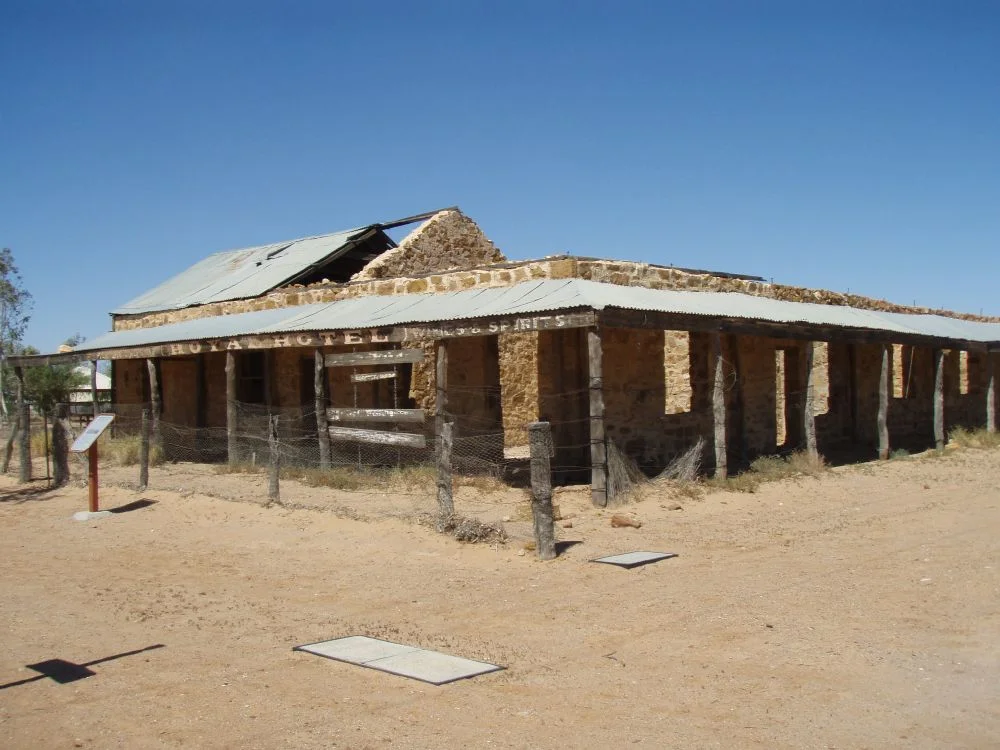
On the painted false front, weathered to ghostly faintness, four words can still be read: 'Best Brands, ROYAL HOTEL, Ales, Wines, Spirits.' Below the sign there is no longer much of a hotel, only a roofless, L-shaped sandstone shell on Adelaide Street, the main street of Birdsville. Walls have collapsed and been rebuilt; doorways open onto sky. It would be easy to mistake this ruin for an ordinary frontier pub that simply gave up. It was not ordinary. Within these soft-mortared walls, the modern outback learned how to call for help.
A Town Built of Stone
Birdsville rose in the early 1880s around a rough depot at the Diamantina Crossing, a marshalling point for cattle being driven south to the markets of Adelaide. There was no timber to build with, so the settlers quarried local sandstone. The Royal Hotel went up around 1883, its first licence issued to Alfred Tucker, and by the 1885 survey it was marked as Groth's hotel after the man who bought the block for two hundred and sixty pounds. It was one of three pubs in a town that, at its 1895 peak, held barely two hundred and twenty people. The wide verandahs and thick stone walls were not decoration. They were engineering, holding back a heat that routinely pushed past forty degrees in a place a thousand miles from Brisbane.
The Nursing Sisters Arrive
The hotel's licence lapsed in the early 1920s, and in 1923 the building began a second life. The Presbyterian Australian Inland Mission, led by the Reverend John Flynn, leased it as the very first of what would become a string of thirteen bush nursing homes across the centre of the continent. Two nursing sisters arrived that September to six unfurnished rooms and a collapsing stone store out the back, which someone wryly christened the 'Hole in the Wall Hospital Store'. For people scattered across enormous distances, the nearest trained medical help had often been hundreds of kilometres and many days away. Now it had an address on Adelaide Street. The problem that remained was how a station family, dozens of kilometres out, was supposed to reach it in time.
The Voice in the Wires
John Flynn's answer was radio, and it nearly defeated him. He experimented from the Birdsville hostel as early as 1925, but the technology was not ready. The breakthrough came from Alfred Traeger, whose pedal-powered transceiver finally made reliable bush radio possible. In September 1929, Traeger installed one of six experimental sets at the Birdsville hostel, linked to a generator worked by the feet. For eighteen months operators tapped out Morse code. Then voices came through. The hostel connected to the surrounding stations and, crucially, to the new Aerial Medical Service Flynn had founded in 1928, the ancestor of today's Royal Flying Doctor Service. A roofless ruin today, this building was once a node in the nervous system of the outback, the place where a calm voice could promise that a doctor was on the way.
The Galah Session
In 1934 two sisters at the hostel, Edna McLean and Amy Bishop, noticed something the engineers had not planned for. The women of the Diamantina stations, isolated for weeks at a stretch, began using the early-morning radio schedule simply to talk to one another. The sisters formalised it into a daily open call. Somebody, with the affectionate irreverence of the bush, named it the 'Galah Session' after the chattering pink-and-grey parrots, and Birdsville's set, VKK, became the 'Voice of the Diamantina Country'. It is remembered as Australia's first talkback radio, born not in a studio but in a desert nursing home, out of the simple human need for company. In 1937 the mission moved to a purpose-built hostel down the road. The old Royal was lived in, then abandoned, then left to fall. Stabilised in 1984 and 1994 and heritage-listed in 1992, it stands now as the rarest kind of ruin: one where you can still hear the voices.
From the Air
The Royal Hotel ruin sits at roughly 25.90 degrees south, 139.35 degrees east, on the southeast corner of Adelaide and Frew Streets in central Birdsville, far southwestern Queensland. Birdsville Airport (ICAO YBDV) is moments away, directly across from the town's main pub. From the air the site is part of the small grid of Birdsville on the eastern edge of the Simpson Desert; navigate by the braided Diamantina River channels and the red dunes running west. Recommended viewing is low and slow over the township; the surrounding country is best flown April to October, when heat is moderate and the risk of flooding that isolates the town is lower. Visibility is generally excellent.
Nearby Stories
- Annandale Station 3.4 km away
- Eromanga Sea 11 km away
- Carcory Homestead Ruin 50 km away
- Koonchera Point Massacre 56 km away
- Munga-Thirri National Park 86 km away
- Cordillo Downs 90 km away
- Munga-Thirri–Simpson Desert National Park 99 km away
- Currawilla 154 km away