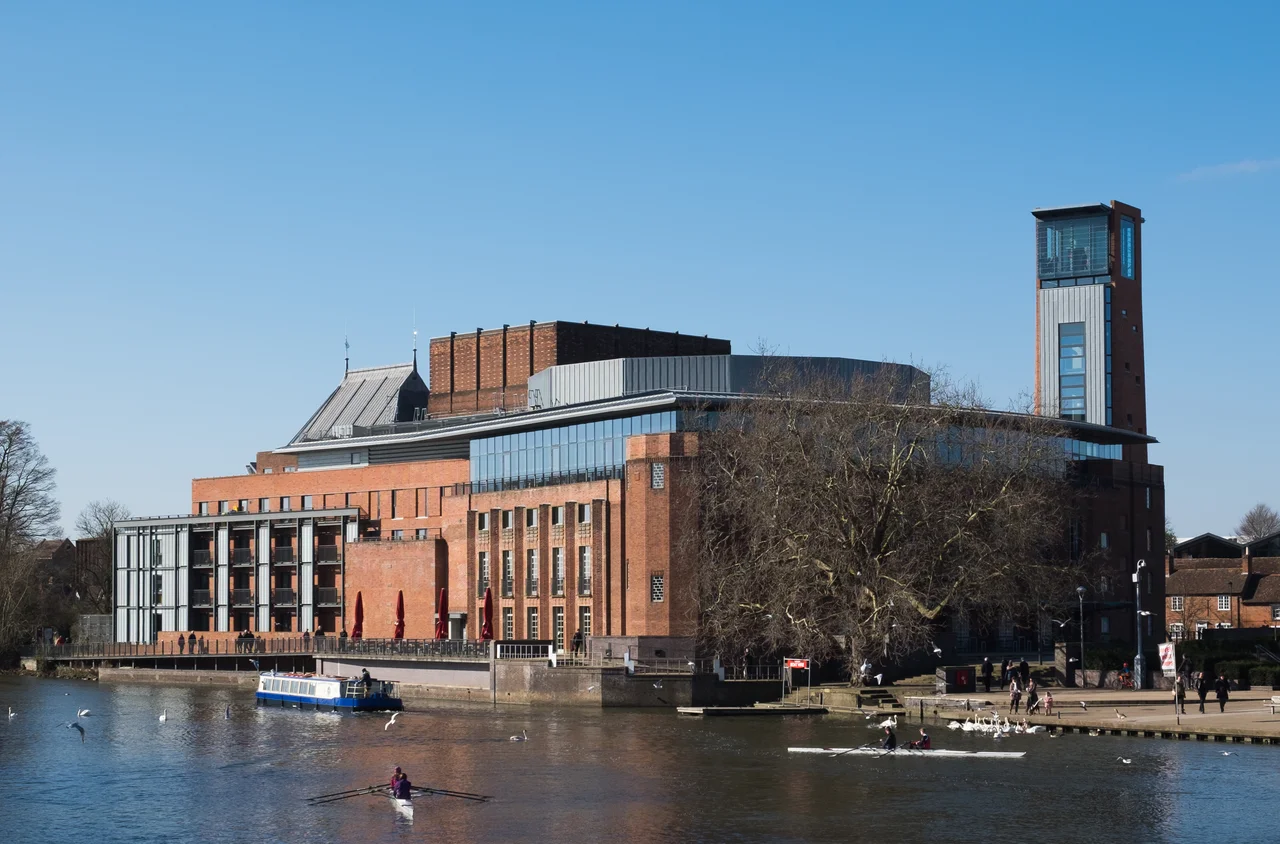

Royal Shakespeare Theatre
On the night of 6 March 1926, the original Shakespeare Memorial Theatre on the banks of the Avon burned to the ground. George Bernard Shaw famously sent a telegram of congratulation -- he had loathed the building's Victorian Gothic excess and considered the fire an aesthetic improvement. The townspeople of Stratford-upon-Avon did not see it that way. They had spent half a century building Shakespeare a permanent home, brick by red brick, with money raised by a local brewer who believed his hometown owed its most famous son a stage. What rose from those ashes, six years later, became the first major British building designed by a woman -- and a century after its predecessor went up in smoke, that 1932 theatre is still the beating heart of the world's most famous Shakespeare company.
A Brewer's Crusade
The campaign began in 1864, the three hundredth anniversary of Shakespeare's birth, when Stratford had nothing more permanent to offer pilgrims than a few half-timbered houses and a country churchyard. Edward Fordham Flower and his son Charles Edward Flower, who ran the local brewery and ran most of the town's political life with it, decided that this would not do. They raised the money, donated the land beside the Avon, and on 19 April 1879 -- as close to Shakespeare's birthday as a calendar would allow -- opened the original Shakespeare Memorial Theatre. William Unsworth and Edward Dodgshun designed it in florid Victorian Gothic: pinnacles, pointed arches, a riot of red brick. Critics groaned. Audiences came anyway. For nearly half a century the building defined Stratford's theatrical life until the night of 6 March 1926, when fire gutted it from end to end.
Elisabeth Scott's Quiet Revolution
The international competition to design the replacement drew seventy-one entries. The winner, announced in 1928, stunned the architectural establishment: Elisabeth Scott, a thirty-year-old great-niece of Sir George Gilbert Scott, became the first woman to win a major British public building commission. Her design was modernist, austere, and deeply unfashionable -- long brick masses, deliberate horizontality, almost no ornament. The press was unkind. The theatre opened on 23 April 1932, Shakespeare's birthday, and continued to draw architectural complaints for decades. Edward Elgar called it the ugliest building in England. But Scott had built something that worked, something that lasted, and something that quietly broke a barrier. When the Royal Shakespeare Company was founded by Peter Hall in 1961, the building was renamed the Royal Shakespeare Theatre in its honour.
The Transformation
By the early 2000s, the proscenium-arch auditorium Scott had designed felt increasingly remote from contemporary theatre. Actors stood behind a picture frame; audiences sat in rows that stretched too far back for the kind of intimacy Shakespeare's plays demand. So the RSC closed the theatre in 2007 and gutted it. Bennetts Associates designed a new thrust stage that pushes into the audience, with no seat more than fifteen metres from the actor's face. The shell of Scott's 1932 building stayed; the heart inside it was rebuilt. During construction, an urn containing the ashes of actor Ian Richardson -- the great RSC alumnus who had died in February 2007 -- was placed into the foundations by his widow and son. The new theatre opened in November 2010. Queen Elizabeth II returned on 4 March 2011 to officially open it with a performance of the balcony scene from Romeo and Juliet.
What Rises Above the Avon
The transformed building gave Stratford something the old theatre never had: a tower. A thirty-six metre column rises from the riverside, with a viewing platform at thirty-two metres that lifts you above the medieval roofline and across the water meadows toward Holy Trinity Church, where Shakespeare lies buried. A colonnade now links the Royal Shakespeare Theatre to its smaller sister, the Swan, sharing back-of-house and front-of-house for the first time. A rooftop restaurant looks over the Avon's slow brown current. The riverside walk, which used to climb and descend a punishing sequence of steps, now runs level all the way from Bancroft Gardens to the churchyard -- a half mile through Shakespeare's life. The whole building, for the first time in its century-and-a-half history, is fully accessible to visitors and performers and staff who use wheelchairs.
The Bardolaters Still Come
Roughly 2.5 million people visit Stratford every year, and a sizeable share of them come specifically for the theatre Charles Flower built. The 1,040-seat auditorium fills nightly through the season. Tickets for the major productions sell out months in advance. The actors who work here form what amounts to a national repertory company -- Ian McKellen, Judi Dench, Patrick Stewart, David Tennant, and on through every generation. The Flowers' brewery is long gone, demolished decades ago. Elisabeth Scott's name appears on no plaque at the entrance. But what they built together, by improbable degrees, became what they hoped for: a place where Shakespeare's plays are performed every night of the year, in the town where he was born, by some of the finest actors in the English-speaking world.
From the Air
Located at 52.1904N, 1.70392W on the west bank of the River Avon in Stratford-upon-Avon, Warwickshire. The brick mass of the Royal Shakespeare Theatre and its 36-metre observation tower are the most prominent landmarks on the river. Holy Trinity Church spire rises a half mile downstream. Nearest airports: EGBB (Birmingham, 22nm NW), EGBE (Coventry, 18nm N). Best viewed at 1,500-2,500 ft AGL with the Avon as your guide.
Nearby Stories
- RAF Defford 3.6 km away
- Great Witcombe Roman Villa 4.1 km away
- Coventry War Memorial 4.5 km away
- Hagley Hall 4.6 km away
- Battle of Naseby 5.4 km away
- Silverstone Circuit 5.9 km away
- Waddesdon Manor 8.8 km away
- Woodstock Palace 15 km away