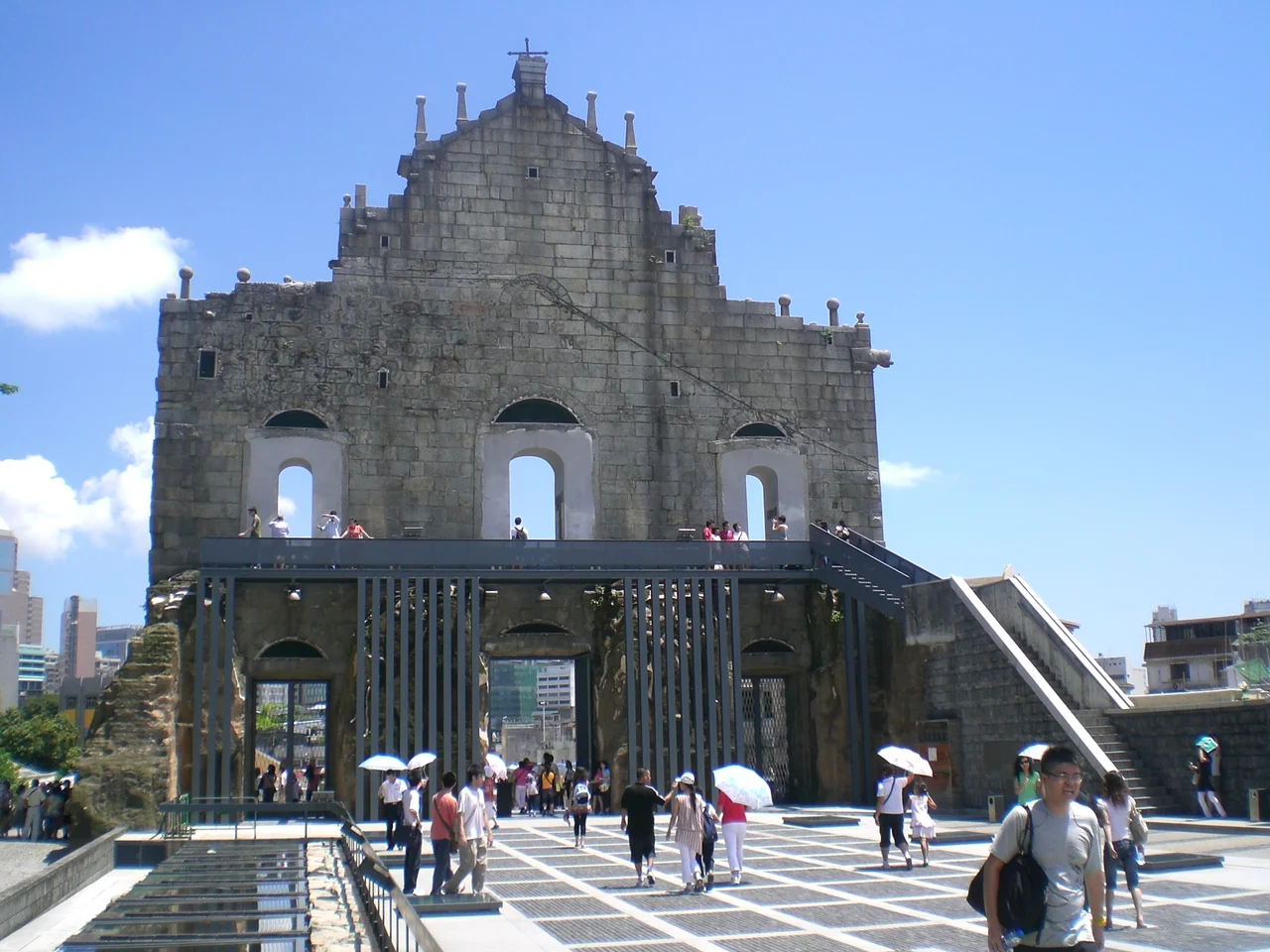

Ruins of Saint Paul's
On the night of 26 January 1835, a typhoon drove a fire through the kitchen of a military barracks, and by morning the Church of St. Paul was gone. What remained was the façade — five tiers of carved stone rising above 68 steps, facing east over the rooftops of Macau. The fire consumed the wooden interior, the roof, the side walls, the altar furnishings. The stone front, which the church's Jesuit builders had decorated with as much theological ambition as any structure in Asia, simply refused to fall. It has been standing on that small hill ever since, through another 190 years of typhoons, the end of Portuguese colonial rule, and the transformation of Macau into one of the world's most visited cities. The ruin turned out to be more durable than the church.
Forty Years in the Building
Construction began in 1602 and was not finished until 1640 — a span that outlasted the Jesuit order's peak influence in Japan and coincided with the height of Macau's golden age as a trading entrepôt. The Jesuits built with ambition proportional to what Macau then was: one of the busiest ports in the Far East, the hub of the China-Japan-Europe trade, the ecclesiastical capital of Catholic missions across East Asia. The church was one of the largest Catholic churches in Asia at the time of its completion.
The labor and design reflected that ambition. Portuguese architects worked alongside Japanese Christian craftsmen — refugees from Japan's brutal persecution of Christians, who had fled to Macau after the Tokugawa shogunate began its crackdown in 1614. Chinese artisans contributed as well. The façade they collectively produced is neither purely European baroque nor purely Asian in its imagery. It is something specific to Macau: a theological statement in stone that draws on multiple traditions to declare that this place, at the junction of two civilizations, believed itself to be the center of something important.
A Façade That Reads Like a Book
The five tiers of the façade are an illustrated sermon. The bottom tier frames the entrance with Ionic columns. The second tier bears Jesuit symbols and an image of the Virgin Mary at the center, the whole composition shaped like a retable — a painted or carved altarpiece translated into stone architecture. Higher tiers carry Christ, the instruments of the Passion, a Portuguese galleon sailing among the waves (symbol of the missions carried by sea), a dragon, a demon fleeing from the Virgin, and a chrysanthemum that owes more to Japanese iconography than to Iberian Catholicism.
This fusion was intentional. The Jesuits were sophisticated missionaries who understood that images familiar to their Asian congregations might carry the faith further than purely Western symbolism. Whether their converts always understood the theology precisely as intended is another question. What matters is that the decision to embed Asian imagery into a European baroque façade produced an object that is genuinely, irreducibly hybrid — and that this hybrid quality is the reason the structure still resonates, across every tradition that contributed to it, nearly four centuries later.
What the Excavations Revealed
For much of the nineteenth century and most of the twentieth, the surviving façade was simply there — a picturesque ruin, a backdrop for photographs, a stop on every visitor's itinerary. Its deeper history waited underground. From 1990 to 1995, archaeologists from the Instituto Cultural de Macau excavated the site systematically, uncovering the crypt and the full foundations of the original complex.
The crypt held more than architectural information. Excavators found the relics of Chinese Christian martyrs — men and women who had died for their faith during Japan's persecution of Christians — interred alongside the remains of Jesuit clergy. Among them, archaeologists identified Father Alessandro Valignano, the founder of the Jesuit college in Macau. These were people whose lives crossed oceans and empires, who died in circumstances of religious violence, and whose bones came to rest in the foundation of a church that burned down before anyone living could remember it. The museum now built into the crypt houses their relics, along with the religious artifacts recovered from the site, making the underground spaces as significant as the stone wall above them.
The Ruin as a Living Place
The Ruins of Saint Paul's were named one of the Seven Wonders of Portuguese Origin in the World by the Portuguese government in 2010. In 2005, they were designated part of the Historic Centre of Macau, a UNESCO World Heritage Site. These designations formalized what visitors have always understood instinctively: the façade is not an absence but a presence. The missing church has become the point.
The concrete and steel buttressing installed during the 1990s restoration is deliberately understated, preserving the aesthetic integrity of the façade while preventing the lean that once gave conservation engineers nightmares. A steel stairway once allowed tourists to climb to the top; structural concerns ended that access. The 68 stone steps that lead up from street level to the façade remain one of the most photographed approaches in Macau — partly because the climb is theatrical, the scale of the stone wall increasing with every step, and partly because what waits at the top is both complete and incomplete. A wall that was once a church. An entrance with nowhere to go. A monument that makes absence visible.
From the Air
The Ruins of Saint Paul's stand at 22.197°N, 113.541°E on a small hill in the Santo António district of the Macau Peninsula. The façade faces east and is oriented toward Senado Square, a short walk downhill — from the air, this central cluster of historic buildings is the densest concentration of heritage architecture on the peninsula. The white façade is a distinct visual element among the surrounding tiled rooftops. At low altitude on approach from the east, the stepped silhouette of the façade is legible against the hillside. The Monte Fort, a massive stone fortification, sits immediately northeast of the ruins and is an even more visible landmark from the air. Macau International Airport (ICAO: VMMC) is located on Taipa Island, approximately 4 km to the southeast. The Pearl River Delta is visible to the east in clear conditions, with Hong Kong's Lantau Island on the far horizon.
Nearby Stories
- 2024 Shenzhen Stabbing 0.8 km away
- Lantau Peak 1.5 km away
- Kweilin Incident 2.4 km away
- Taishan City 7 km away
- Wanshan Archipelago Campaign 38 km away
- Hong Kong 12 68 km away
- Battle of Nanpeng Island 82 km away
- Erhai Lake 1335 km away