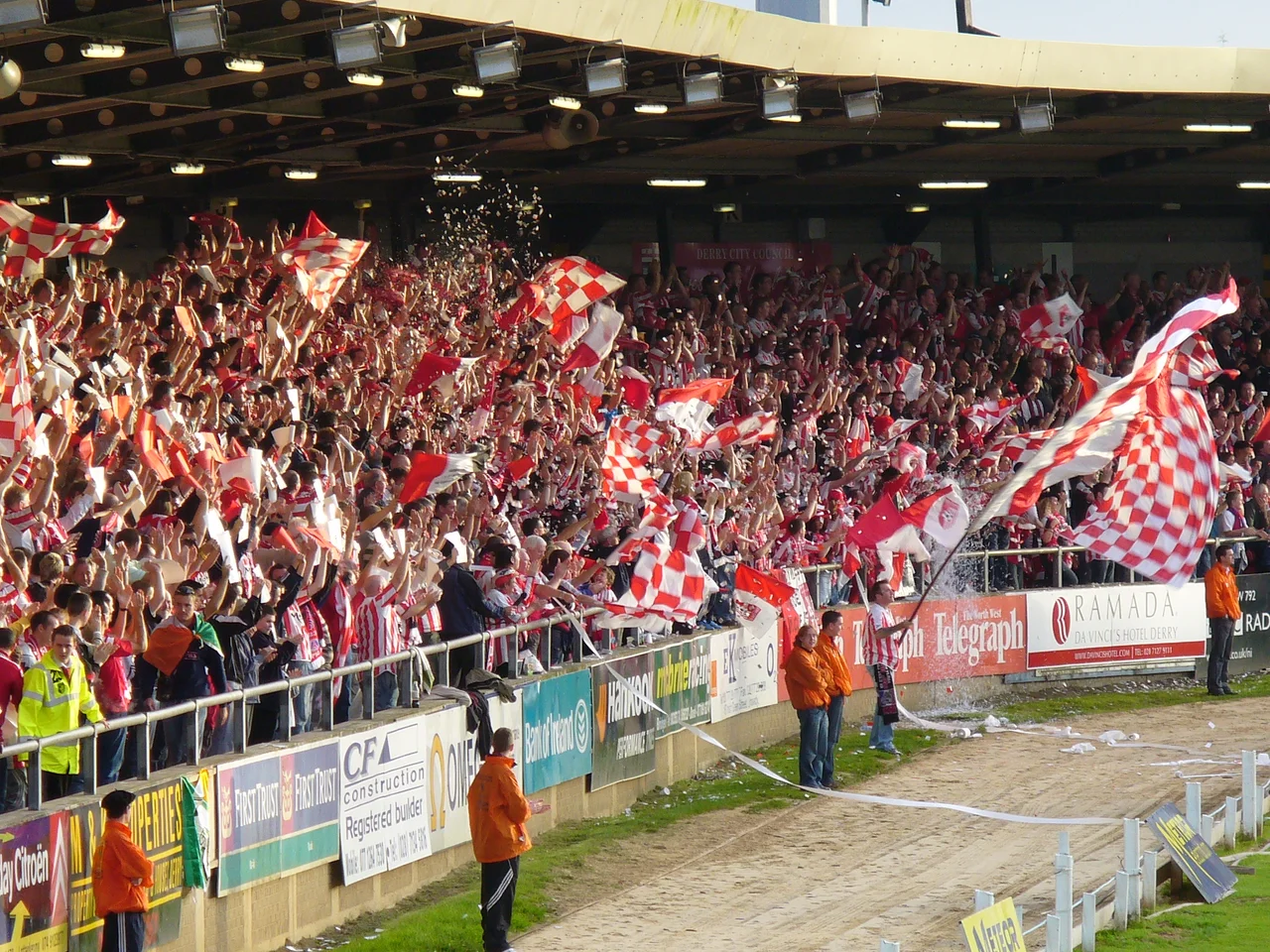

Ryan McBride Brandywell Stadium
Ryan McBride was 27 years old, the captain of Derry City Football Club, when his sister found him dead at his home in the Brandywell area on the morning of 19 March 2017. He had played a full ninety minutes the night before in a 4-0 win over Drogheda United. The post-mortem found a heart defect that nobody had known about. The wake at the stadium drew thousands. A year later, in September 2018, Derry City Council renamed the ground in his honour: the Ryan McBride Brandywell Stadium, the place he had loved since he was a child living on Lone Moor Road. Above the entrance a sign now bears his number five and his name. Locals just call it the Brandywell, as everyone always has.
The Well of Pure Water
The Brandywell name comes from the Irish 'Tobar an Fhíoruisce', the well of pure water, a spring that once fed the area south-west of the Bogside. By the late nineteenth century the open ground had become a sports field. Derry City Football Club was founded in 1928 and approached Londonderry Corporation - now the Derry City Council - for the use of the pitch the following year. The club has played there ever since, though not as owner. The land is still held by the council under conditions set by the Honourable the Irish Society's seventeenth-century charter, which require it to remain available for community recreation. Derry City's first home match was on 22 August 1929 against Glentoran. The Brandywell shares Lone Moor Road with Celtic Park, headquarters of the Derry GAA, putting Gaelic football and association football a stone's throw apart in the same neighbourhood.
Banned at Home
For fourteen seasons, between 1971 and 1985, Derry City could not play home matches at the Brandywell. The reason was the Troubles. The Bogside was a flashpoint, the ground sat in a republican-nationalist neighbourhood with active barricades, and both the RUC and the Irish Football League ruled it unsafe. Visiting teams with unionist support refused to travel. In the 1971-72 season Derry played their 'home' games at Coleraine Showgrounds, an hour's drive away. The next year the police ruled the Brandywell safe again, but a league vote on Derry's return failed by a single ballot. Faced with collapse, the club withdrew from the Irish League entirely in October 1972. For thirteen years the stadium hosted only greyhound meetings and junior football. Then in 1985 Derry City did something nobody had done before: they joined the League of Ireland, the league of the Republic, becoming the only club in Ireland to play in a different jurisdiction from where they were based. Senior football returned to the Brandywell that year. The crowds came back. They have not stopped coming since.
The Jungle and the New Stand
Generations of Derry City fans have stood on the Brandywell terraces. The most famous section was 'the Jungle', a covered terrace that housed the loudest hardcore support until it was demolished in 2004. Many of those fans now occupy Block J in the curved cantilever New Stand, built in 1991. The quieter blocks of the New Stand are sometimes called 'the Library' as a joke. The pitch measures 111 yards by 72 - tighter than many grounds, which contributes to the home advantage. The stadium hosted Derry City's 1-0 win over IFK Goteborg in the UEFA Cup first qualifying round on 27 July 2006, and the FAI League Cup final the same year against Shelbourne, decided on penalties. In 2002 BBC Radio 5 Live's listeners voted the Brandywell their tenth-favourite sporting venue in the UK. The Glentoran Stand on the far side - an old wooden structure originally from the Oval in Belfast, disassembled and reconstructed at the Brandywell in the 1940s - was torn down during a long-delayed redevelopment that finally began in late 2016. A new 3G pitch and all-seater stand opened for the 2018 season. In April 2025 the new £2 million North Stand opened, bringing planned capacity above seven thousand.
The Randywell
A road sign outside the stadium has at various times been altered, by unknown hands, to read 'Randywell Road'. The reason is a chant that Derry City fans have sung for decades, to the tune of the Beatles' Yellow Submarine: 'We all live in the randy Brandywell, the randy Brandywell, the randy Brandywell.' The fans pack out matches whose audiences extend far beyond the stadium: on 1 November 2024 the Derry City vs Shelbourne League of Ireland Premier Division match peaked above 400,000 television viewers, the highest TV audience for any League of Ireland match. The record attendance at the stadium itself remains 9,800, set on 23 February 1986 when Derry City played Finn Harps in an FAI Cup Second Round tie. Greyhound racing left in 2016 after 84 years on the track around the pitch; a new stand-alone track opened in 2018. The Brandywell is also home now to NIWFA Championship side Foyle Belles FC, who play their matches on the same grass where Ryan McBride captained his last game. The randy Brandywell remains, in all its noisy, complicated, deeply local glory, the place that gives a city its Friday nights.
From the Air
The Ryan McBride Brandywell Stadium sits on Lone Moor Road on the west bank of the River Foyle at 54.991 N, 7.336 W, just south-west of the Bogside in Derry. The nearest airport is City of Derry Airport (EGAE), six miles north on Lough Foyle; Belfast International (EGAA) lies sixty miles east-southeast. From altitude, look for the open pitch immediately south-west of the dense streets of the Bogside and Creggan neighbourhoods, with Celtic Park just to the south along the same road.
Nearby Stories
- Portrush Lifeboat Station 1.9 km away
- Main Street, Letterkenny 2.1 km away
- Inishowen 6 km away
- Rosguill 6.3 km away
- County Tyrone 7.1 km away
- St Patrick's College, Maghera 9.6 km away
- St Patrick's Purgatory 11 km away
- Coalisland Canal 17 km away