.jpg)
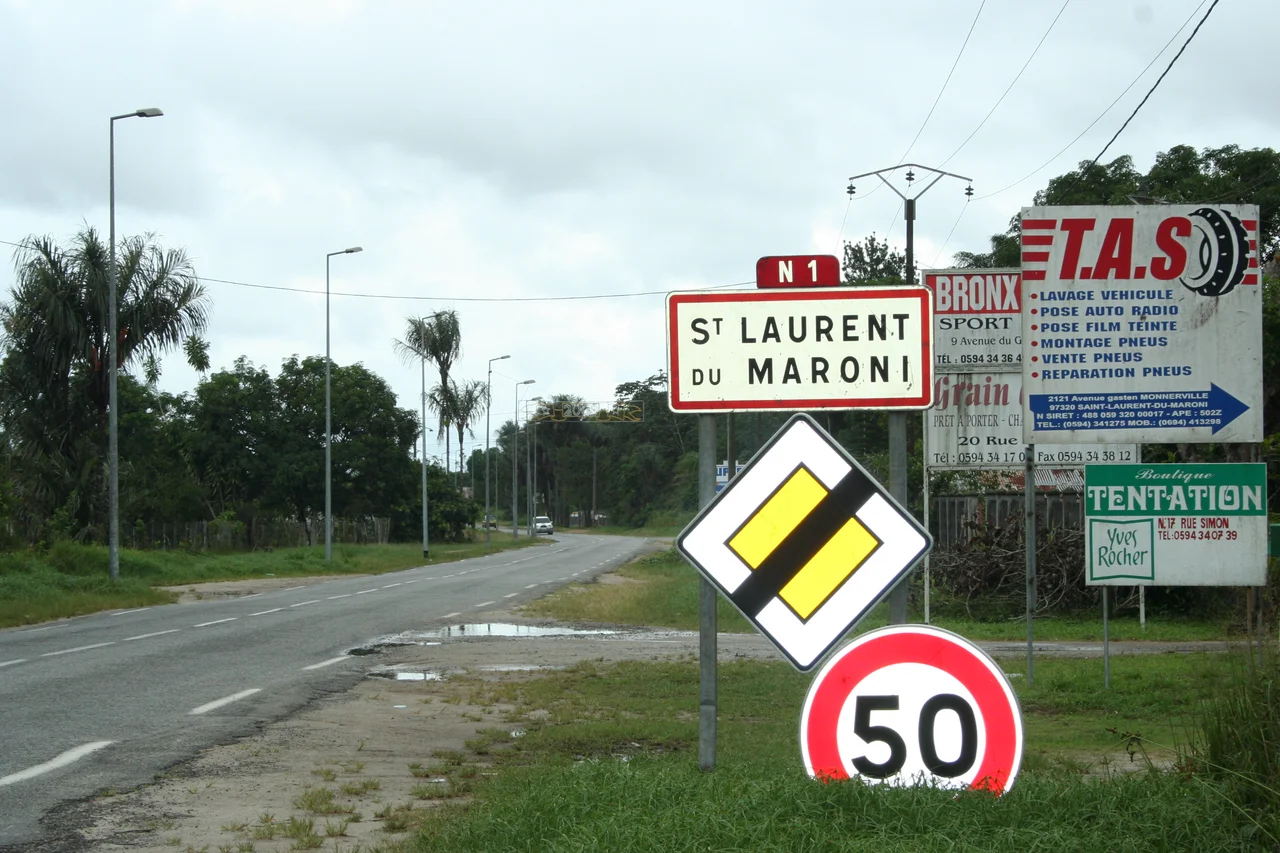
Saint-Laurent-du-Maroni
Somerset Maugham visited in 1936 and wrote that Saint-Laurent-du-Maroni was a pretty little place, its streets wide and tree-lined, the houses nestled in gardens of bougainvillea and hibiscus. And then, at the end of a paragraph, he delivered the punchline: the streets are neat because there is no shortage of convicts to sweep them. This was the town whose reason for existing was the prison camp at its center.
The Camp de la Transportation
Saint-Laurent-du-Maroni was founded in 1858 by Auguste Baudin for a single purpose: to receive prisoners shipped from France. The Camp de la Transportation was the arrival point, the first stop for convicts whose sentence of transportation often meant a life term - even those who completed their time were required to remain in the colony. The town grew around the administration of punishment. Its wide avenues, its Hotel de Ville and Palais de Justice of which, Maugham noted, many a town in France would have been proud, all existed because thousands of men arrived here in chains. The prison system ran until 17 June 1938 when it was officially repealed, though the final closure did not come until 1946. The buildings nearly crumbled from neglect before restoration in the early 1980s turned the penitentiary district into the town's star attraction.
The Border Town
Across the Maroni River lies Albina, Suriname. A ferry runs between them, and pirogues carry passengers back and forth for a few euros. The river forms the border - there is no bridge - and the town's location was deliberate: penal authorities chose a site without an Atlantic coast to make escape by sea impossible. The Maroon communities who live here today include descendants of those same freedom seekers who escaped enslavement and built their own sovereign nations in the Surinamese interior, plus refugees from Suriname's 1980s civil war. Maroons are now the largest ethnic group in town, followed by Creoles, Amerindians, Haitians, Brazilians, and metropolitan French. A 2009 census counted 7,631 Surinamese-born residents, nearly 3,000 Brazilians, and 1,199 Haitians. The second-largest city in French Guiana, with 54,429 people at the 2023 census, Saint-Laurent-du-Maroni is what happens when a penal colony outlives its purpose and becomes something else.
Henri Charriere's Island
Out in the Maroni River sits a small island where the prison once isolated its leprosy patients. The convict Henri Charriere - known to the world as Papillon - wrote about hiding there during one of his escapes. His memoir, whether you believe every word of it or not, made the French penal colony in Guiana infamous in a way the administration could never live down. Charriere's book sold millions and became a Hollywood film. The system he described - the harsh labor, the disease, the arbitrary cruelty, the survivors who came home broken - was accurate in outline even where his personal tales may have borrowed from other men's lives. The leprosy island is still there in the river. So is the camp he escaped from.
Beyond the Bars
Today the town is the jumping-off point for ecotourism into the Amazonian rainforest. Operators run trips 70 kilometers upriver to the Voltaire Falls, and visitors can spend nights in jungle huts with hammocks strung between trees. Sugarcane fields nearby produce La Belle Cabresse rum, fifty to fifty-five percent alcohol, aged in the equatorial heat. Along the road to Saint-Jean-du-Maroni, Saramaka artisans sell carved woodwork - chairs and tables in a tradition that their ancestors, self-liberated people turned forest sovereigns, developed in the centuries when the French were still pretending they could be recaptured. On 27 September 2016 the town recorded 38.0 degrees Celsius, the highest temperature ever measured anywhere in French Guiana. On 23 May 2009, scientists discovered a previously unknown species of caecilian - a legless amphibian - within the town itself. The forest is closer than it looks.
The New Prison
History has a way of coming back around. In 2025, France announced it would open a new high-security prison at Saint-Laurent-du-Maroni, choosing this town again, for the same geography that made it useful in 1858. Also in June 2025, the French state began transferring 91 hectares of land to the commune, part of a larger 250,000-hectare handover to French Guiana that will enable housing, public facilities, and a business park. The penitentiary buildings restored in the 1980s are now protected historic monuments. A few kilometers away, new concrete will rise. Saint-Laurent continues to live with what it was, even as it builds what it wants to become.
From the Air
Saint-Laurent-du-Maroni sits at 5.50 degrees N, 54.03 degrees W on the east bank of the Maroni River, which forms the French Guiana-Suriname border. Recommended viewing altitude 3,000-6,000 feet for river crossing and old penitentiary district visibility. Saint-Laurent-du-Maroni Airport (ICAO: SOOA) serves local flights via Air Guyane Express. Cayenne-Felix Eboue (SOCA) is the main regional hub roughly 250 km east. Albina, Suriname, is directly across the river.
Nearby Stories
- Salvation Islands 98 km away
- Paramaribo swamp forests 150 km away
- Saint-Georges (French Guiana) 238 km away
- Oiapoque 285 km away
- Guyana-Venezuela Territorial Dispute 623 km away
- Orinoco 784 km away
- Amazon River 811 km away
- SS Noemijulia 3991 km away