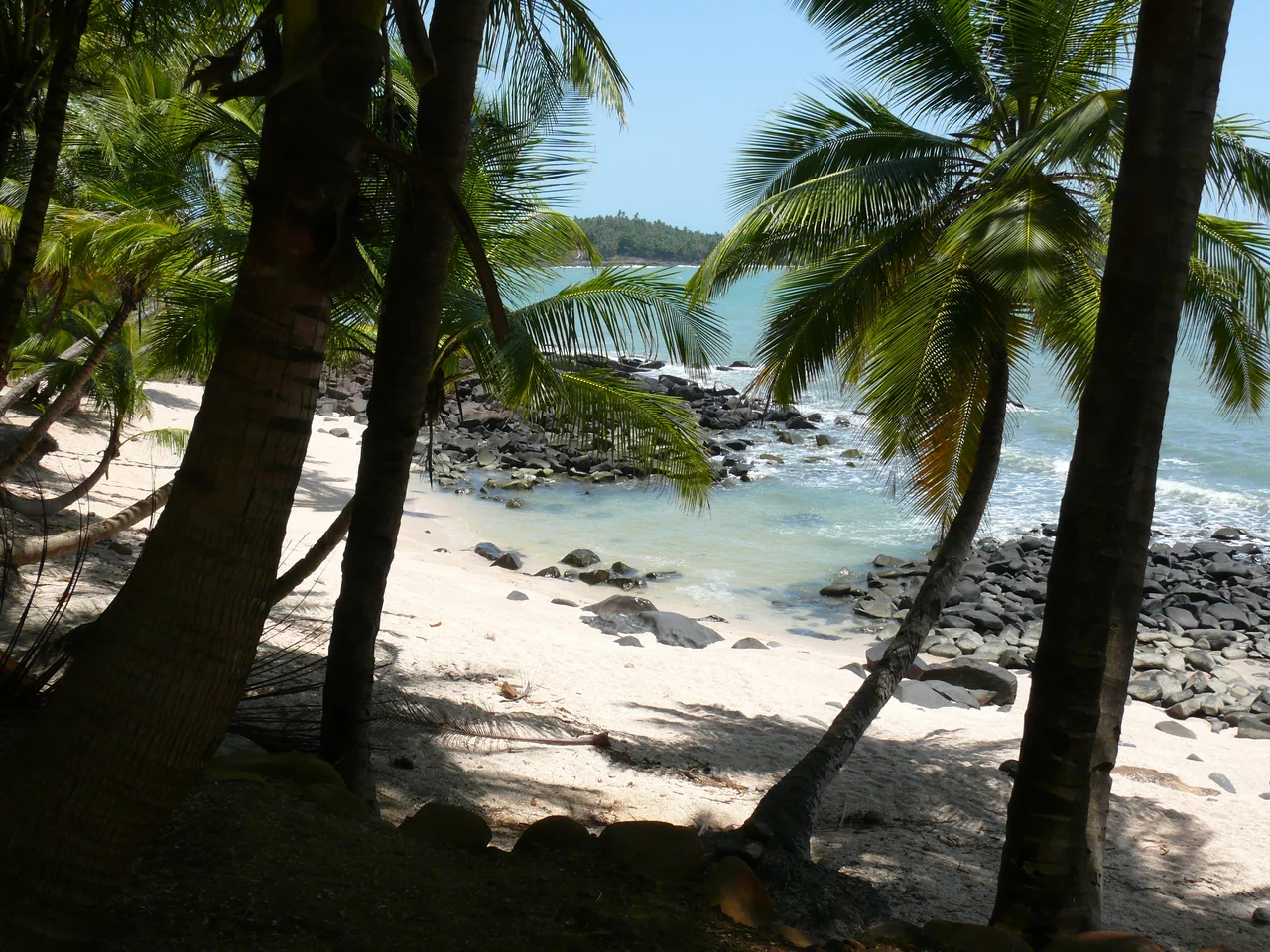

Salvation Islands
The missionaries called them the Salvation Islands because they fled here to escape plague on the mainland. The name was meant in thanks. For the prisoners France sent to these three rocks a century later, salvation was the last word anyone would have used.
Three Islands, Three Purposes
From the air, the Iles du Salut look unremarkable: three small volcanic islands clustered 11 kilometers off the French Guianan coast, 14 kilometers north of Kourou, a total land area of just 0.62 square kilometers. But each island had a role in the French penal machine. Ile Royale, the largest, was the reception center, where prisoners lived in relative freedom because the surrounding Atlantic made escape a matter of swimming through currents that were known to contain sharks. Saint-Joseph held the Reclusion, where men sent for solitary confinement spent their sentences in silence and darkness - punishment for infractions committed on the mainland or for attempted escapes. Devil's Island, the smallest, was reserved for political prisoners. The channels between them bear French names - Passe des Grenadines, Passe de Desirade - elegant words for what divided man from man.
Captain Dreyfus
The most famous prisoner of Devil's Island was Captain Alfred Dreyfus, a French army officer convicted of treason in 1894 on fabricated evidence. From 1895 to 1899 he was held here alone, a political scandal so potent that it split France into camps and drew Emile Zola into writing J'Accuse. Dreyfus spent years in a small stone hut on an island of roughly 14 hectares, while in Paris the affair that bore his name tore at the republic's soul. He was eventually exonerated. The hut still stands. Photographs show a spare structure, whitewashed and low, sitting on a rocky point beaten by Atlantic surf. For four and a half years this was a man's entire world. France was debating his guilt, and he was debating the horizon.
Brutality and Survival
Between 1852 and 1953, the penal colony of which these islands were the best-known part claimed thousands of lives. Tropical diseases - malaria, yellow fever, dysentery - killed men faster than any warden. Prisoner-on-prisoner violence was common. The system was officially designed to deter crime in France by terrorizing the criminal class; broken survivors who returned home served as walking advertisements for the horror. The policy worked only in the sense that it generated horror. The penal colony was gradually phased out and ended completely in 1953. Joseph Conrad set his 1906 short story An Anarchist largely on these islands. Henri Charriere, who claimed nine years of imprisonment here, wrote the autobiography Papillon and turned the Iles du Salut into a global byword for colonial cruelty.
The Islands Now
Since 1979 the Salvation Islands have been protected areas managed by the Conservatoire du littoral. The prison buildings are ruins being slowly swallowed by tropical growth. Coconut palms lean over old walls. A lighthouse still marks the group for ships crossing between Kourou and the open Atlantic. The islands have become an unlikely tourist destination - visitors take day boats from Kourou, walk past Dreyfus's house, photograph the cell blocks, swim in coves where sharks once dissuaded the desperate. Ile Royale has a small hotel in what was once the commandant's quarters. The contrast is strange: arriving tourists enjoy the views that broke other men, and that is perhaps the only honest way to remember what happened here. The view was always beautiful. That was part of the cruelty.
Above the Surf
The climate on Royale Island is tropical savanna, not the wet rainforest of the French Guianan mainland. Average lows sit around 26.9 degrees Celsius in January, with October reaching the yearly highs. May brings the most rain. The highest temperature ever recorded on Royale was on 10 November 2008; the lowest, on 10 July 1979. Even the weather records speak of a place where time has been kept, measured, registered - a habit the administrators brought with them from Paris and that outlasted the prison itself. Today the only guards are the seabirds, wheeling over the surf line between Royale and Saint-Joseph, keeping watch over rocks that France has finally let rest.
From the Air
The Salvation Islands lie at 5.29 degrees N, 52.59 degrees W, about 11 km off the coast of French Guiana and 14 km north of Kourou. Recommended viewing altitude 2,000-5,000 feet to distinguish all three islands. The Guiana Space Centre at Kourou is the nearest major landmark and airport (Cayenne-Felix Eboue, ICAO: SOCA, is about 75 km east-southeast). Clear weather typical October-December; May is wettest.
Nearby Stories
- Saint-Laurent-du-Maroni 106 km away
- Saint-Georges (French Guiana) 137 km away
- Oiapoque 170 km away
- Oyapock 324 km away
- Guyana-Venezuela Territorial Dispute 779 km away
- Orinoco 935 km away
- SS Noemijulia 3856 km away