
Saint-Leu
Surfers know Saint-Leu for a single, perfect line of water. When a strong swell rolls up from the southwest, the reef here bends it into a long left-hander that peels for hundreds of meters - a wave so clean it has hosted world-tour competition. But this stretch of Réunion's leeward coast holds a far older story than surfing, one written in the ravines that climb behind the town, where in 1811 some two hundred enslaved people decided they would rather risk death than remain in chains.
The Revolt of 1811
On the night of 8 November 1811, the largest slave uprising in Réunion's history began in the hills above Saint-Leu. It had been planned in secret, in the depths of the Ravine du Trou, during the long hours enslaved people spent on forced labor away from the plantations. Their leader was a blacksmith called Élie, who organized the rising alongside his brothers. They struck out for freedom, but the colonial militia hunted them down. Several dozen were killed in the fighting; roughly 150 were captured. The reprisals were deliberate and public. Élie was condemned and beheaded in 1812, together with three of his brothers, and their severed heads were displayed in towns across the island as a warning. Two centuries later, Réunion has not forgotten them. The revolt is commemorated each year, and a monument now honors the people who chose rebellion over bondage - real men and women whose names and courage the island deliberately keeps alive.
A Promise Carved Into the Hillside
Half a century later, Saint-Leu acquired a very different legend. In 1859, an epidemic of cholera swept Réunion and killed some 2,700 people. As the disease closed in, the town's priest, Father Saissac, made a public vow: if Saint-Leu were spared, he would build a chapel to Notre-Dame de la Salette. The epidemic, the story goes, stopped at the edge of town. Whatever the medical truth, the chapel was built and blessed that same year, and the vow turned into one of the island's great traditions. Every September, tens of thousands of pilgrims climb to Notre-Dame de la Salette - one of the largest religious gatherings in Réunion, born from a town's fear and gratitude.
Coffee, Salt, and Sea Turtles
For most of its life Saint-Leu earned its living from the land and the water. The slopes above town once grew the coffee that made the island famous in the 1700s, and sugar cane and fragrant geranium followed. Down at the shore, workers burned coral to make lime - the last lime kiln on Réunion stood here - and evaporated seawater for salt until the final saltworks closed in 1970. Today the town's old industries have mostly given way to tourism and science, and the sea-turtle station at Pointe-des-Châteaux now raises its animals for research and education rather than the table.
Living on the Leeward Side
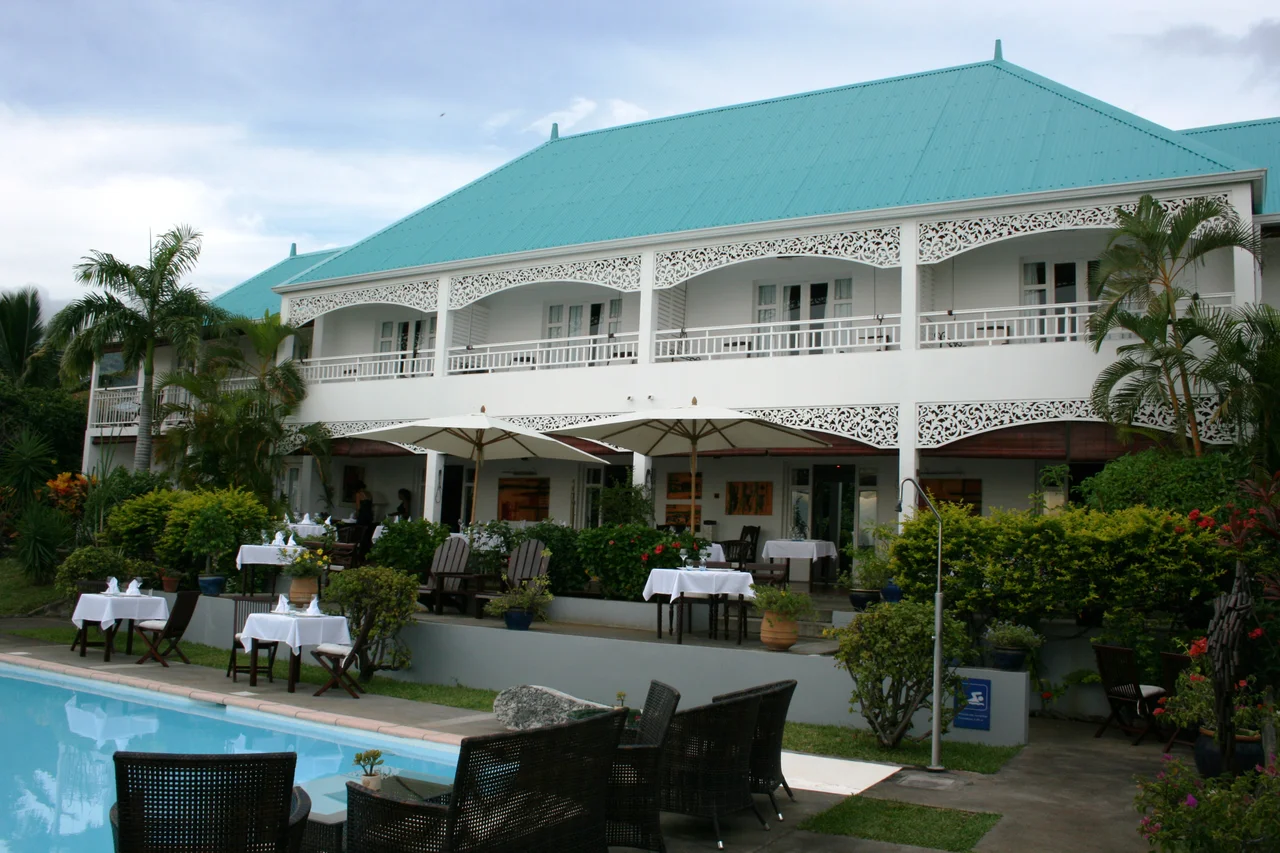
Saint-Leu sits on the dry, sheltered western flank of Réunion, strung along the coast road with the mountains rising sharply behind. The beach is pebbles rather than sand, fringed by a lagoon, and life here moves to the rhythm of the swell and the sun. The town is small enough that its main street is also its shopping street, and unhurried enough that visitors come mostly to do two things: ride the famous wave when the ocean delivers it, and walk up to the chapel and the ravines where so much of the island's memory is kept.
From the Air
Saint-Leu lies on Réunion's west (leeward) coast at approximately 21.17°S, 55.29°E, at sea level, with terrain rising steeply inland toward Piton des Neiges. Being leeward, it sits in the island's rain shadow and is typically the clearest, sunniest quadrant - good visibility most of the day. The nearest airport is Pierrefonds / Saint-Pierre (ICAO FMEP), a short distance down the southwest coast; Roland Garros / Saint-Denis (ICAO FMEE) lies on the north coast. Offshore, watch for the long line of the reef break that makes the town famous.
Nearby Stories
- Nouvelle Route du Littoral 3.8 km away
- Tromelin Island: The Forgotten Enslaved People of the Isle of Sand 560 km away
- Battle of Tamatave 653 km away
- Canal des Pangalanes 738 km away
- Ambalavao 872 km away
- Siege of Galle (1640) 4003 km away
- Galle Fort 4024 km away
- French Western Australia 5777 km away