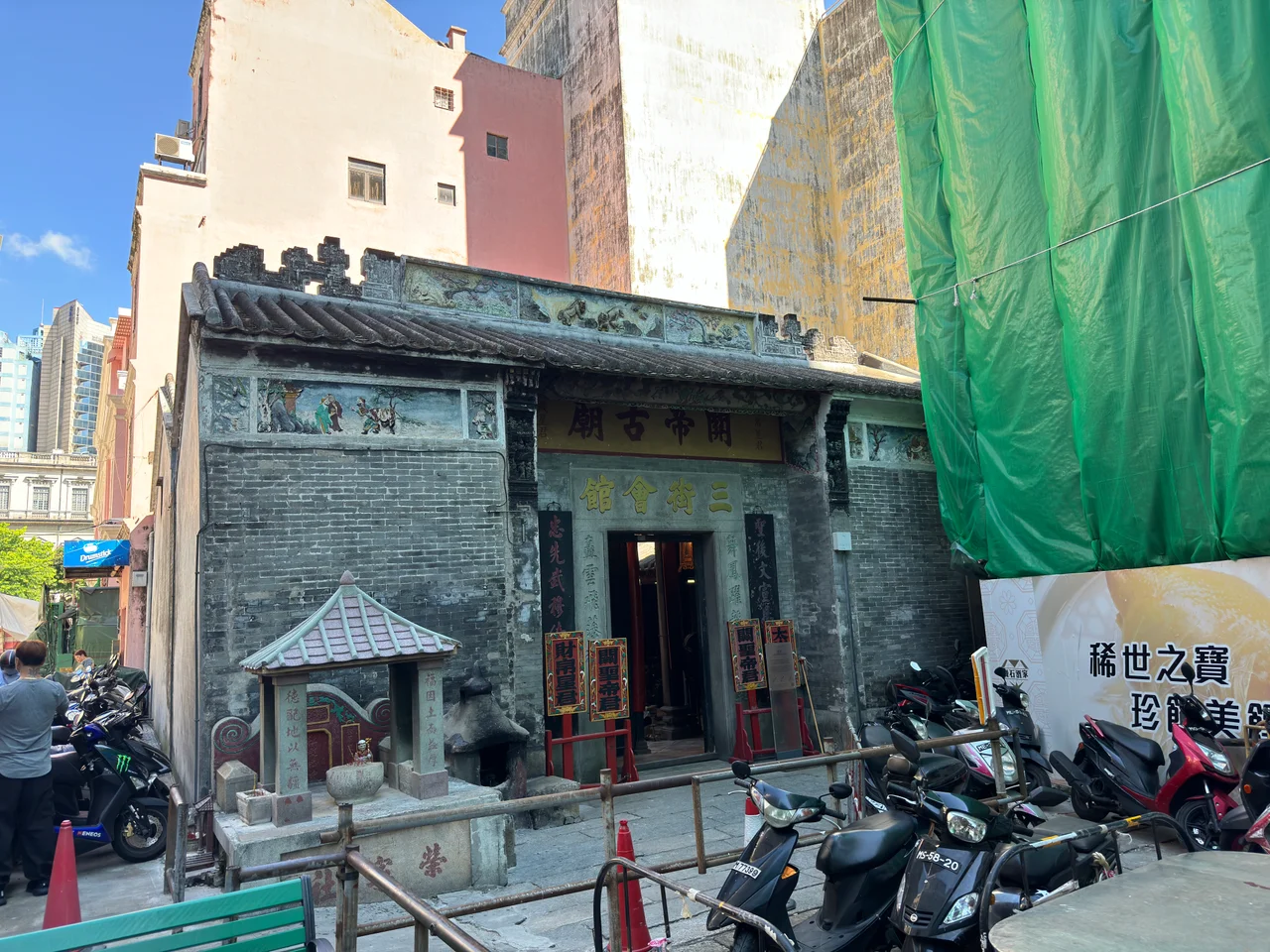

Sam Kai Vui Kun (Kuan Tai Temple)
Guan Yu died in 220 CE, executed after his defeat in a military campaign during the Three Kingdoms period. Within a century of his death, stories of his loyalty, courage, and fierce integrity had begun to accumulate around his name. Within a thousand years, he had been deified. Today he is worshipped in Taoist temples, honored in Buddhist shrines, and invoked in Confucian ceremonies across the Chinese-speaking world — arguably the most widely venerated historical figure ever to have lived. Sam Kai Vui Kun, built in Macau in 1750 near the heart of the old city, is one of the places where that veneration has been continuous for nearly three centuries.
The General Who Became a God
Lord Guan — Guan Yu, Guan Di, Kuan Tai in the Cantonese pronunciation that Macau's residents use — served under the warlord Liu Bei during the fragmentation of China's Han dynasty. His battlefield reputation for personal bravery was matched, in the stories that gathered around him, by a reputation for absolute loyalty: he famously refused to betray his sworn brothers even when captured by an enemy who treated him generously. These qualities — martial courage and personal fidelity — made him an ideal figure for veneration by communities that prized both.
Over the following centuries, imperial courts issued successive titles elevating him higher in the cosmic hierarchy. The Qing dynasty in particular promoted his cult, partly because a general of exemplary loyalty was a useful model to propagate across an empire that stretched from Mongolia to Vietnam. By the time Macau's temple was built in 1750, Lord Guan was simultaneously the god of war, the protector of police and soldiers, the patron of merchants and secret societies, and an exemplar of righteousness honored in Buddhist and Confucian contexts as well as Taoist ones. The breadth of that appeal has no real parallel in any other tradition.
A Temple in Three Worlds
Sam Kai Vui Kun means something like "community hall of the three streets" in Cantonese — a name that refers to the three oldest commercial streets of Macau where the merchants it served operated: Rua dos Mercadores, Rua das Estalagens, and Rua dos Ervários. As a meeting place for merchants dealing in the essential commodities of the city, the temple served those who provisioned Macau with food and goods.
The temple sits in the Sé district, facing St. Dominic's Market Complex, a short walk from Senado Square. This geography matters. Senado Square was, and remains, the administrative and commercial heart of the Macanese city: the Leal Senado building, where the Portuguese municipal government operated for centuries, stands on one side of the square. The proximity of a Taoist temple dedicated to commerce and civic virtue is not accidental. The merchants who worshipped Lord Guan at Sam Kai Vui Kun were the same merchants who paid taxes to the Leal Senado and traded at the docks. The temple was their institution, the way the Senate was the Portuguese institution. Both operated in the same small city.
Classical Lingnan Architecture
The building itself belongs to the classical Lingnan architectural tradition — the style that developed in Guangdong province and spread through Cantonese communities across Southeast Asia. Lingnan buildings use ceramic roof ridges decorated with elaborate figurines: dragons, phoenixes, historical scenes rendered in vibrantly glazed tile. The ornamentation is not merely decorative but narrative, each ridge and gable telling stories drawn from history, mythology, and the moral universe of Chinese civilization.
At Sam Kai Vui Kun, the interior is organized around the altar where Lord Guan's image stands, flanked by figures representing his companions from the Three Kingdoms stories. Incense smoke rises continuously during temple hours, drifting through air that always carries the particular quality of a space where people have come to ask for help with serious matters — business decisions, family wellbeing, the uncertain outcomes that every generation faces. The structure is classified as an immovable heritage property by the Macau government, a designation that recognizes both its architectural integrity and its uninterrupted function as a living place of worship.
Part of the World Heritage Center
In 2005, Sam Kai Vui Kun was designated one of the sites of the Historic Centre of Macau, inscribed on the UNESCO World Heritage List. The designation acknowledged something that anyone who has walked from Senado Square past the temple already senses: the historic center is not a Portuguese colonial district with a few Chinese monuments preserved as curiosities. It is a place where European baroque and classical Lingnan architecture, Catholic churches and Taoist temples, share the same few streets because they were always part of the same city.
Macau has older temples — the A-Ma Temple dates to 1488, the Kun Iam Temple to 1627. Sam Kai Vui Kun, at 1750, arrived in the city's middle period, when the Portuguese commercial establishment was a functioning reality and the Chinese community had been there, in its own institutions, all along. The temple that survives today is the continuity of that Chinese presence: three centuries of merchants and workers and families who came to ask Lord Guan for what they needed, in a city that was always, whatever the official maps said, two cities in one.
From the Air
Sam Kai Vui Kun stands at 22.194°N, 113.539°E in the Sé district of the Macau Peninsula, a few hundred meters southwest of the Ruins of St. Paul's. The temple is part of the dense historic center cluster that includes Senado Square, the Leal Senado building, and several other heritage structures within walking distance. From the air, this area is identifiable by its lower-density historic streetscape contrasting with the casino tower district to the south and east. The cathedral spire and the rooflines of the heritage buildings mark the center. Macau International Airport (ICAO: VMMC) is on Taipa Island, approximately 4 km to the southeast. Approach from the north or east for the clearest view of the peninsula's historic core before the reclaimed land and casino districts come into frame.
Nearby Stories
- 2024 Shenzhen Stabbing 0.8 km away
- Lantau Peak 1.5 km away
- Kweilin Incident 2.4 km away
- Taishan City 7 km away
- Wanshan Archipelago Campaign 38 km away
- Hong Kong 12 68 km away
- Battle of Nanpeng Island 82 km away
- Erhai Lake 1335 km away