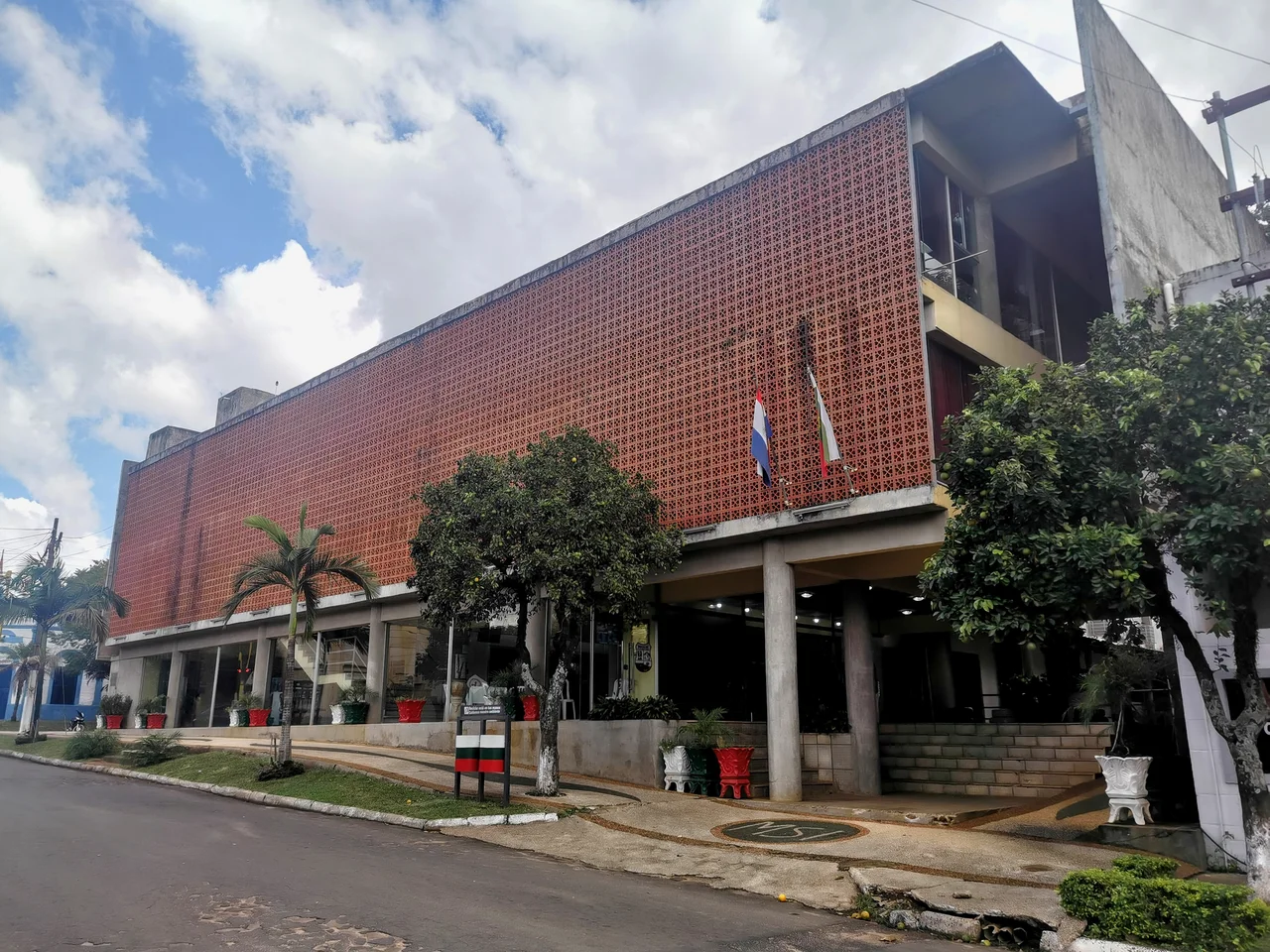

San Ignacio, Paraguay
On Good Friday at dusk, the streets of San Ignacio fill with candlelight. A procession winds through the dark, and along its path local people hold themselves perfectly still inside carefully lit scenes - living recreations of famous paintings, breathing tableaux the town calls cuadros vivos. The tradition is the work of the Paraguayan artist Koki Ruíz, but the impulse behind it is far older. For more than four centuries this place has translated faith into image, and image into something you can walk through. San Ignacio was the first Jesuit mission in Paraguay, and it has never stopped being a town built around art.
Where the Missions Began
In December 1609, two Jesuit priests, Marcial de Lorenzana and Francisco de San Martín, arrived on land offered by a Guaraní leader named Arapysandú. They raised an altar and said the first mass, and within a year the mission was formally established as San Ignacio Guazú - guazú meaning "great" in Guaraní, to distinguish it from the smaller San Ignacio Miní across what is now the Argentine border. Father Roque González de Santa Cruz organized it into the hub of the whole enterprise. From here the Jesuits fanned out to found the towns that followed: Santa Rosa, Santiago, Santa María, San Cosme y Damián, even Encarnación. Every one of those missions traces its origin to a departure from San Ignacio. It is, quite literally, the mother town.
A People and a Partnership
The reductions were a complicated arrangement, and they deserve to be understood as more than a chapter in church history. The Guaraní who settled here were not passive converts. They became the artisans, builders, and musicians whose skill defined the missions - the first inhabitants, as the record plainly states, who learned many arts from the European masters and then made those arts their own. The result is a style now called the Hispanic-Guaraní baroque, and San Ignacio holds enough of it to be considered its capital. Not everyone joined. In a settlement called Tañarandy - the name means roughly "land of the heretics" - lived Guaraní who refused the mission's authority and kept their independence at the edge of the new order.
The Saints in the Old College
The town's treasure sits in the Diocesan Museum of Jesuit Art, housed in a building that dates to the Spanish colonial period and still tended by the Society of Jesus. Inside, carved saints stand in rooms arranged like a sermon in four parts: Creation, Redemption, the history of Christ in the Church, and the story of the Jesuit company itself. These are not museum reproductions but the actual sculptures and objects of the mission, alongside documents and maps from Paraguay's first reduction. Look closely at the faces. The hands that shaped this wood belonged to Guaraní artists working under European tutelage, and what they produced is neither wholly Europe nor wholly the Americas, but something that could only have been made here.
The Heart of the South
San Ignacio calls itself the Corazón del Sur, the Heart of the South, and the geography backs the claim - it sits at the meeting point of three southern departments, Ñeembucú, Misiones, and Itapúa, with roads running out in every direction. With an estimated 38,489 residents, it is the largest and fastest-growing city in the Misiones Department, a center of commerce, cattle, and agriculture. But the town wears its history close to the surface. One colonial house across from the church now documents the years of the Stroessner dictatorship, 1954 to 1989, as a memorial to its victims. Another holds relics of two wars. Every January the Missioner Tradition festival fills the streets with folklore, horsemanship, and plates of batiburrillo, the local stew - a reminder that this is a living town, not a ruin.
From the Air
San Ignacio Guazú lies in the Misiones Department of southern Paraguay at 26.89°S, 57.03°W, about 225 km southeast of Asunción along Route 1. From the air the town reads as a compact grid set in rolling cattle country and farmland, the large colonial plaza and church marking the historic core. Best viewed from 2,000-3,500 ft AGL; the surrounding open pasture gives long sightlines, and the red-earth roads radiating from town are easy navigation references. Nearest major airport is Asunción's Silvio Pettirossi International (ICAO SGAS), roughly 200 km northwest; Encarnación's Teniente Amín Ayub González (ICAO SGEN) lies southeast. The subtropical climate brings clear, mild winter days (June-August) ideal for viewing, with afternoon haze and storms more likely in the October-April wet season.
Nearby Stories
- Doctor Moisés Bertoni 25 km away
- Battle of Estero Bellaco 26 km away
- Fortress of Humaita 31 km away
- Santiago, Paraguay 35 km away
- San Cosme y Damián 37 km away
- Ybycuí National Park 57 km away
- El Paraíso Verde 61 km away
- Pilcomayo River 132 km away