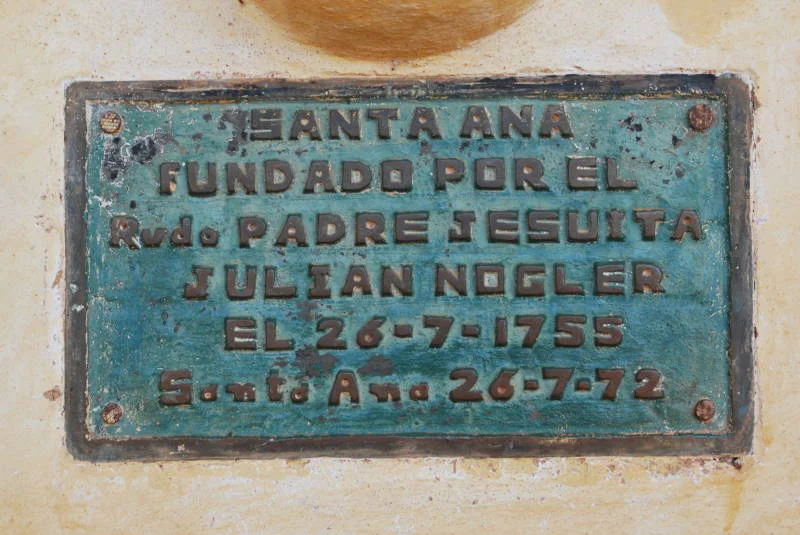

Santa Ana de Velasco
Santa Ana de Velasco holds a quiet distinction among the Jesuit missions of the Chiquitos: its church is the one built largely without the Jesuits. When the order was expelled from Spanish America in 1767, the community here did not abandon the project. The Chiquitano people of Santa Ana raised the church themselves, faithfully following the architectural language the missionaries had taught them. The result is the smallest of the mission churches and, by wide agreement, the most original, the single sanctuary that has come down to us closest to its untouched colonial state.
A Latecomer Among Missions
Santa Ana was among the last of the Chiquitos reductions to be founded, established in 1755 by the Jesuit Julian Knogler, decades after the earliest missions had taken root. Its founding came barely a dozen years before the expulsion that would scatter the Jesuits from the continent forever. That timing shaped everything. Where older missions had generations to build under Jesuit direction, Santa Ana was still young when the priests departed, leaving its community to complete what had only just begun. The town grew up small and remote in the Chiquitania, the rolling country between the city of Santa Cruz and the Brazilian border, and small it has largely remained.
Built by the People Themselves
What makes Santa Ana extraordinary is who finished it. With the Jesuits gone after 1767, the Chiquitano inhabitants carried on, constructing and maintaining the church on their own according to the designs they had been taught. This was not unique to Santa Ana; across the missions, towns preserved and sometimes extended their churches after the expulsion. But here the indigenous hand is most clearly the whole story, and the church is celebrated as one of the most faithful surviving expressions of the original Jesuit-Chiquitano architectural vision. It is, fittingly, the only mission whose church remains preserved entirely in its original state, never rebuilt, never replaced.
The Most Original Survivor
Among the colonial-era missions inscribed by UNESCO as a World Heritage Site in 1990, Santa Ana is regularly called the most authentic. While its sisters underwent extensive restoration in the twentieth century, much of it led by the architect Hans Roth, Santa Ana's church survived in a state so close to the original that visitors and scholars treasure it precisely for what it has not lost. Its interior is considered particularly beautiful, intimate in scale where grander missions overwhelm. To step inside is to encounter the Chiquitos baroque not as a restored showpiece but as something that has simply, stubbornly endured, weathered timber and adobe holding their shape across more than two and a half centuries. That endurance is the whole point of Santa Ana, the reason a small church at the end of a dirt road carries weight far beyond its size.
A Town at the End of the Road
Santa Ana sits at an elevation of 464 meters, reached today by a dirt road that runs south from San Ignacio de Velasco and passes through after some forty-five kilometers. From the departmental capital of Santa Cruz it is a journey of well over four hundred kilometers, much of it on roads that demand patience, which keeps the crowds away. The town has grown slowly but steadily, from 284 residents recorded in the 1992 census to 483 by 2001 and several hundred more in the years since, a small place expanding at its own unhurried rate. Everyday speech is now Camba Spanish, though the mission once echoed with languages related to Otuke, tongues like Covareca and Curuminaca that have since faded from daily use. There is a stillness to Santa Ana that suits its history. In the least-altered of the Chiquitos churches, in a town few travelers reach, the past feels remarkably present.
From the Air
Santa Ana de Velasco lies at 16.58 degrees south, 60.69 degrees west, at an elevation of about 464 meters in the Chiquitania of Bolivia's Santa Cruz department, in gently rolling woodland and pasture between the Amazon basin and the dry interior. The compact town with its modest mission church sits along the dirt road running south from San Ignacio de Velasco; a viewing altitude of 2,500 to 4,000 feet AGL frames the settlement and its road link, about forty-five kilometers from San Ignacio. The nearest significant airport is San Ignacio de Velasco (SLSI) just to the north, the regional hub for the missions. Santa Cruz Viru Viru International (SLVR), well to the west, is the principal gateway to the Chiquitania. The dry season from roughly May to October gives the clearest air; the wet season brings haze and vigorous afternoon storms.
Nearby Stories
- Immaculate Conception Cathedral, Concepción 94 km away
- Concepción (Bolivia) 106 km away
- Vila Bela da Santíssima Trindade 150 km away
- Serra Ricardo Franco State Park 197 km away
- Avion Pirata 235 km away
- Kaa-Iya del Gran Chaco National Park 252 km away
- Guaporé River 256 km away
- Pantanal Matogrossense National Park 307 km away