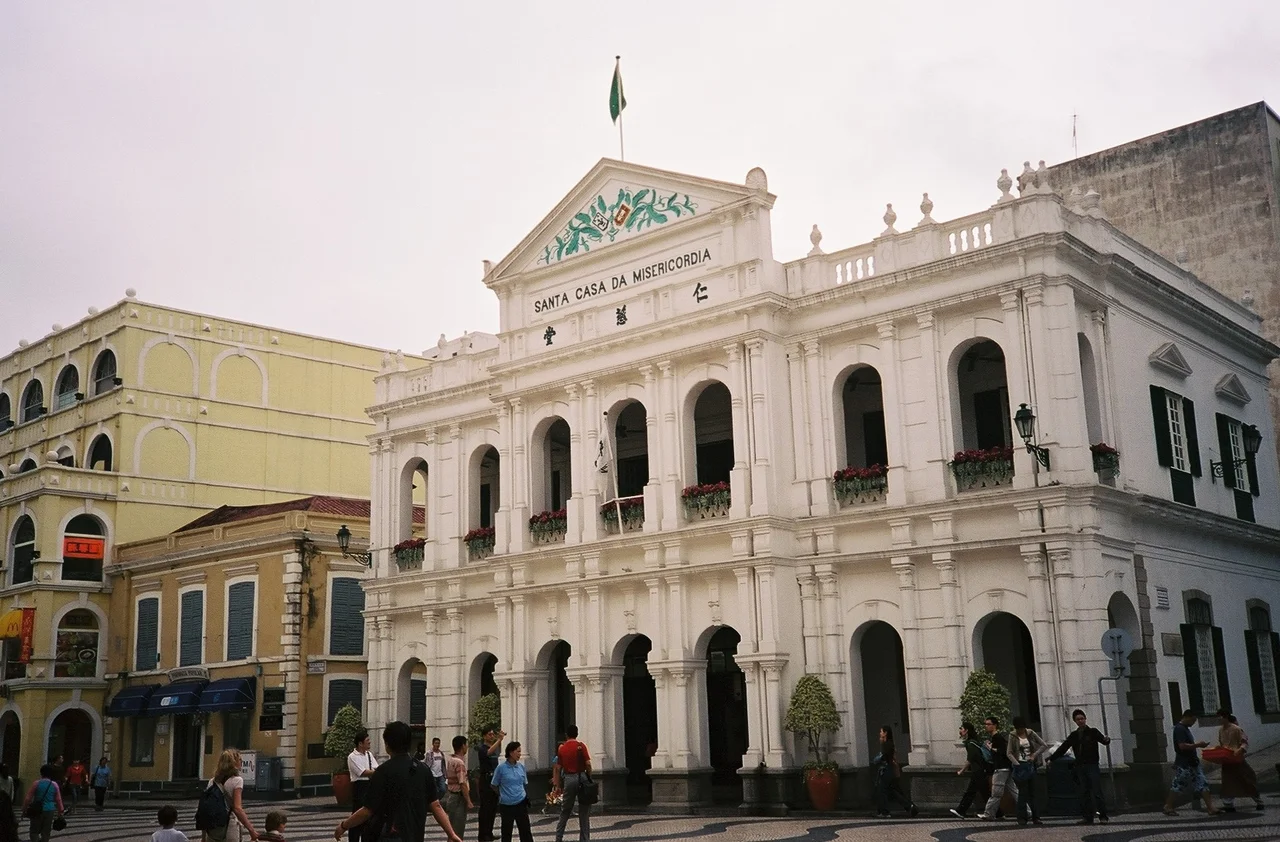

Santa Casa da Misericórdia of Macau
Before Macau had a proper hospital, before it had courts or schools of any permanence, it had the Santa Casa da Misericórdia. Bishop Belchior Carneiro Leitão ordered it built in 1569, just decades after the Portuguese established their foothold on the Pearl River Delta, and from the start its mission was radically human: care for the sick, shelter orphaned children, and give refuge to women whose sailor husbands had vanished into the South China Sea. Charity, in this small colonial outpost at the edge of the known world, arrived before almost everything else.
A Bishop's Act of Mercy
Belchior Carneiro Leitão was not the typical colonial official. Arriving in Macau as its first bishop in 1568, he came with a mandate that was as much humanitarian as ecclesiastical. The Portuguese Misericórdia — literally the Holy House of Mercy — was already an established institution back in Lisbon, a charitable brotherhood founded in 1498 under Queen Leonor. Carneiro transplanted it to Asia, making the Macau branch one of the earliest in the entire Portuguese colonial network. The building he commissioned rose on the north side of what would become Senado Square, its neoclassical white façade a deliberate statement: that mercy was civic architecture, not merely private virtue. It was part medical clinic, part social safety net, functioning at a time when the boundary between religious duty and public welfare barely existed.
Widows, Orphans, and the Logic of a Port City
The sea took men constantly. Ships left Macau bound for Goa, for Nagasaki, for Lisbon — and many never returned. The Santa Casa became the institutional answer to that grief, offering shelter to the widows left behind and taking in the children who had no one left. It was a practical arrangement as much as a compassionate one: a trading port required that its resident community not simply dissolve when sailors died. The orphanage and refuge functions of the building shaped entire generations of Macau's Eurasian community, the Macanese, who grew up within or around its walls. The institution's longevity — it has operated continuously for more than four and a half centuries — speaks to how fundamental that original need was, and how persistently the city has found ways to honor it.
White Façade on a World Heritage Square
Today the Santa Casa da Misericórdia stands on Senado Square as one of the more quietly authoritative buildings in a neighborhood of showpieces. The square itself, with its distinctive wave-patterned Portuguese calçada pavement, draws crowds of tourists past the Leal Senado Building and toward St. Dominic's Church. The Santa Casa's neoclassical façade — bright white, composed, restrained by comparison with some of its neighbors — tends to attract a second, slower look. It was recognized as part of the Historic Centre of Macau when UNESCO inscribed the site as a World Heritage Site. Visitors who step inside find the institution still active, still rooted in social service, its long history encoded in the building's bones rather than announced in any flashy way. The charity house endures on the same corner where it first opened, doing roughly what Bishop Carneiro intended, more than 450 years on.
An Institution Older Than the Modern City
It is worth pausing on the date: 1569. Macau would not formally become a Portuguese colony until 1887. The British would not found Hong Kong for another 272 years. When the Santa Casa was established, the Reformation was still fresh in European memory, Shakespeare had not yet been born, and the Mughal Empire was at its height. That an institution founded in those years continues to function in the same city, in the same neighborhood, on the same civic square, is the kind of continuity that most places simply cannot claim. The building has been reconstructed and modified over the centuries, but the mission has remained coherent. In that sense, the Santa Casa da Misericórdia is not just a historic site — it is an ongoing argument, made in stone and practice, about what a city owes its most vulnerable people.
From the Air
The Santa Casa da Misericórdia sits at approximately 22.1936°N, 113.5403°E on the northern edge of Senado Square in central Macau. Approaching from the east at 2,000–3,000 feet, the dense urban grid of the Macau Peninsula is visible below, with the Grand Lisboa tower serving as a prominent landmark to the southeast. Macau International Airport (VMMC) lies roughly 4 nautical miles to the southeast on the Cotai reclamation. The white neoclassical building fronting the square is surrounded by the yellow Leal Senado Building and the terracotta rooflines of nearby baroque churches. Visibility in the Pearl River Delta can vary significantly with seasonal haze and monsoon weather; morning approaches typically offer the clearest views.
Nearby Stories
- 2024 Shenzhen Stabbing 0.8 km away
- Lantau Peak 1.5 km away
- Kweilin Incident 2.4 km away
- Taishan City 7 km away
- Wanshan Archipelago Campaign 38 km away
- Hong Kong 12 68 km away
- Battle of Nanpeng Island 82 km away
- Erhai Lake 1335 km away