
Santana Group
A hundred and thirteen million years ago, northeastern Brazil was a rift. South America and Africa were pulling apart. Where the town of Crato now sits, a chain of shallow lakes and lagoons filled the rift basin, and the creatures that died in those lakes sank through still, oxygen-poor water into fine mud. That mud became limestone, and that limestone preserved whatever fell into it with astonishing fidelity: fish with soft tissue, pterosaurs with wing membranes, dinosaurs with skin impressions, insects with patterned wings, and feathers so detailed that scientists can see individual barbs. The Santana Group, dated to the Early Cretaceous, is one of the richest fossil deposits on Earth.
Three Formations, One Story
The Santana Group stacks three rock formations on top of each other, each telling a different chapter of the same basin. The Crato Formation sits at the bottom, laid down as six intervals of laminated limestone with calcareous siltstone and marl between them. It holds most of the insect and amphibian fossils. Above it, the Ipubi Formation is mostly black, organic-rich shale and gypsum-anhydrite beds, a record of episodes when the lake became extremely salty and evaporated in places. Above that, the Romualdo Formation records a marine incursion: the proto-Atlantic briefly flooded into the interior of the continent during the Albian stage, leaving a layer of fine sandstone, siltstone, and limestone packed with fish, turtles, and pterosaurs. Three formations, one basin, roughly thirteen million years of change.
Feathers Before the Birds
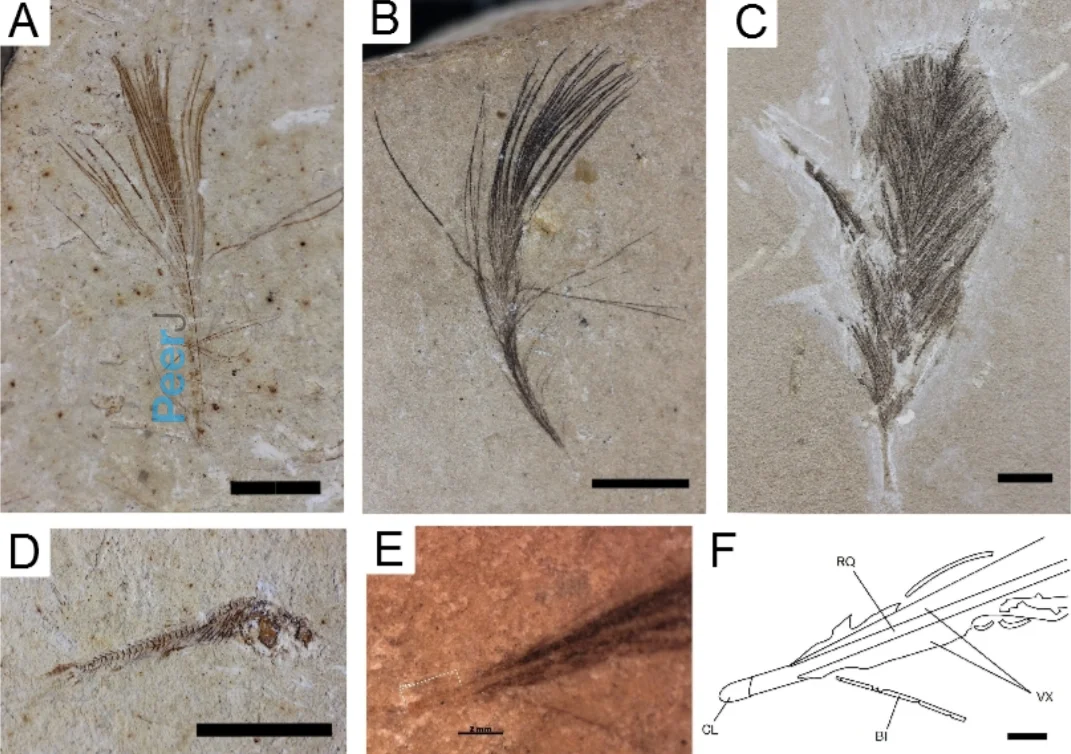
The Santana Group holds the first record of Mesozoic birds from Brazil. Fossil feathers found in the Crato and Romualdo formations show that feathered animals were already living in the basin at a time when the lineages leading to modern birds were still diverging from their theropod dinosaur cousins. Some of the feathers are preserved so completely that their color patterns can be reconstructed, because melanosomes, the tiny structures that produce color in feathers, survived in the rock. The feathers are displayed alongside the fossilized teleost fish Dastilbe, which fills the Crato laminites in such numbers that quarry workers sometimes pull up slabs with dozens of fish visible on a single surface.
The Pterosaur with the Headcrest
Thalassodromeus sethi, named in 2002, was a large pterosaur recovered from the Romualdo Formation. Its lower jaw and the base of its skull preserve a bony crest that rose almost vertically above its head, taller than the rest of its body depending on how the angle of the neck is reconstructed. Researchers have argued about what the crest was for: thermoregulation, display, stability while skimming the water for fish. Thalassodromeus shared the basin with Irritator challengeri, a spinosaurid dinosaur named in 1996 by paleontologists who were irritated by the illegal fossil preparation work done on the holotype specimen before it reached them. Irritator had the long, narrow snout of a fish-eater, and given that the basin's lakes were full of fish, that probably meant exactly what it looks like.
Why the Fossils Are So Good
Most places on Earth do not preserve soft tissue. Bodies rot, bones disarticulate, scavengers take what they can. The Santana Group preserves fossils the way it does because the conditions at the bottom of the basin's lakes were rare and repeatable. The water was stratified, with oxygen-poor bottom layers that scavengers could not tolerate. Fine-grained carbonate mud settled slowly and evenly. Dead animals sank into that mud undisturbed and were encased almost as quickly as they decomposed. Geologists call deposits like this Lagerstatten, from a German mining term meaning storage place, and the Crato and Romualdo Formations both qualify. In 2006, UNESCO designated the broader Araripe Basin a Global Geopark, recognizing the scientific significance of what the rocks have held for a hundred million years.
The Basin's Deep History
The rocks of the Santana Group are only the middle of a much longer basin story. Before the rift, the area was quiet and stable, with Silurian and Devonian sandstones from braided rivers. In the Late Jurassic came a pre-rift phase, where slow thermal subsidence laid down red shales and sandstones that sometimes carry silicified wood of the conifer Dadoxilon benderi. Then, from the Berriasian through the Hauterivian stages of the Early Cretaceous, the rift itself tore the region into grabens and half-grabens, filling them with shales, siltstones, and conglomerates. The Santana Group settled into those post-rift lake basins. Above it lies the last chapter: the Araripina and Exu Formations, sandstones deposited during a late sag phase that ended only after the Cenomanian. The Chapada do Araripe, the flat-topped plateau that now rises above the Cariri Valley, is the top of that sag layer, still guarding the fossil beds below.
From the Air
The Santana Group outcrops across the Chapada do Araripe and the surrounding valleys of northeastern Brazil. The primary geohash 6x42 points into the Amazon, but the most productive fossil quarries lie near Santana do Cariri in Ceara state, roughly at 7.18 degrees S, 39.72 degrees W. Nearest airport is Orlando Bezerra de Menezes (SBJU) near Juazeiro do Norte. Best viewed from 10,000 to 15,000 feet where the flat mesa of the Araripe plateau rises above the surrounding caatinga semi-desert.
Nearby Stories
- Amazonas (Brazil) 76 km away
- Nascentes do Lago Jari National Park 118 km away
- Amazonas (Brazilian state) 153 km away
- Juruá-Purus Moist Forests 191 km away
- Humaita National Forest 201 km away
- Medio Purus Extractive Reserve 228 km away
- Tefe 243 km away
- Ituxi Extractive Reserve 257 km away