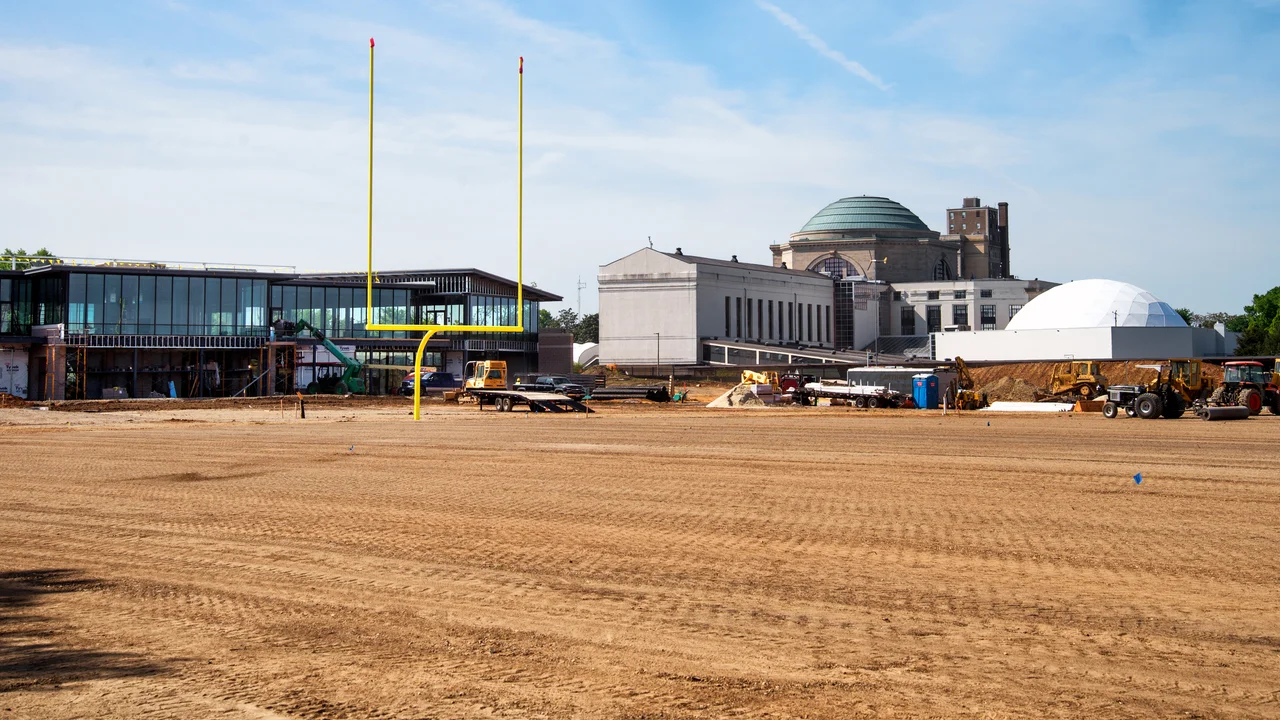

Science Museum of Virginia
An SR-71 Blackbird hangs from the ceiling of what used to be Track 1. Below it, a Chesapeake and Ohio Kanawha-class steam locomotive sits where it might have steamed in 1948, when this was Broad Street Station and the Silver Meteor rolled in from Miami. The building - a neoclassical temple designed by John Russell Pope in 1917 - was scheduled for demolition in the 1970s. Friends of a museum that had no home and no funding pressed the state to let them in. They got the building. Today the Science Museum of Virginia is the kind of place where a child can stand under a Mach 3 reconnaissance jet, then walk through a train station, then watch a movie on the largest screen in the state - all in the same afternoon.
Seventy Years to Get Started
The Virginia General Assembly first approved funds for a state exhibits center in 1906, to display mineral and timber specimens at the 1907 Jamestown Exposition. After the fair ended, the items were moved to Richmond's Capitol Square. The 'State Museum' opened in 1910. In 1942, the General Assembly endorsed a 'Virginia Museum of Science.' Then World War II intervened. Then the postwar recession. Then a 1964 study commission, also dead in committee. The State Museum's collections were quietly dispersed to state universities in the mid-1960s, and that almost-death is what finally galvanized the Virginia Academy of Sciences. Led by Dr. Roscoe D. Hughes, they lobbied Governor Mills E. Godwin between 1965 and 1967 to push enabling legislation through. On July 1, 1970, the Science Museum of Virginia was finally established. It had no building, no collection, and no real plan.
Saving the Train Station
Broad Street Station opened in 1919 after construction began in 1917, built for the Richmond, Fredericksburg and Potomac Railroad - architect John Russell Pope's neoclassical statement on the city's western edge. It also served the Atlantic Coast Line, the Norfolk and Western, and eventually the Seaboard Air Line. Much of the RF&P stock was owned by the State of Virginia's Retirement System, dating back to before the Civil War. When passenger rail collapsed and the state bought the building outright, the wrecking ball was scheduled. Friends of the museum pressed for an alternative use. The museum staff moved in on January 22, 1976, treating Pope's rotunda as both gallery and centerpiece. Governor Godwin, in his second term, dedicated the first exhibit gallery - The Discovery Room - on January 6, 1977. The event celebrated both the fifty-eighth anniversary of the station and the seventy-year arc from 1906 to that day.
The Dome and the Kugel
Most visitors come for the spectacle. The Dome opened in 1983 as the Universe Planetarium and Space Theater, with an Evans and Sutherland Digistar projector - the world's first computer-video planetarium system - and a 76-foot domed screen that was then the largest in the world. It is still the largest screen in Virginia, equipped now with a digital projection system upgraded in 2014. In 2003 the museum unveiled the Grand Kugel: an 86-ton sphere of South African black granite, eight feet and almost nine inches in diameter, floating on a thin film of water over a granite base. It cracked almost immediately, the fissure spreading until it could no longer float. A replacement was installed in October 2005. The original, cracked but still spectacular, sits behind the museum, where visitors run their hands across the fault line like it is geology itself.
Trains, Planes, and a Lost Atomic Bomb
The old train loading area is now the museum's industrial gallery. The C&O Kanawha-class steam locomotive #2732 sits where freight once moved. The RF&P 'Car One' business car is open for walk-throughs. Above them all hangs the Aluminaut - the world's first aluminum submarine, designed and built by Richmond-based Reynolds Metals Company in the 1960s. The Aluminaut earned its place in history not at Richmond but in the deep Mediterranean, helping recover a 'lost' U.S. atomic bomb in 1966 after a B-52 crashed into a refueling tanker over Palomares, Spain. In 2016 the museum opened the Speed exhibition, with a Lockheed SR-71 Blackbird suspended overhead - relocated from the Virginia Aviation Museum near Richmond International Airport. A reconnaissance jet that flew above 80,000 feet at Mach 3 now hangs above schoolchildren in a train shed.
The Sundial in the Parking Lot
Some of the museum's strangest exhibits are outdoors. In 1981 the world's largest analemmic sundial was dedicated in the museum's parking lot - later listed in the Guinness Book of World Records. Visitors stand on the marker for the date and read their own shadow. The 1982 Crystal World exhibit was once the largest crystallography display in the world; that same year the museum acquired the Solar Challenger, the first solar-powered airplane to cross the English Channel. The 2017 Da Vinci - Alive the Experience brought Renaissance art and engineering to Broad Street. The museum's Danville affiliate extends its reach into Southside Virginia. Pope's neoclassical rotunda still anchors everything: a former train station turned into a place where the building itself is part of the lesson, and the kid sliding down the helix near the front desk does not know yet that the floor she is laughing on used to be the platform where Floridians caught the Silver Meteor home.
From the Air
The Science Museum of Virginia sits at 37.5611 N, 77.4658 W, on West Broad Street in Richmond's Museum District. From the air, look for the distinctive neoclassical dome of the former Broad Street Station, with the surrounding museum campus and the I-195 / Boulevard interchange to the west. The nearest major airport is Richmond International (KRIC), about 9 nm to the east. Recommended viewing altitude is 1,500-2,500 ft AGL to take in the rotunda, the old rail yards behind it, and the Boulevard corridor running south to the Carillon.
Nearby Stories
- Kings Dominion 8.4 km away
- Battle of Hatcher's Run 9.7 km away
- Francisco's Fight 14 km away
- Piney Grove at Southall's Plantation 17 km away
- Jamestown Settlement 19 km away
- Battle of Amelia Springs 22 km away
- Menokin 29 km away
- Highland (James Monroe House) 42 km away