
Segontium
In AD 77 or 78, the Roman general Gnaeus Julius Agricola - the same Agricola whose son-in-law Tacitus would write his biography and so make him immortal - completed his campaign against the Ordovices in north Wales. He then planted a fort on a low ridge above the estuary of the Afon Seiont, overlooking the Menai Strait. He called it Segontium. It would hold its place at the edge of empire for over three centuries. When the Roman coinage finally stops appearing in the archaeology at this site - around AD 394 - Britain is still officially Roman, but only just. Segontium had outlasted whole dynasties of emperors.
Strong Place
The name is older than the fort. Segontium is a Latinised form of the Brythonic seg-ontio, which scholars translate as 'strong place', probably first applied to the river Seiont itself or to a British settlement on its banks. The Romans took the name with them. The fort was the principal Roman base in the north of Roman Wales, designed for about a thousand auxiliary infantry - not the elite legionaries of Chester (Deva Victrix) down the coast, but the support troops who actually held the frontier. A Roman road connected Segontium to Chester. The first defences were timber and earth, replaced in stone in the first half of the 2nd century, when a substantial courtyard house with its own small bathhouse was built inside the walls - the residence, archaeologists believe, of a high official, possibly the procurator in charge of regional mineral extraction. Anglesey's copper made the area valuable.
Who Was Stationed Here
An inscription on an aqueduct from the reign of Septimius Severus - that hard, scarred African emperor who died at York in 211 - tells us that by the 3rd century Segontium was garrisoned by 500 men of the Cohors I Sunicorum. The Sunici were a Germanic people originally levied from Gallia Belgica, in what is now Belgium. They had probably never been to Germany. They were now policing the Welsh coast against Irish raiders and pirates - the early form of the raids that would eventually become the Scotti settlements and, much later, the Norse. The fort shrank through the 3rd and 4th centuries as the empire pulled in its outer threads. But it never quite emptied. Coins keep appearing in the layers right up until 394.
Constantine's Mother and Macsen's Dream
Welsh medieval tradition layered legends thick over Segontium. The 9th-century History of the Britons, attributed to Nennius, listed it among the 28 cities of Britain and recorded that the emperor Constantius - probably the father of Constantine the Great - had died here. The historical Constantius Chlorus actually died at York in AD 306. But the Welsh built a different memory. Constantine's mother in Welsh tradition was Saint Elen, who appears in the Mabinogion's dream-tale Breuddwyd Macsen Wledig - the dream of Macsen, identified with the late Roman usurper Magnus Maximus. In the tale, Macsen dreams of a beautiful woman at 'the fort at the mouth of the Seiont'. He travels to find her. She is here. Saint Elen would in turn give her name to Sarn Helen, the Roman road that runs the length of Wales. History and dream-vision braided themselves together at Segontium, which is why Mary Stewart used the place in her Merlin novels and why Wallace Breem's post-Roman novel Eagle in the Snow opens and closes here.
What Remains
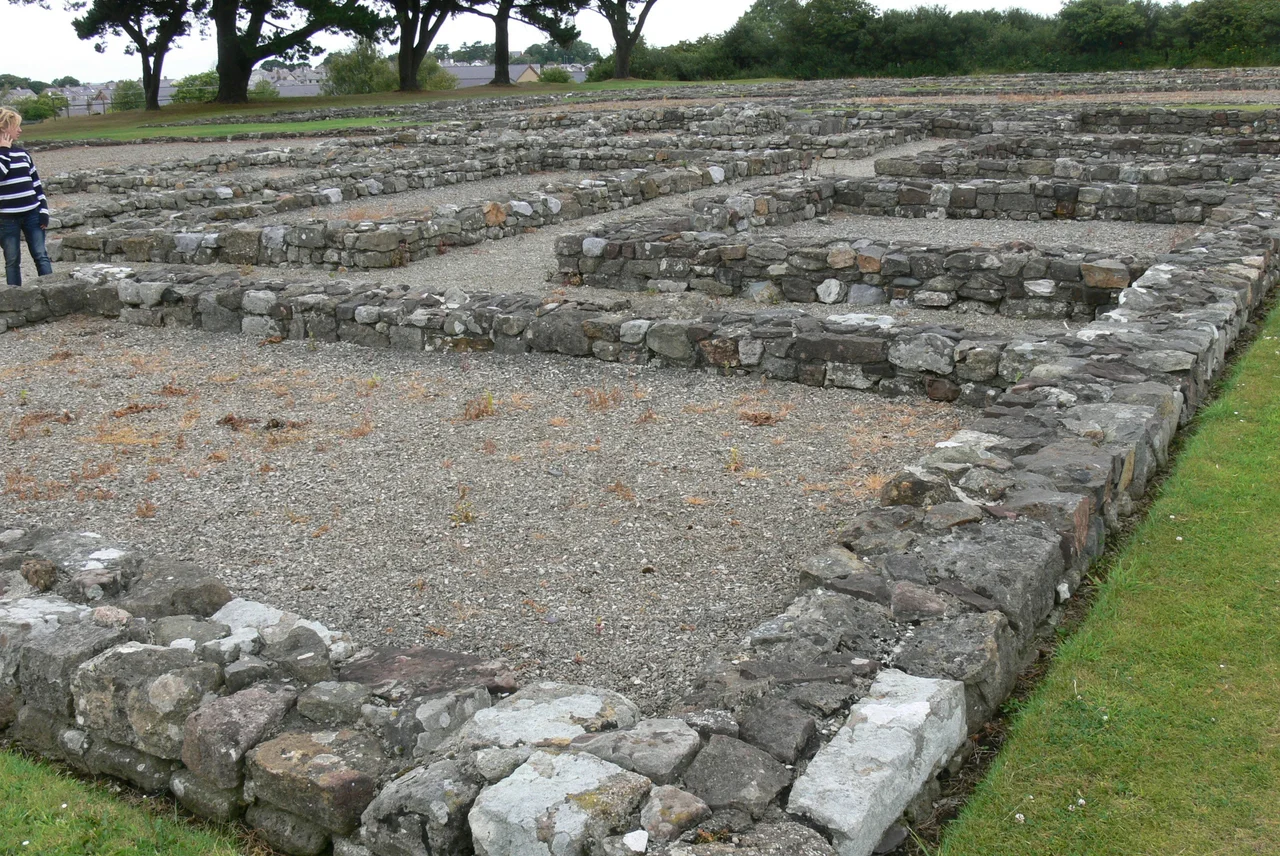
The A4085 to Beddgelert now cuts straight through the fort. The Normans built a motte nearby in the 11th century, and Edward I's masons replaced everything around it with Caernarfon Castle in the 13th. But Segontium's foundations are remarkably preserved. You can walk the rectangle of the walls, trace the principia and praetorium, see the commander's house and the barracks lines and the basement strongroom. A small civilian settlement and a temple of Mithras - the Caernarfon Mithraeum - have been identified outside the walls. The site is in the care of Cadw and the National Trust. Guidebooks are sold at Caernarfon Castle. Stand on the higher ground inside the fort, look north and west across the strait toward Anglesey, and you are seeing exactly what an auxiliary infantryman of the Cohors I Sunicorum would have seen on watch in AD 200 - the Druidic island Tacitus described being invaded by his father-in-law, the salt water moving back and forth, the rain coming in from the west.
From the Air
Segontium occupies a low ridge on the southeast edge of Caernarfon at 53.137N, 4.266W, with the Afon Seiont and the Menai Strait visible to the west. Caernarfon Airport (EGCK) is 3.5 nm southwest; RAF Valley (EGOV) is 16 nm northwest across the strait. From the air, look for the prominent rectangular layout of the fort foundations on rising ground, with the A4085 (Beddgelert road) cutting through diagonally. Caernarfon Castle - the immense Edwardian fortress - is half a mile northwest on the harbour, a useful landmark. Snowdonia rises sharply to the southeast.
Nearby Stories
- Wakestock 1.7 km away
- Trefriw 3.8 km away
- Irish Sea 8.7 km away
- Irish Sea Bridge 20 km away
- East–West Interconnector 30 km away
- Machynlleth 36 km away
- HMS Tyler 41 km away
- New Brighton Lifeboat Station 54 km away