
Sepik
The Sepik does not hurry. From the highlands of the interior to the Bismarck Sea it drops almost nothing in altitude, so the river simply wanders - doubling back on itself, spawning oxbow lakes, soaking the forest into swamp at every bend. In a year its level can rise or fall by five metres, and when it rises high enough the villages along its banks become islands, then archipelagoes. This is Papua New Guinea's Amazon, and the people who live along it have the highest concentration of languages found anywhere in the world, carrying traditions in yam cultivation, spirit houses, and garamut drums that the outside world only began to intrude upon in 1885.
Two Provinces, One River
The Sepik region is really two provinces stitched together by water. East Sepik, with around 400,000 people and the provincial capital at Wewak, is dominated end to end by the Sepik River itself, one of the largest in the world by volume. South of the river the land tilts up into mountains and swamp-fed catchments. West Sepik is officially Sandaun, Tok Pisin for 'sun down,' because along with Western Province it marks the westernmost edge of PNG before the Indonesian border. Its capital, Vanimo, doubles as a surf destination and a pit stop for expatriates renewing their Indonesian visas. Inland, the townships of Telefomin and Oksapmin are said to be the most remote towns in the country.
The Haus Tambaran and the Yam Cult
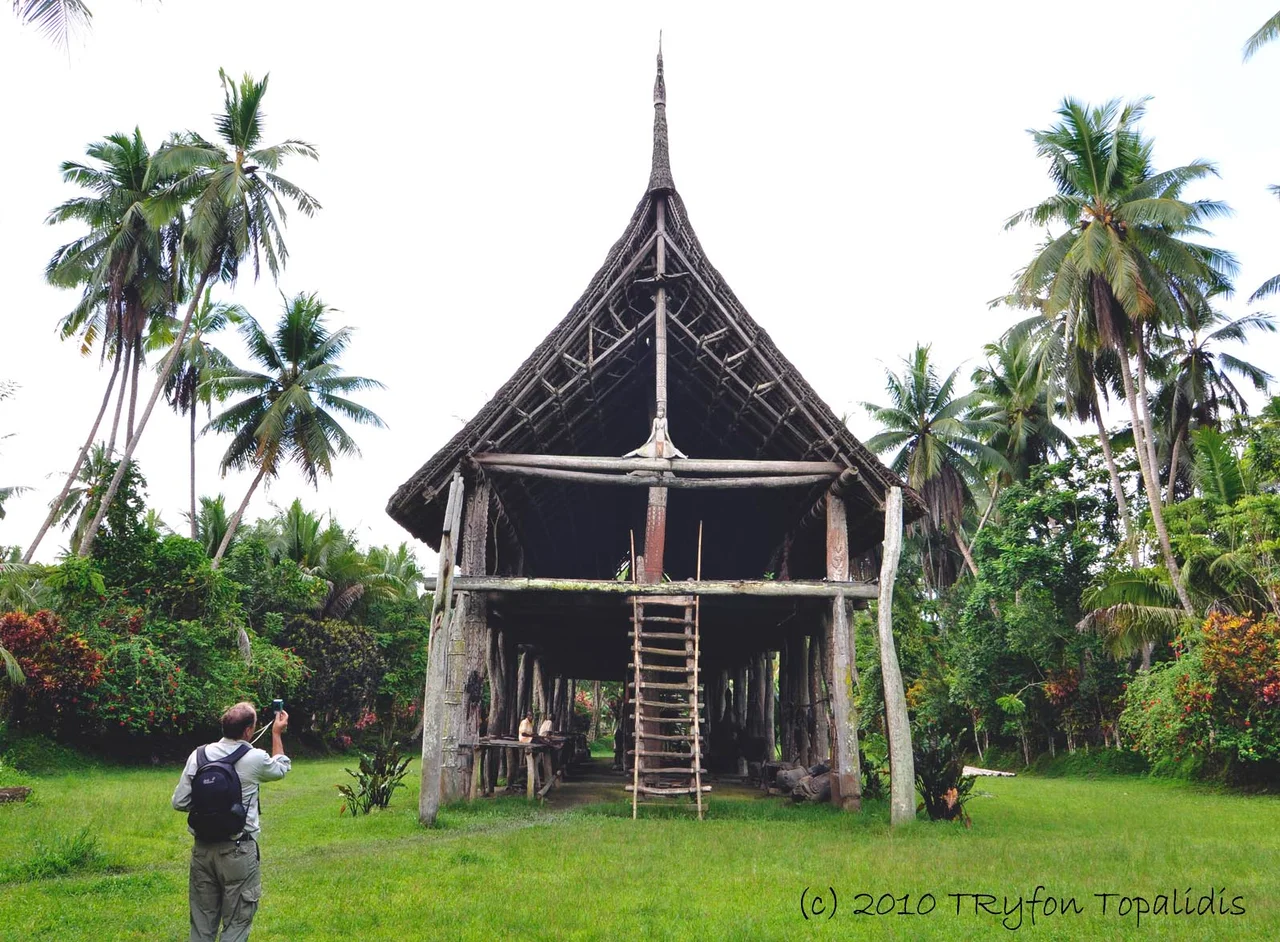
Nothing tells you where you are in the Sepik quite like a Haus Tambaran. These ancestral spirit houses rise two or three storeys, their facades carved and painted with faces, their ridgepoles often swept up into gable peaks that resemble prows. The finest examples stand around Maprik. Inside, elaborate paintings cover the walls - their preparation is a sacred act - and the buildings serve as meeting house, initiation site, and temple for the yam cult that sits at the centre of Sepik life. Yams here are not merely food. Farmers compete to grow the largest tubers, and the planting and cultivation of yams carries strict rules about diet, sexual abstinence, and ritual cleansing. A giant spirit is said to speak from within the Haus Tambaran, and its voice is taken very seriously indeed.
Carvings, Canoes, and Drums
The Sepik is renowned for its artistic output - so much so that Papua New Guinea's first prime minister, Michael Somare, came from this region, and the country's parliament building in Port Moresby was modelled on a Haus Tambaran. Villages along the river carry their own distinct styles of painting and carving, and village identity is often staked on what is produced there. Garamut drums - long tree trunks hollowed and carved into totem animals - still send messages between settlements. Manhood initiation ceremonies remain elaborate and secretive. Dugout canoes with outboard engines are the workhorses of daily life. For the adventurous traveller, it is possible to rent one, with a boatman, and head off into a landscape where each bend reveals a different language and a different set of designs.
Islands and Shipwrecks
Just off the coast from Wewak lie three small islands - Kairiru, a volcanic peak rising from the sea; Mushu, a coral atoll surrounded by reef fish; and Robuin, uninhabited, which the Japanese used as a fuel dump during World War II and the Allies bombed into memory during the Aitape-Wewak campaign. That campaign ended with General Adachi's surrender of all Japanese forces in PNG. Further west, tiny Wuvulu - nineteen kilometres in circumference, nowhere more than two metres above the sea - is encircled by coral reef. Jacques Cousteau described its diving as among the best in the world. Close to Aitape is the Sissano Lagoon, where in 1998 a tsunami triggered by an offshore earthquake killed about 2,000 people; the memory of that wave still shapes how coastal villages watch the sea.
Getting There and Getting Around
The Sepik is not a casual destination. Air Niugini flies into Wewak daily from Port Moresby, Lae, and Madang, and PNG Air connects Wewak with Mount Hagen. Mission Aviation Fellowship keeps twelve aircraft moving across the country, supplying mission stations and remote airstrips. Tourists sometimes hitch rides. June to November offers the driest conditions and the fewest mosquitoes. Villages along the river are often accessible only by boat, and a local guide is not a luxury - language groups shift every few kilometres, and so do politics. Major floods arrive about once a decade and the people have learned to adapt, though cholera and dysentery sometimes arrive with them. Travel here slowly, or not at all.
From the Air
The Sepik River mouth lies near 3.84 degrees south, 144.54 degrees east, on the north coast of Papua New Guinea. From cruising altitude the river is unmistakable - a muddy brown ribbon looping across dense green floodplain, its oxbows visible from thousands of feet up. Wewak airport (AYWK / WWK) is the main gateway and hosts flights from Port Moresby, Lae, and Madang. Vanimo (AYVN / VAI) serves the western Sandaun coast. Tadji (AYTJ / TAJ) near Aitape is the former WWII airstrip. Expect heavy tropical buildups in the afternoons and seasonal widening of the entire river floodplain during the wet season. Best visual conditions are the dry months of June through November.
Nearby Stories
- Manam Motu 41 km away
- Bombing of Wewak 62 km away
- Operation Copper 63 km away
- Karkar Island 108 km away
- 2024 East Sepik Earthquake 109 km away
- Naval Base Alexishafen 161 km away
- 2002 Sandaun Earthquake 193 km away
- Manus Island 246 km away