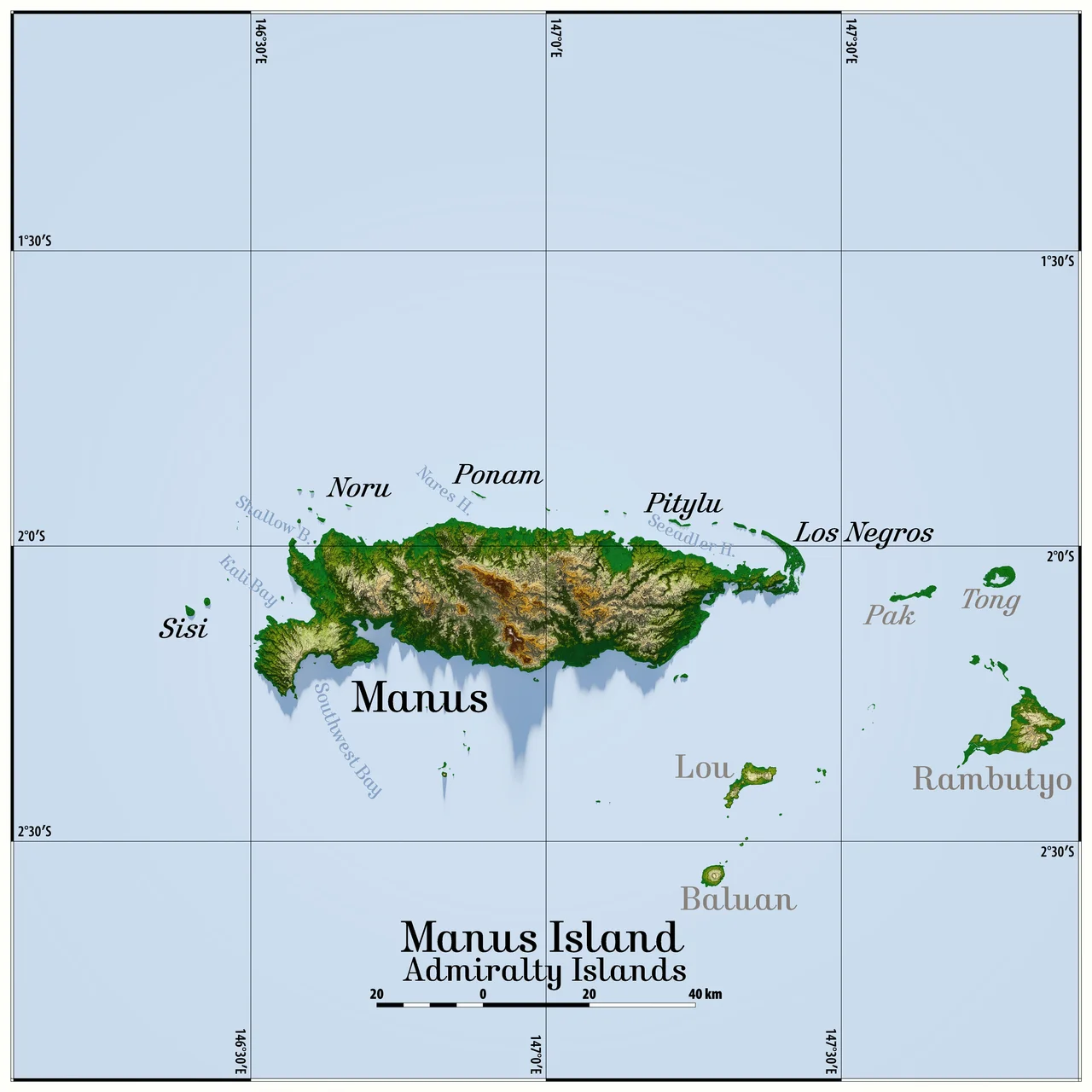

Manus Island
In April 2022, American researchers confirmed something that had been under classified review for years: a meteor that struck the atmosphere near Manus Island on January 8, 2014 had originated from beyond our solar system. The object, designated CNEOS 2014-01-08, was the first known interstellar visitor to strike Earth. Some of its debris may still be lying on the sea floor off the Manus coast, waiting for a research vessel equipped to look. It is a strange footnote for an island that has already been many things - a Spanish chart note from 1528, the site of Margaret Mead's most famous fieldwork, a Pacific Fleet base, and more recently a place the Australian government sent asylum seekers it did not want on its own soil.
Volcanic Bones, Coral Skin
Manus is the fifth-largest island of Papua New Guinea. It broke through the ocean's surface in the late Miocene, between eight and ten million years ago, as a volcano pushing up from the sea floor. The bones of the island are volcanic rock. The skin is uplifted coral limestone - reefs that the Earth lifted into the sky, then covered with rainforest. At the island's geographic center, near the south coast, Mount Dremsel reaches 718 meters. Everywhere else is lowland tropical forest, rivered and layered, home to the endemic emerald green snail whose shell was harvested for jewelry until the species was listed as vulnerable. The island's shape is the product of volcanic building and coral layering and eight million years of equatorial rain.
Saavedra's Sighting
On August 15, 1528, a Spanish ship called the Florida was trying to reach New Spain from the Maluku Islands. Her captain was Alvaro de Saavedra, and when Manus appeared off the bow he circled it and probably landed at a small island called Murai to the southwest. The landing was not peaceful. Canoes came out from the shore and the men inside fired bows and arrows at the Spanish. Saavedra captured three of them, carried them away, and returned them the following year on a second, also failed, attempt to cross the Pacific. He charted the island as Urays la Grande - Big Urays - which linguists now suspect is a Spanish mangling of the local name Murai. Those three men, whose names were never recorded, made the longest involuntary round trip in the recorded history of the region and came home to an island that had not changed but no longer felt the same.
Margaret Mead's Field
In 1928, the American anthropologist Margaret Mead arrived on Manus Island with her husband, Reo Fortune, to study Manus children and their society. She returned again after World War II. Her two books from the work - Growing Up in New Guinea and New Lives for Old - tracked the same community across two and a half decades and documented how quickly the war, missionaries, and contact with the wider world reshaped their lives. Mead's fieldwork on Manus helped establish the comparative study of childhood across cultures, and her later return gave her a longitudinal view that almost no other twentieth-century anthropologist possessed. The people she lived among were not specimens. They were the Manus, and their own names and voices run through her books alongside her theorizing. The island, she wrote, was both familiar and profoundly strange by the time she went back.
The War That Made the Harbor
The Japanese first bombed Manus on January 25, 1942, targeting a radio mast maintained by a small Australian observation post. In February and March 1944, American forces launched the Admiralty Islands campaign and retook the archipelago. What followed was construction at a scale the islanders had never seen: the Manus Naval Base at Seeadler Harbor grew into one of the largest Allied forward installations in the western Pacific, supporting the American advance on the Philippines and eventually the British Pacific Fleet. Seeadler is a deep-water harbor, protected and vast, and the United States Navy turned it into a floating city. On November 10, 1944, the ammunition ship USS Mount Hood exploded at anchor in Seeadler, killing hundreds of American sailors and destroying several nearby vessels. The war marked the harbor for generations. The Royal Australian Navy operated a base here from the 1950s until transferring it to the Papua New Guinea Defence Force in 1974.
The Detention Years
In 2001, the Australian government opened the Manus Regional Processing Centre on Los Negros Island, adjacent to Manus, as part of what it called the Pacific Solution. Asylum seekers who arrived in Australian waters by boat were held on Manus for processing, often for years. The facility closed in 2004, reopened in 2012, and became the subject of sustained international criticism. On April 26, 2016, the Supreme Court of Papua New Guinea ruled the detention of asylum seekers on Manus illegal. Prime Minister Peter O'Neill announced the center would close. The process was painful - a standoff in late 2017 involved PNG police and military, with men refusing to leave until power was cut and alternatives arranged. By November 23, 2017, all remaining men had been moved to new accommodation near Lorengau. In late 2019, the last asylum seekers were transferred to Port Moresby and Australia terminated its contracts on November 30 of that year. The men who lived through those years are scattered now, across refugee resettlement in several countries and a continuing uncertainty about what it meant to be held on a tropical island for a decade.
From the Air
Manus Island centers near 2.1 degrees south, 146.9 degrees east, about 300 kilometers north of mainland New Guinea. Momote Airport (AYMO) on nearby Los Negros Island is the airfield for the island, connected to Manus by a road bridge. Seeadler Harbor on the north coast is a protected deep-water anchorage - one of the best in the Pacific - and visually obvious from altitude. Mount Dremsel, the 718-meter highpoint, sits near the center of the south coast. The island reads green from the air against the deep blue of the surrounding sea. Afternoon convective weather is common year-round; the Ndrolowa Wildlife Management Area protects a stretch of coast south of Lorengau.
Nearby Stories
- USS Mount Hood (AE-11) 5.6 km away
- Manam Motu 241 km away
- Karkar Island 276 km away
- Sepik 278 km away
- Landing on Emirau 300 km away
- New Hanover Island 328 km away
- Battle of Lone Tree Hill 827 km away
- Mamberamo River 987 km away