_explodes_at_Seeadler_Harbor_on_10_November_1944.jpg)
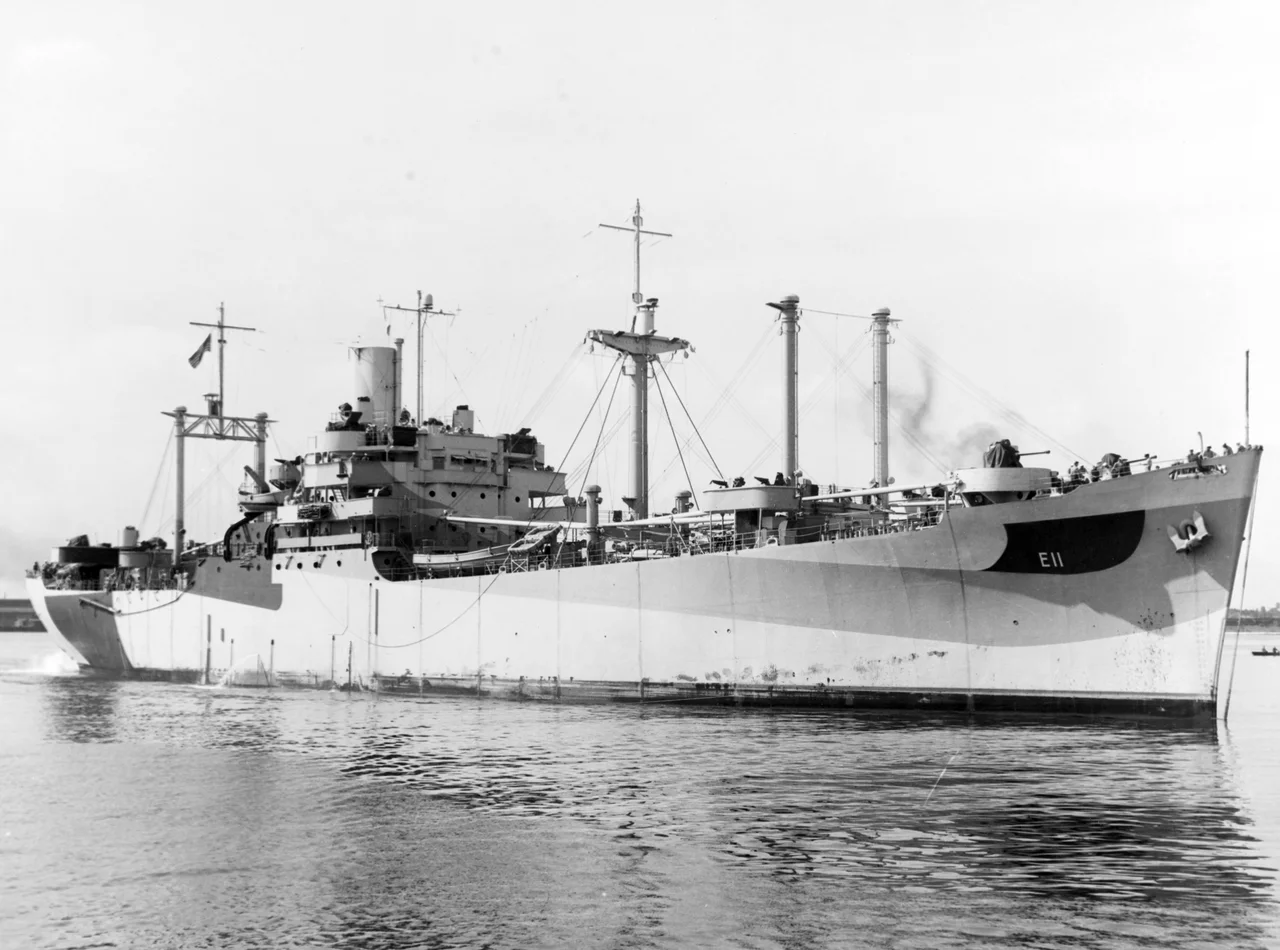
USS Mount Hood (AE-11)
Lt. Lester Wallace and seventeen enlisted men walked off USS Mount Hood at 8:30 in the morning on November 10, 1944, heading for the base post office. Two of them were headed to the brig for court-martial. Others wanted mail from home, or a few minutes with the base chaplain. Twenty-five minutes later, at 08:55, a blast knocked Wallace and his men off their feet 4,600 yards from where their ship had been anchored. They scrambled into a boat and turned back toward the harbor. There was nothing to return to. Mount Hood was gone. Three hundred fifty men were gone with her. Those eighteen shoregoers were the entire surviving crew.
From Marco Polo to Mount Hood
She had started life as a Maritime Commission cargo ship called Marco Polo, built by the North Carolina Shipbuilding Company in Wilmington. On November 10, 1943 - exactly one year before she would destroy herself - the Navy renamed her for the Cascade volcano in Oregon, conversion to her new purpose handled by the Norfolk Navy Yard. Commissioning came on July 1, 1944. After a brief shakedown in Chesapeake Bay she loaded munitions at Norfolk, transited the Panama Canal on August 27, and ran independently via Finschhafen to Seeadler Harbor, arriving September 22. Her job was simple: hand out ammunition and explosives to the warships preparing to invade the Philippines.
Berth 380
Standard procedure for an ammunition ship was to moor well away from other vessels - far out in open water where a worst-case detonation would mostly hurt empty sea. Mount Hood was not moored that way. She lay at Berth 380 in the central harbor, near the entrance. The logic was convenience: the berth offered calmer water, shorter boat rides for men transferring ammunition, and enough room for cruisers to come directly alongside for loading. On the morning of November 10, all five of her hatches stood open. 500-pound bombs were being lowered into Number 3 Hold. Around her decks lay 100-pound bombs, powder charges, machine-gun cartridges in three calibers, aerial depth charges, and rocket motors. In total she held roughly 3,800 tons of explosives. Small craft and landing barges clustered along her sides.
The Two Explosions
The first blast at 08:55 sent flame and smoke above masthead height from amidships. Within seconds, the rest of her cargo detonated. The second explosion was the larger of the two. A mushroom of smoke obscured the harbor for hundreds of yards in every direction. When it cleared, Mount Hood was not there. The seabed where she had floated showed a trench - reports put it at roughly 300 feet long, 50 feet wide, and 30 to 40 feet deep. The largest recognizable piece of her hull was found in that trench, and it was not large. Of her approximately 350 men aboard, and the boat crews alongside her, no human remains were ever recovered. A few pages from a signal notebook floated several hundred yards off, tattered. That was what came back.
The Damage Around Her
The blast tore through the anchorage. Twenty-two smaller craft were sunk or damaged beyond repair. USS Mindanao, a repair ship lying broadside-on about 350 yards away, took the worst of it. Every man on her topside was killed outright. Metal fragments from Mount Hood penetrated Mindanao's side plating and killed or wounded dozens below decks. Mindanao lost 82 of her own crew. In a small irony that made the whole thing even harder, the only Mount Hood crewman ever positively identified was a man who had been working aboard Mindanao at the moment of the explosion. Nine LCM landing craft and a pontoon barge moored alongside Mount Hood were destroyed outright. Add the wounded from other damaged ships to the 432 dead and the total casualty count reached 803. The official investigation, convened within days, could never determine what had set it off.
What the Navy Carried Forward
Mount Hood was struck from the Naval Register on December 11, 1944, little more than a month after she vanished. The charges against the two men who had been headed for the brig were quietly dropped - they were suddenly the luckiest defendants in the fleet. The West Loch disaster that May in Pearl Harbor and the Port Chicago explosion in California that July had already shown how fragile the ammunition-handling system could be. Mount Hood became the third catastrophe in a single year, and the worst loss of Navy life in the Pacific outside combat. The men she took with her were cooks and gunner's mates and seamen, fathers and sons and fiancés. The Navy put their names on rolls of honor and kept their ship's name on a second AE-11 that served later. But what happened in Seeadler Harbor that morning was, and remains, a wound the service was never quite able to explain.
From the Air
The wreck site of USS Mount Hood lies near Berth 380 in the central portion of Seeadler Harbor, approximately 2.03 S, 147.35 E, between Manus Island and Los Negros. Depth at the site is about 114 feet. Momote Airport (ICAO: AYMO) on Los Negros is the nearest active airfield and was in use during WWII. The harbor itself is distinguishable from 5,000 feet in clear weather as a U-shaped bay opening north. The sea-floor trench carved by the explosion has softened but is still noted on wreck-site charts.
Nearby Stories
- Admiralty Islands 8.7 km away
- Landing on Emirau 222 km away
- New Hanover Island 250 km away
- Karkar Island 283 km away
- Kavieng 316 km away
- Vitu Islands 333 km away
- Battle of Lone Tree Hill 905 km away
- Mamberamo River 1065 km away