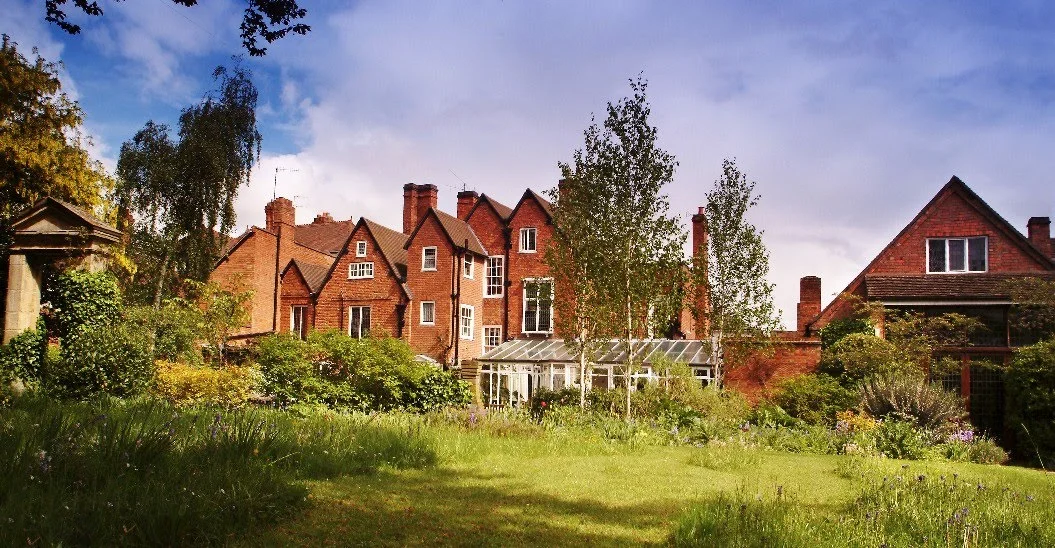

Shakespeare Institute
In the 1890s, the most popular novelist in England was not Hardy or Conan Doyle or Wilde. It was Marie Corelli -- a writer whose name almost nobody recognises today, but whose books outsold every one of her famous contemporaries combined. She bought a Queen Anne house in Stratford-upon-Avon called Mason Croft, planted a garden, kept a pet pony she sometimes brought indoors, and made the literary pilgrimage to Shakespeare's hometown her personal court. When she died in 1924, her house sat quiet for a generation. Then in 1951, the University of Birmingham did something improbable: it founded the world's first postgraduate research centre devoted entirely to Shakespeare, and chose Corelli's old drawing rooms to house it.
A House Full of Books
Mason Croft today contains roughly sixty thousand volumes, including three thousand early printed and rare books -- one of the deepest collections of Renaissance drama scholarship anywhere on Earth. The library was purpose-built in 1996, attached to the Queen Anne house, designed to hold the kind of material that Shakespeare scholars actually use: First Folios, quartos, archival film scripts, theatre company papers, the unpublished records of productions that exist nowhere else. The Renaissance Theatre Company archive lives here. So does the Renaissance Films PLC archive, and the New Shakespeare Company archive, and the E. K. Chambers Papers from the great scholar who reshaped the field in the early twentieth century. A newscuttings collection that has been added to continuously since 1902 fills its own room.
An Improbable Foundation
Allardyce Nicoll, the Glaswegian theatre historian, became the first director in 1951 and stayed a decade. The idea -- an institute existing only to study one playwright -- was unusual enough that nothing quite like it had been attempted before. The 1970s nearly killed it. Birmingham's budget tightened, and the Institute was forced to relocate to the main campus, which felt to Shakespeareans like exile from the source. Stanley Wells, who became director in 1988, reversed the move and brought the Institute back to Mason Croft. The 1996 library cemented its return. When the current director Michael Dobson took over, he described Mason Croft as 'the best place on earth in which to explore the impact Shakespeare's work has had across four centuries of world culture' -- a statement that sounds like puffery until you realise nowhere else has tried.
The Players in the Garden
The Institute's dramatic society, the Shakespeare Institute Players, has existed in various forms since 1953. Postgraduate students who spend their days reading folios spend their evenings staging the plays they read. The first recorded production was A Yorkshire Tragedy, an anonymous early Jacobean piece performed in February 1953 in the rooms where Corelli once entertained royalty. Productions still happen in the house and the garden. Watching graduate students perform Shakespeare in the garden where a forgotten Edwardian bestseller used to ride her pet pony is the kind of layered absurdity that only Stratford produces.
Stratford's Other Academic Life
Most visitors to Stratford never know the Institute exists. They walk past Mason Croft on Church Street -- a substantial brick house with a walled garden -- on their way to Shakespeare's Birthplace or the Royal Shakespeare Theatre, unaware that behind the wall, doctoral students are arguing about whether the 1623 First Folio's compositors B and E systematically miscorrected the dramatist's spelling. The Institute attracts roughly a hundred students a year from around the world. Many go on to careers in academic Shakespeare studies, theatre, and editing. The directors -- Nicoll, Terence Spencer, Philip Brockbank, Wells, Peter Holland, Russell Jackson, Kathleen McLuskie, Dobson -- read like a roll-call of the discipline. Stratford is famous as a tourist town. Mason Croft quietly turns it back into a university town for a few hundred people every year.
Corelli's Ghost
Marie Corelli would be appalled, and pleased, in equal measure. Appalled, because she fought her whole Stratford life to keep the town small and unchanged, picking feuds with anyone who proposed paving, electric lights, or motor cars near her beloved monuments. Pleased, because she also fought tirelessly to centre everything in Stratford around Shakespeare. She campaigned to save buildings he might have known. She published a book about him. She lobbied to preserve the medieval frontages on Henley Street. The Shakespeare Institute is, in a way, the realisation of what she wanted -- a permanent academic life devoted to the one writer she insisted Stratford existed to honour. That it operates from her drawing room, while a tablet on the wall commemorates the woman almost nobody now reads, is the kind of literary irony Shakespeare himself would have appreciated.
From the Air
Located at 52.18975N, 1.70935W on Church Street in Stratford-upon-Avon, roughly 300 metres south-west of the town centre and within walking distance of Holy Trinity Church. Mason Croft is a substantial brick Queen Anne building with a walled garden -- not easily distinguished from the air, but identifiable by its position south of Chapel Street. Nearest airports: EGBB (Birmingham, 22nm NW), EGBE (Coventry, 18nm N). Best viewed at 1,500-2,500 ft AGL.
Nearby Stories
- RAF Defford 3.6 km away
- Great Witcombe Roman Villa 4.1 km away
- Coventry War Memorial 4.5 km away
- Hagley Hall 4.6 km away
- Battle of Naseby 5.4 km away
- Silverstone Circuit 5.9 km away
- Waddesdon Manor 8.8 km away
- Woodstock Palace 15 km away