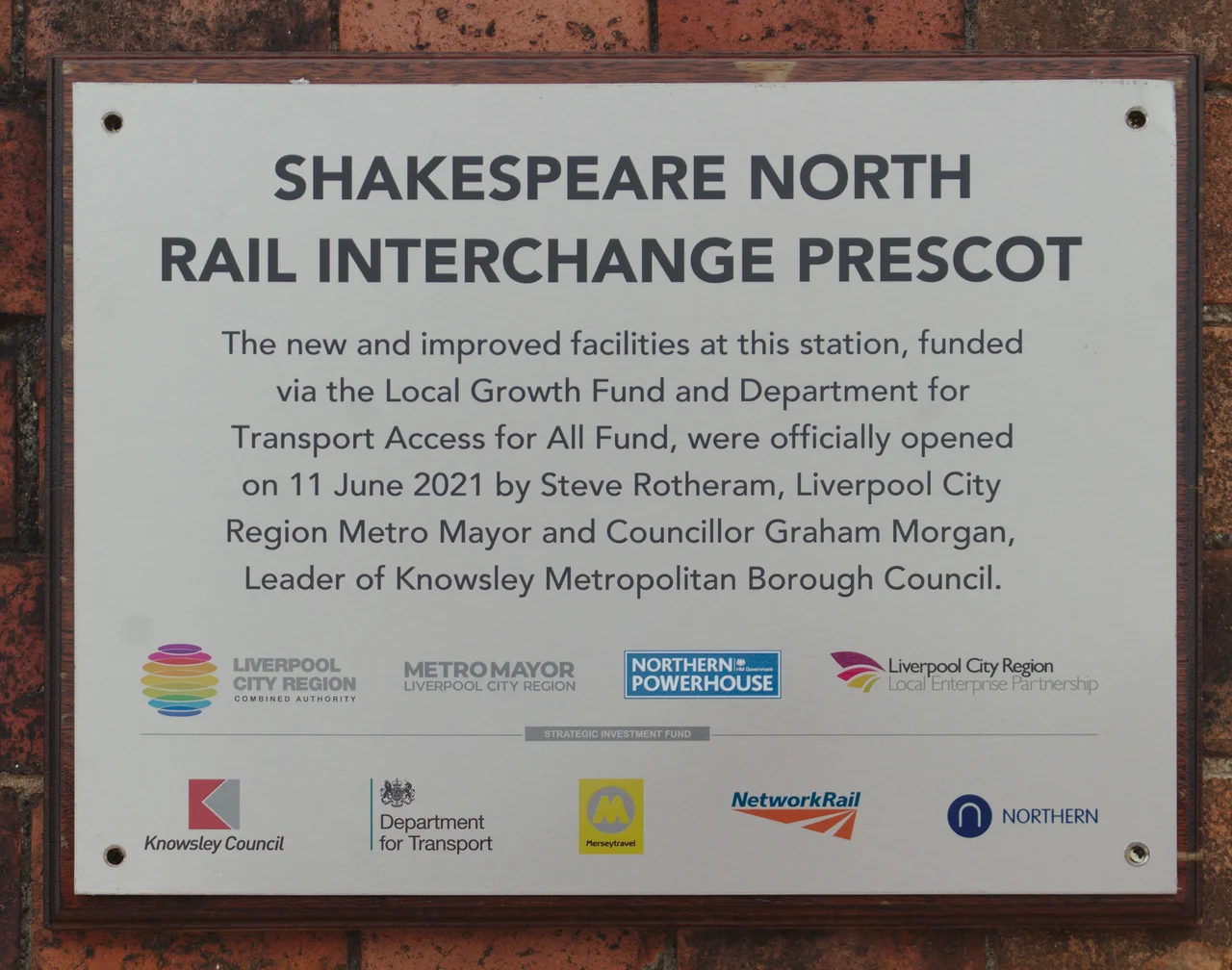

Shakespeare North
Somewhere in the small Merseyside town of Prescot, between roughly 1590 and 1610, stood the only purpose-built Elizabethan theatre outside London. The shareholders of the Globe knew it. The men who acted Shakespeare's plays in the wooden O on the Thames also performed at the Prescot Playhouse, taking their craft into a Lancashire mining town owned by the Earl of Derby. Then the playhouse vanished. No architectural plans of it survived, no detailed accounts, no images, just the bare fact of its existence and a handful of documentary fragments. The Shakespeare North Playhouse, which opened in Prescot on 15 July 2022, sits on the site of the old Mill Street car park, a stone's throw from the parish church. It does not pretend to recreate what was lost. Instead it recreates something else, something equally remarkable and equally extinct, and in doing so it brings four centuries of theatrical history under a single roof.
The Lost Playhouse
Prescot in the late sixteenth century was a market town with strong ties to the household of the Stanleys, Earls of Derby, whose seat at Knowsley Hall lay a few miles to the west. The Stanleys maintained a company of players, Lord Strange's Men, who became among the most important theatrical troupes of the Elizabethan period. Several actors who would later perform at the Globe under the King's Men patent, including some who acted opposite William Shakespeare, are believed to have worked with Lord Strange's Men. The playhouse the Stanleys helped establish at Prescot was extraordinary in its own right: a purpose-built theatre in a provincial market town, at a time when every other dedicated playhouse in England stood in London. It vanished from the records in the early seventeenth century and from the ground at some point afterward. The new venue does not attempt to reconstruct a building no one can describe. Instead it commemorates the audacity of a town that once had what no other provincial town in England had managed: a theatre of its own.
Inigo Jones in Knowsley
Since no plans of the original Prescot playhouse survive, the architects Helm Architecture and Austin-Smith:Lord turned to a different model. The auditorium within the new Shakespeare North Playhouse is modelled on the Cockpit-in-Court theatre at Whitehall Palace, designed by Inigo Jones for King Charles I and completed in 1629. The Cockpit-in-Court was itself the culmination of more than a century of English playhouse evolution, from Henry VIII's original 1530 cockpit through its successive conversions to private royal theatre. Jones's design transformed a venue meant for blood sport into a sophisticated indoor playhouse, a model that would influence Restoration theatre design after the playhouses reopened in 1660. The new Prescot replica is one of only two reconstructions of an Inigo Jones theatre in the United Kingdom; the other is the Sam Wanamaker Playhouse at Shakespeare's Globe in London. A full Frons Scenae, the architectural backdrop of the stage, was installed in 2023, completing the auditorium's connection to its 1629 model.
Funding a Long Wait
The Shakespeare North Trust was founded by the academics Richard Wilson and David Thacker, with Edward Stanley, 19th Earl of Derby, serving as patron. The Stanley connection runs deep: the Earl provided land for the complex, continuing nearly four centuries of family involvement with theatre in Prescot. In 2007 the Trust submitted a £20 million bid to the National Lottery, which was unsuccessful. The project required another nine years to secure planning permission, which Knowsley Metropolitan Borough Council granted in April 2016, and additional funding from the council, the Liverpool City Region Combined Authority, and a £5 million governmental contribution announced in the 2016 Budget. The total cost rose with time. One of the more touching contributions came from Anne Dodd, the widow of the Liverpool-born comedian Ken Dodd, who provided £700,000 through Sir Ken Dodd's foundation to create the outdoor performance garden. Dodd had been one of the most beloved music-hall and stand-up performers in British history; his foundation's investment in Shakespearean theatre placed his memory in unlikely but generous company.
A Town That Got Its Theatre Back
The four-storey complex on Mill Street holds a 470-seat main auditorium, a modern studio space, the outdoor performance garden funded by the Dodd foundation, and an exhibition and visitor centre. Beyond performance, the building serves as an educational centre offering opportunities for what the Trust describes as life-long learning. Prescot itself, a Knowsley town of roughly 11,000 people that grew up around watchmaking and clockmaking before industrial decline, has been transformed by the project. The new Playhouse sits north of Prescot Parish Church, threading the venue into the medieval and Tudor street layout of the town. For Knowsley, one of the smaller and historically poorer metropolitan boroughs in the Liverpool City Region, the Playhouse represents one of the most significant cultural investments in its modern history. The Royal Shakespeare Company, the Globe, and the rebuilt Sam Wanamaker Playhouse now have a northern cousin. The Prescot players whose names are mostly lost, the Stanleys whose theatrical patronage made the original possible, and the Inigo Jones who designed the auditorium that the new building references all converge here. The playhouse opened on 15 July 2022. The town that once had England's only provincial Elizabethan theatre had it again, more than four hundred years later.
From the Air
Located at 53.43°N, 2.81°W in Prescot, in the Metropolitan Borough of Knowsley, Merseyside, immediately east of Liverpool. From the air, Prescot sits on rising ground between the M57 and M62 motorways, with Knowsley Hall (the Earl of Derby's seat) and the Knowsley Safari Park visible to the west. The Playhouse complex is just north of the parish church in the town centre. Recommended viewing altitude 2,000–3,500 ft. The town occupies a transitional landscape between the urban density of Merseyside and the rural Lancashire plain to the east. Nearest airports: Liverpool John Lennon (EGGP) 5 nm south, Manchester (EGCC) 22 nm east, Hawarden (EGNR) 16 nm southwest. Watch for jet traffic on approach to Liverpool's runway 09.
Nearby Stories
- Anson Engine Museum 1.3 km away
- West Kirby 2.9 km away
- Battle of Nantwich 6.2 km away
- Winter Hill Air Disaster 8.3 km away
- Horseshoe Pass 8.8 km away
- Caverswall Castle 12 km away
- Murder of Lindsay Rimer 15 km away
- Piel Castle 50 km away