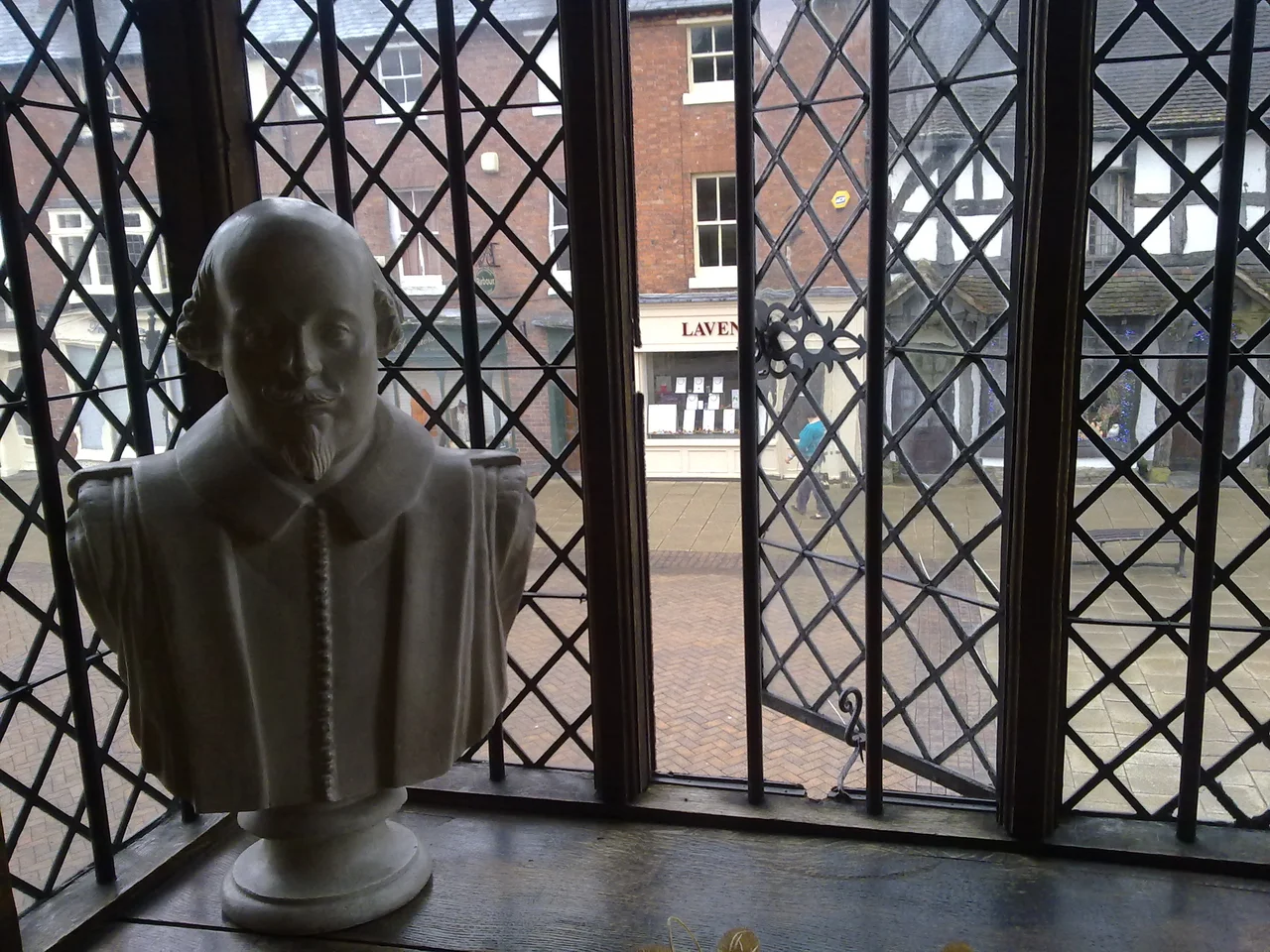

Shakespeare's Birthplace
In 1847, P. T. Barnum -- the American showman who would later invent the modern circus -- tried to buy Shakespeare's Birthplace. He intended to dismantle the half-timbered Henley Street house plank by plank, ship it across the Atlantic, and reassemble it as a sideshow attraction. The plan very nearly succeeded. The shock of nearly losing the house galvanised Britain. A hastily formed Shakespeare Birthday Committee, including Charles Dickens among its donors, raised three thousand pounds in a public subscription and bought the building from under Barnum's nose. The committee evolved into the Shakespeare Birthplace Trust, which still owns it today. What was almost a Barnum exhibit became, instead, what is now the most-visited literary site in the world.
The House John Shakespeare Bought
John Shakespeare was a glover -- a maker of fine leather gloves, a respectable trade in Elizabethan Stratford. He had moved into town from the village of Snitterfield in 1551, and by the early 1550s he was renting a substantial half-timbered house on Henley Street. The earliest hint of his life there is unflattering: in 1552 he was fined for leaving a pile of muck outside his door, suggesting that civic standards in early modern Stratford involved a level of public sanitation he had not quite reached. He prospered nonetheless. He married Mary Arden of the local gentry around 1557. He bought the two freehold houses outright a decade later. And in 1564, in one of the upstairs chambers of the Henley Street house, his son William was born.
How the Building Worked
The plan was straightforward by Tudor standards: a parlour at one end with a fireplace, a hall with an open hearth in the middle, a cross passage, and at the far end a room that likely served as John Shakespeare's workshop -- the place where the gloves were cut and stitched. Three chambers above mirrored the ground floor, reached by a staircase from the hall. Tradition holds that the chamber over the parlour is the birthroom itself. A separate single-bay cottage, now called Joan Hart's Cottage after Shakespeare's sister, was attached to the north-west end. The materials are local: oak frame, wattle-and-daub infill, brick chimneys added later. It would have been a substantial dwelling for a successful tradesman -- not grand, but not modest either.
Pilgrims Begin to Arrive
Visitors started coming in the late seventeenth century, scratching their names into the windowpanes -- a kind of early autograph book that has survived in places. By the eighteenth century, the cult of Shakespeare had grown into what historians now call Bardolatry, and the house had become a destination. David Garrick's 1769 Jubilee in Stratford raised the temperature further. By the nineteenth century, the Birthplace was a tourist economy unto itself. The interior had been carved over with names of the famous and the obscure: Walter Scott, Thomas Carlyle, Lord Tennyson. The walls were eventually painted over to stop the vandalism, but signatures remain on the glass. Visitors leaned out the windows to scratch them, leaving signatures impossible to remove without breaking the panes.
Saved from Barnum
The 1847 sale notice that prompted Barnum's offer also produced the response that saved the house. The Shakespeare Birthday Committee was formed almost overnight. Donations arrived from across Britain and beyond -- writers, politicians, schoolchildren, working people who had never been to Stratford. Dickens lent his celebrity to the appeal. The three thousand pounds was raised, the house was purchased, and the committee evolved by Act of Parliament into the Shakespeare Birthplace Trust. By the late nineteenth century, Edward Gibbs renovated the building to look more like a Tudor farmhouse, removing later accretions and restoring exposed timber. The 1951 listing as a Grade I building made formal what had long been understood: that this was one of the most important domestic buildings in England, not because of what happened in it architecturally, but because of who slept upstairs.
The Most Visited Literary Site on Earth
Roughly seven hundred thousand people pass through Shakespeare's Birthplace every year in normal times -- pilgrims of a kind, from Tokyo and Toronto and Tehran, who pay their entrance fee and queue up the narrow stairs to see the room. They look at the bed and the cradle and the small leaded panes. They take photographs of the carved oak. Some are scholars. Most are not. They come because four hundred years ago a glover's son was born in this room, and somehow the things he wrote afterwards rearranged the English language so completely that the room itself became sacred. The Shakespeare Centre next door, completed in 1964, handles the crush of modern visitors. The house behind it stays small and quiet, the way Tudor houses do, with low ceilings and wide oak floors that creak under every footstep.
From the Air
Located at 52.1939N, 1.708W on Henley Street in central Stratford-upon-Avon, Warwickshire. The Birthplace is a half-timbered building set back slightly from the street, identifiable by surrounding open ground and the modern Shakespeare Centre to its east. Holy Trinity Church spire is visible a half-mile to the south. Nearest airports: EGBB (Birmingham, 22nm NW), EGBE (Coventry, 18nm N). Best viewed at 1,500-2,500 ft AGL.
Nearby Stories
- RAF Defford 3.6 km away
- Great Witcombe Roman Villa 4.1 km away
- Coventry War Memorial 4.5 km away
- Hagley Hall 4.6 km away
- Battle of Naseby 5.4 km away
- Silverstone Circuit 5.9 km away
- Waddesdon Manor 8.8 km away
- Woodstock Palace 15 km away