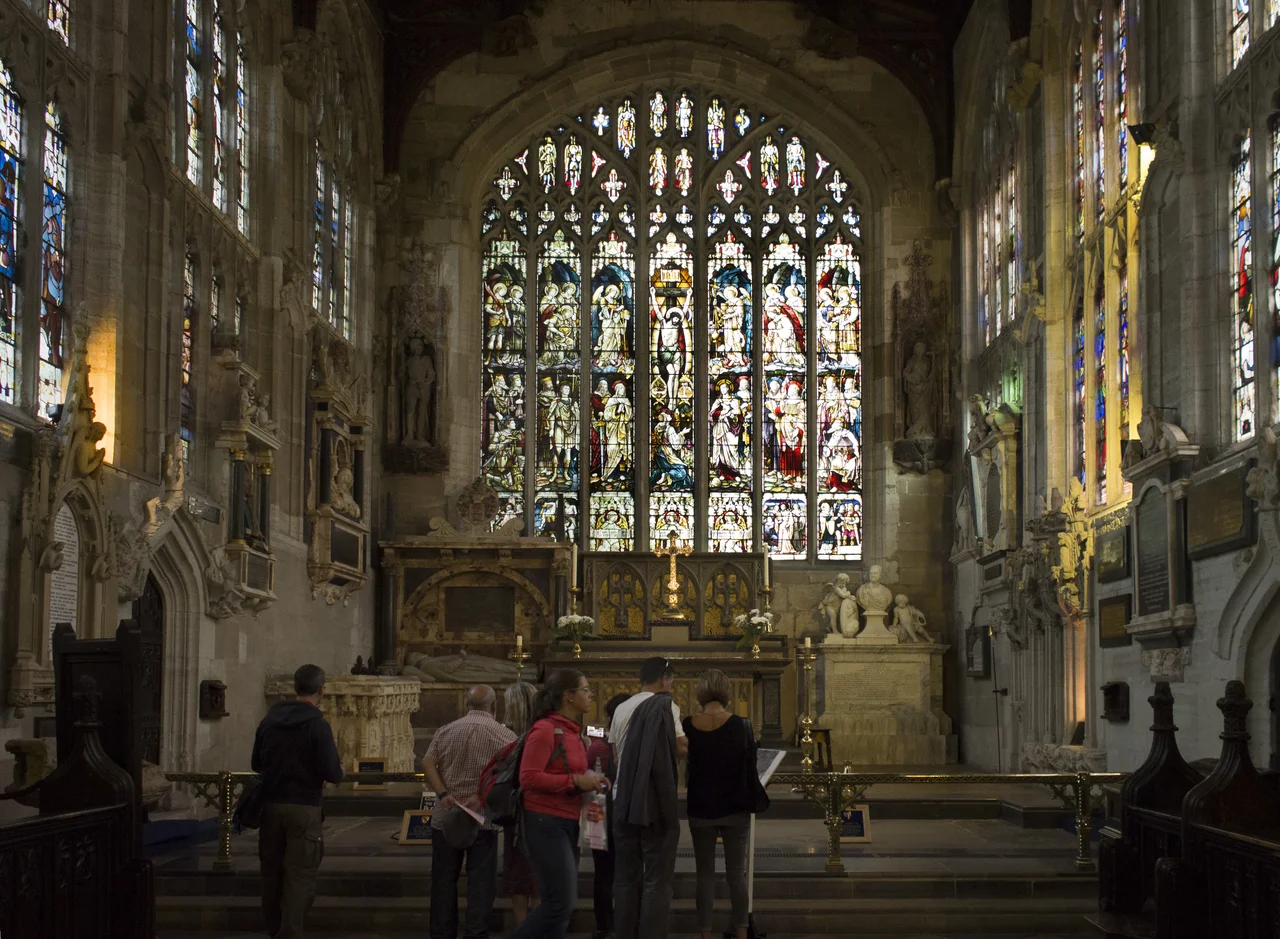

Shakespeare's Funerary Monument
On the north wall of the chancel at Holy Trinity Church, a few feet from where William Shakespeare is buried, a coloured limestone bust looks out over the pews. The eyes are hazel, the hair and beard auburn, the doublet originally scarlet beneath a black scholar's gown. The quill in his right hand is a real feather, and over the centuries the quill has been stolen so many times that the parish stopped bothering to keep it secured. The bust was carved sometime between Shakespeare's burial in 1616 and 1623, when Ben Jonson referred to it in print. Whoever modelled it knew Shakespeare, or knew people who did. It is the closest thing the world has to a verified portrait of the man who reshaped the English language.
A Funerary Bust, Built to Endure
The figure is what art historians call a demi-figure -- a half-length effigy of the deceased, set into an architectural niche flanked by columns. This was a fashionable form for early-to-mid seventeenth-century memorials, used most often for clergy, academics, and others whose profession involved books. The columns supporting the entablature are black polished marble. The capitals and bases are gilded sandstone. Two putti -- chubby cherubs -- flank a skull above the bust, a memento mori reminder that even the man who wrote about death so vividly had now met it. The effigy and its cushion are carved from a single block of bluish Cotswold limestone. The inlaid panels behind are black touchstone. The whole structure was designed to last centuries. It has.
Who Carved It
Tradition attributes the monument to the sculptor Gerard Johnson, son of a Dutch immigrant stoneworker. His workshop, near the Globe Theatre in London, would have known Shakespeare in life. But the historian Lena Cowen Orlin has recently argued the work may actually be by Gerard's brother Nicholas Johnson, and -- more provocatively -- that Shakespeare himself may have commissioned it during his lifetime. If she is right, the bust was modelled from life, by a sculptor who looked the man in the face and shaped the limestone to match. The argument has reopened a question scholars thought long settled. Sir Nikolaus Pevsner, the great architectural historian, dismissed the figure unkindly as 'a self-satisfied schoolmaster'. The Guardian, reporting Orlin's research in 2021, ran a headline calling the effigy a 'self-satisfied pork butcher'. Neither verdict is flattering, but both miss the point -- whoever this is, it is the only honest representation of Shakespeare's face we possess.
The Restoration Wars
In 1748 the monument needed repair. The architraves had cracked. The paint had faded. The parish priest, Joseph Greene -- who also ran the local grammar school -- needed money. He hit on a startling idea: he persuaded the actor John Ward's travelling company to perform Othello in the Stratford Town Hall on 9 September 1746, with all proceeds going to fund the restoration. It is the first recorded performance of a Shakespeare play in Shakespeare's own town. The 1748-49 restoration replaced the alabaster architraves with white marble, repainted the figure in its original colours, and re-gilded what had been lost. Greene, in his accounts, insisted that nothing had been altered beyond what was necessary -- a careful claim, repeatedly tested by sceptics ever since.
Painted White, Then Painted Back
In 1793 the Shakespeare scholar Edmond Malone visited Holy Trinity and was appalled. The bust was painted. Painted statuary, in the neoclassical taste of Malone's era, was vulgar -- the Romans, everyone now wrongly believed, had carved in pure white marble. Malone persuaded the vicar to whitewash the entire monument. The paint went on. For sixty-eight years Shakespeare looked out from the chancel wall in austere ghostly white. Then in 1861, sense returned: the whitewash was carefully removed, the original colours recovered from beneath, and the figure restored to something close to its 1623 appearance. In 1973 intruders broke in, hauled the figure from its niche, and tried to chip out the inscription -- they had read rumours that Shakespeare's lost manuscripts were hidden inside. They found nothing. The figure suffered only what the scholar Sam Schoenbaum described as 'very slight damage'.
What the Inscription Says
Beneath the figure, an epitaph in Latin compares Shakespeare to three of the ancient world's greatest figures: Nestor the wise king, Socrates the philosopher, and Virgil the poet -- whose surname, Maro, completes the line. The second Latin line reads: 'Earth covers, people mourn, Olympus holds.' Olympus, the home of the gods. Beneath that, an English poem in seventeenth-century cadence invites the passer-by to pause and pay tribute -- a poem so cryptic that Stanley Wells, one of Shakespeare's most distinguished biographers, admitted he could not entirely make sense of the last stanza. A separate inscription gives the bare facts: died 23 April 1616, in his fifty-third year. Just below the chancel floor, beneath a flagstone carved with the famous curse -- 'Good friend for Jesus' sake forbear / To dig the dust enclosed here' -- the man himself lies. He has not moved in four hundred years.
From the Air
Located at 52.18666N, 1.7075W inside Holy Trinity Church on the south end of central Stratford-upon-Avon, on the west bank of the River Avon. The church's tall spire is one of the most distinctive landmarks in the town and rises clear of the surrounding trees and rooftops. The monument itself is inside, on the north wall of the chancel. Nearest airports: EGBB (Birmingham, 22nm NW), EGBE (Coventry, 18nm N). Best viewed at 1,500-2,500 ft AGL using the spire as your fix.
Nearby Stories
- RAF Defford 3.6 km away
- Great Witcombe Roman Villa 4.1 km away
- Coventry War Memorial 4.5 km away
- Hagley Hall 4.6 km away
- Battle of Naseby 5.4 km away
- Silverstone Circuit 5.9 km away
- Waddesdon Manor 8.8 km away
- Woodstock Palace 15 km away