
Shannon Hydroelectric Scheme
In 1925, the Irish Free State was three years old, broke, and just out of a civil war. It had no national power grid. Most of its towns burned oil lamps or candles. The Dail then voted to spend 5.2 million pounds - roughly one-fifth of the entire state budget - on a single hydroelectric project on the River Shannon. A young engineer named Thomas McLaughlin, working for the German firm Siemens-Schuckert, had convinced Patrick McGilligan, Minister for Industry and Commerce, that one dam could light the country. McGilligan convinced the cabinet. The cabinet convinced the experts from Norway and Switzerland. Four years later, the lights came on.
An Improbable Bet
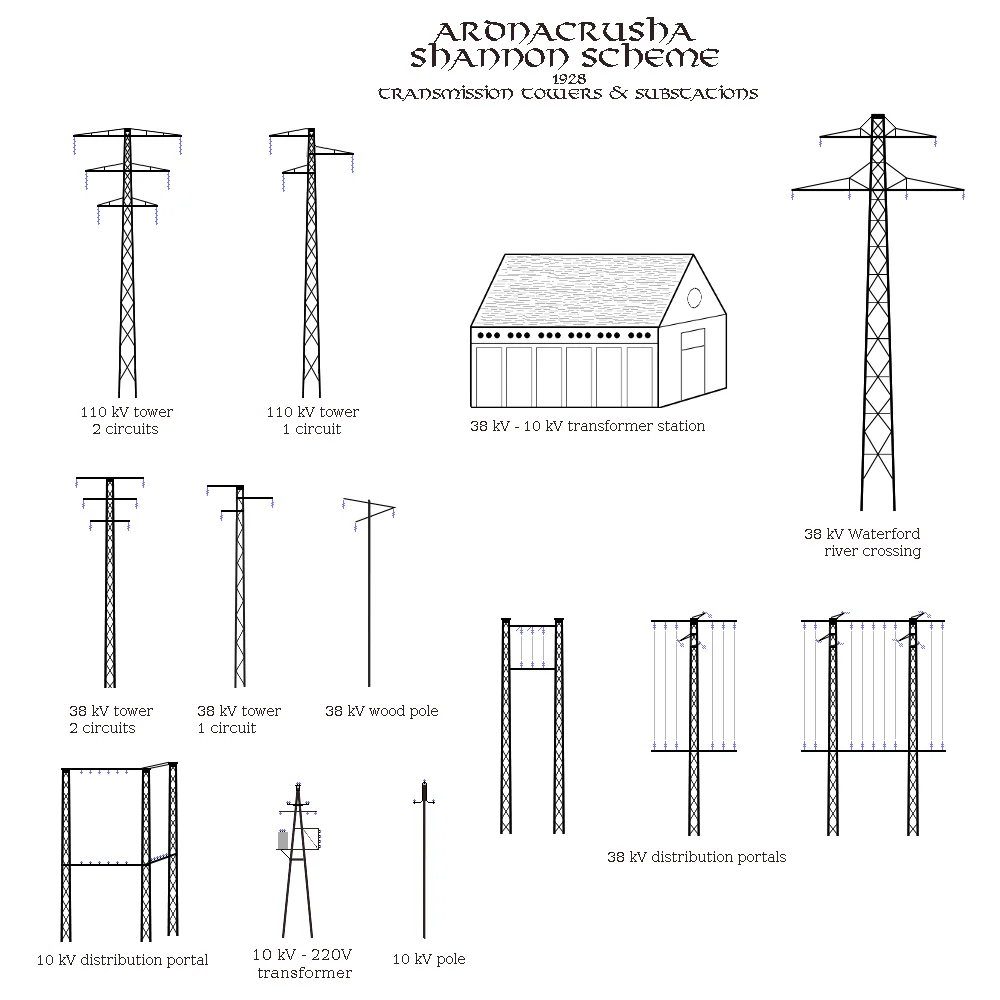
Sir Robert Kane had first proposed harnessing the Shannon's fall between Lough Derg and Limerick in 1844. The idea kept resurfacing - Frazer's Scheme of 1901, inspired by Tesla at Niagara; Dick's variant of 1902; the British Board of Trade committee of 1918. None of them got built. McLaughlin's version was more ambitious than all of them combined. He proposed to exploit the full height difference between Lough Allen and the sea, divert most of the Shannon's flow through a purpose-built head-race canal, and build a national power grid from scratch to distribute the result.
The London Financial Times grasped what was at stake. The young state, the paper wrote, had "thrown on their shoulders the not easy task of breaking what is in reality an enormous inferiority complex, and the Shannon Scheme is one - and probably the most vital - of their methods of doing it." Critics in Dublin wanted smaller, distributed plants. The Norwegian and Swiss consultants sided with McLaughlin. The Shannon Electricity Act passed in April 1925.
Building Ardnacrusha
Siemens broke ground in 1925. Three and a half years was the contract; penalty clauses applied. About 150 skilled German workers and engineers came over from Germany; the rest of the labor was Irish - up to 5,200 men at peak, drawn from the surrounding counties. A construction camp went up at Ardnacrusha with quarters for 750 and a dining room seating 600. Photographs from the period show Bavarian foremen in suits standing alongside Clare laborers in caps and waistcoats, both squinting at the same blueprint.
The work was not idyllic. Unskilled Irish labor was paid only agricultural wages while skilled Germans earned far more, and strikes broke out repeatedly. The Dail debated the conditions. Costs ran over by 150,000 pounds. But the head-race canal got dug - a corridor 12.6 kilometers long and 90 meters wide, diverting the Shannon to fall 28.5 meters through three vertical Francis turbines. When Ardnacrusha was commissioned in 1929 it was, briefly, the largest hydroelectric station in the world. The Hoover Dam, begun a year later, would soon eclipse it.
Lighting a Country
Ardnacrusha's 85 megawatts were more than the entire public electricity supply of Ireland at the time. Within three years demand had grown so much that a second stage went in - a fourth turbine, this one a 30-megawatt Kaplan unit with seven blades, commissioned in 1934. The plant could now produce 75 megawatts, and by 1937 the Poulaphouca scheme on the Liffey added another 35.
For decades afterward, Ireland measured itself by the wires. The Rural Electrification Scheme of the 1940s and 1950s carried Ardnacrusha's current to farmhouses across the country - one of the great social transformations of twentieth-century Ireland. The first turn of a lightbulb in a remote cottage was a literal event in many people's lives. The plant continues to operate in the twenty-first century, though it now produces only two to three percent of Electricity Supply Board output. In 2002 the Institute of Electrical and Electronics Engineers, with the American Society of Civil Engineers, recognised the scheme as an Engineering Milestone of the twentieth century.
What the River Lost
The Shannon between Parteen weir and Limerick - the natural channel bypassed by the head-race canal - used to be world-famous for salmon fishing. The Falls of Doonass at Castleconnell drew anglers from across Europe. The diversion changed everything. There was no fish ladder at first; the salmon could not climb past the dam. Even after a pass was added, the reduced flow encouraged returning fish into the head-race canal or the Mulkear River instead of their old spawning grounds. Stocks dropped by about ninety percent and never recovered.
The ESB is required by law to release ten cubic meters per second down the natural channel - what would have been a dry-summer flow before the dam. The maximum capacity through Ardnacrusha is 400 cubic meters per second, forty times that minimum. In wet winters when Lough Derg overflows, surplus water briefly thunders back through Castleconnell, and the Falls of Doonass are restored to something like their former glory. In some years that never happens. Trees and bushes grow now in what used to be salmon pools. Eels - critically endangered - get past the dam through a trap-and-transport program. The river the scheme replaced has no equivalent today.
From the Air
Ardnacrusha sits at 52.71 N, 8.61 W, in County Clare about 7 km north of Limerick city. Shannon Airport (EINN) is 25 km west; Cork (EICK) is roughly 110 km south. Recommended viewing altitude is 2,000 to 3,500 feet AGL. The dam is recognisable as a concrete intake structure on the broad headrace, with three penstocks dropping to the powerhouse below. Look for the long straight cut of the head-race canal running roughly north-south between Parteen weir at Lough Derg and the powerhouse - it is unmistakable against the meandering natural Shannon channel that bypasses it through Castleconnell to the east. The double lock at Ardnacrusha is the navigation route for boats; the original Shannon channel is dry or near-dry in most weather. Cloud bases over this part of the Shannon basin commonly sit below 2,500 feet.
Nearby Stories
- Cloughjordan 4.8 km away
- Charleville 5.6 km away
- Kilfenora Cathedral 10 km away
- Shanbally Castle 10 km away
- Abbeyfeale 11 km away
- Holy Cross Abbey 15 km away
- 2003 Derrybrien Landslide 20 km away
- Kilrush 23 km away