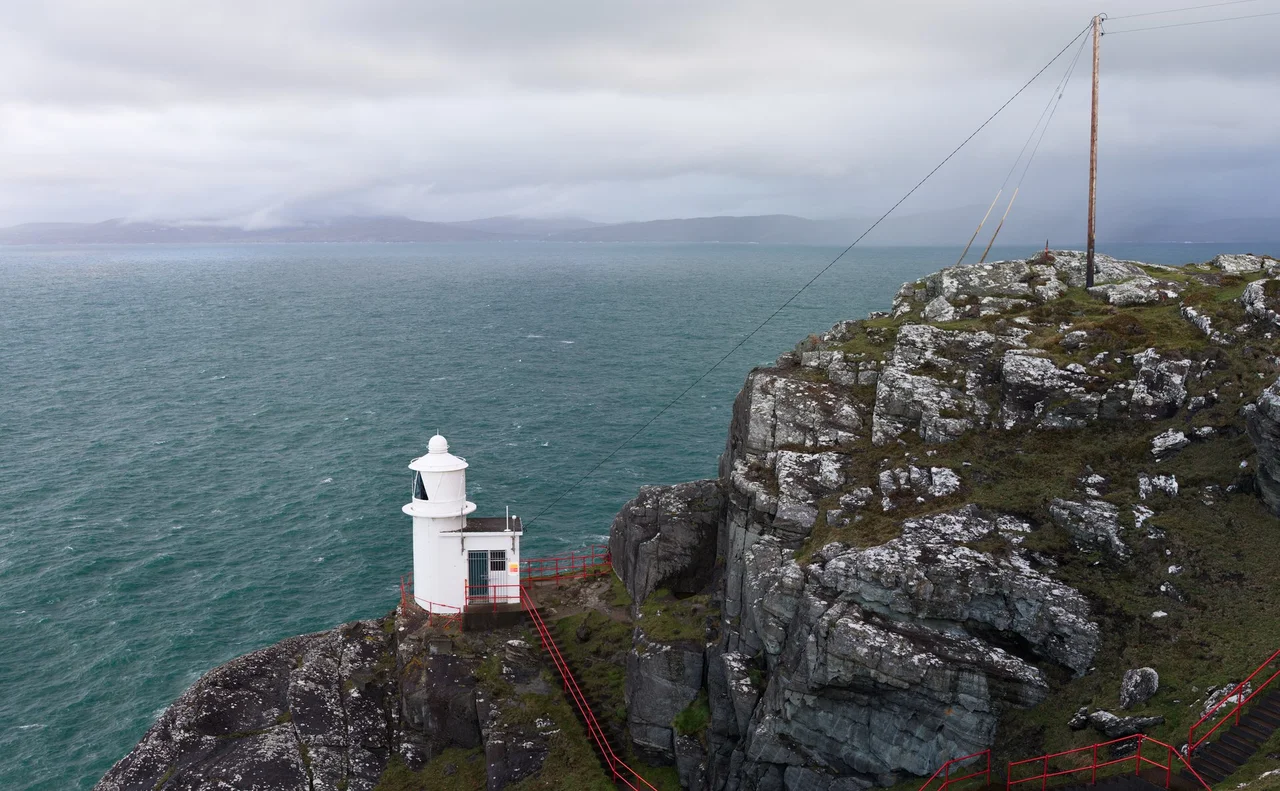

Sheep's Head Lighthouse
The lighthouse at the western tip of Sheep's Head is not very large. It is a squat white round tower on a square white plinth, set into the heather and outcrop of the headland with the Atlantic working away at the cliff below it. From a distance it looks like the kind of small modern lighthouse you would assume had always been there. It hasn't. It is younger than the moon landings - built in 1968 for a single specific purpose: to guide the largest oil tankers in the world into Bantry Bay.
Built for Giants
In the late 1960s, the Gulf Oil corporation chose Whiddy Island, deep in Bantry Bay, as the site for an oil terminal capable of receiving very large crude carriers. The supertankers of the era could not safely make the approach with the existing pattern of lights. Two new lighthouses were ordered: a major upgrade at Mizen Head on the next peninsula south, and a new tower at the previously unlit Sheep's Head. The Commissioners of Irish Lights commissioned both. The Sheep's Head light was built by J. Dennehy of Castletownbere and James Bradfield of Cork. The first tanker to use the new aid - Universe Ireland, then the largest ship afloat at over 312,000 tons - made her approach from Kuwait on 29 October 1968. The lighthouse was barely cold from construction.
Two Hundred and Fifty Helicopter Trips
The site is hard to reach. The end of the Sheep's Head peninsula is a narrow ridge of rock falling steeply to the sea on three sides, with no road, no track that could carry a heavy lorry, and no easy approach by sea. The builders solved the problem by flying everything in. Around two hundred and fifty helicopter trips were required to deliver the lens, the prefabricated tower sections, the diesel backup generator, and the materials for the foundation work. The electricity supply was strung in by the ESB on nineteen wooden poles marching along the ridge - they still mark the line of the modern Lighthouse Loop walking path - at the same time the Mizen Head signal station up the coast was being electrified. The light first burned in 1968. It has been burning since.
What the Light Does
The design borrows heavily from the Achillbeg lighthouse off the Mayo coast: a tall white round tower on a square service building, both painted to be visible against the heather and rock. In its white sector the light has been measured at fifty-one thousand candles - enough to be seen, on a clear night, by the navigation officer of a tanker still well out to sea. The character of the light is three flashes every fifteen seconds. There are backup lights and a backup diesel generator, because a navigation aid that fails when a quarter-million-ton tanker is on approach is worse than no aid at all. Like nearly every active Irish lighthouse, Sheep's Head is unstaffed - the keepers withdrew with the automation programme of the late twentieth century, and the light now runs itself, monitored remotely from the Commissioners of Irish Lights centre in Dun Laoghaire.
The Walk Out
Visitors reach the lighthouse on foot. The Lighthouse Loop runs out from the carpark at Tooreen along the spine of the headland, following the line of the old ESB poles, with the sea on both sides. The walk takes about two hours return for those who linger at the cliff edges. On a clear day you can see the Mizen Peninsula to the south, the Beara to the north, and the open Atlantic running away to the west. The wind is honest about being there. Where the path reaches the lighthouse you can climb the steps and look out from the gallery - one of the few Irish lighthouses where the public can come right up to the tower and the door. The Whiddy Island oil terminal that justified the building of the light has had a complicated history since 1968; the lighthouse keeps marking the channel anyway.
From the Air
Sheep's Head Lighthouse at 51.542 N, 9.849 W, at the western tip of the Sheep's Head Peninsula. Cork Airport (EICK) is approximately 88 nm east; Kerry Airport (EIKY) is 46 nm north. Approach low along the spine of the peninsula from the east for the most dramatic view. The tower is small but very white against the heather. Recommended viewing altitude 800-1,500 ft AGL. Strong winds and turbulence are common at the tip - expect significant updrafts off the cliff face.
Nearby Stories
- Iveragh Peninsula 4.6 km away
- Ballydehob 5 km away
- Battle of Callann 5.2 km away
- HMHS Llandovery Castle 8.9 km away
- Inishvickillane 21 km away
- SM U-68 41 km away
- RMS Lusitania 66 km away
- Sao Miguel 1909 km away