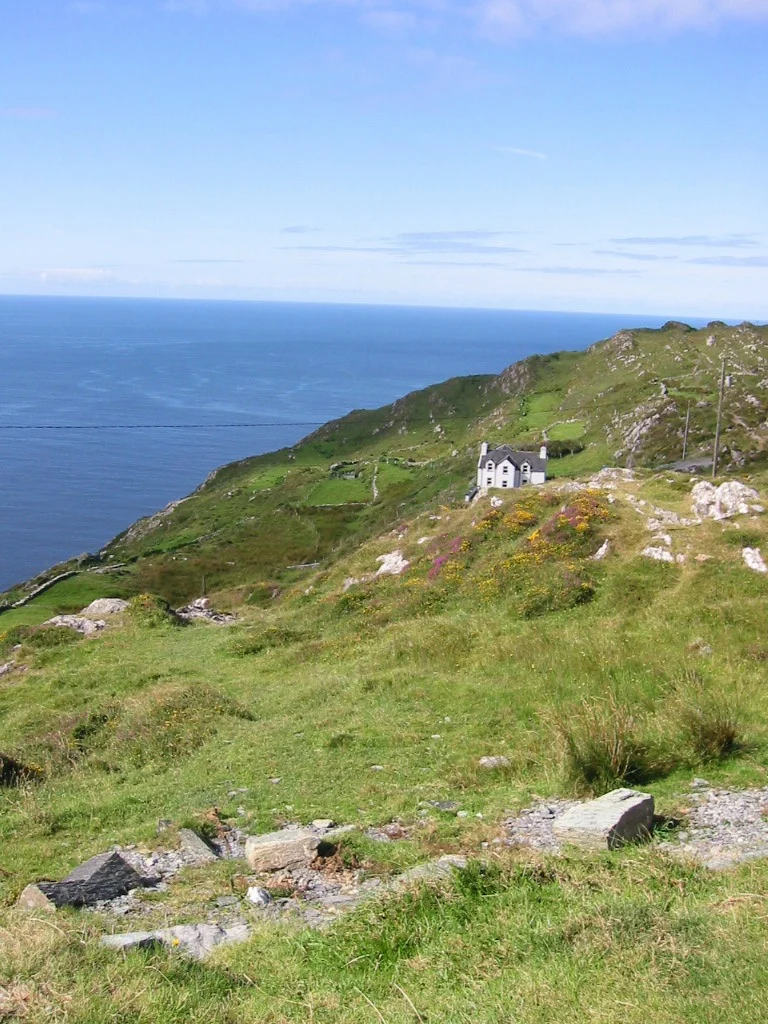

Sheep's Head
Three peninsulas reach west from County Cork into the Atlantic like fingers spread on a table: Mizen at the south, Beara at the north, and Sheep's Head, narrow and low, running between them. It is the smallest of the three by some distance - in places only a couple of miles wide between Bantry Bay and Dunmanus Bay - and from the spine of its ridge you can stand and see saltwater on either hand at the same moment. In Irish it is also called Muntervary. The English name has the long-suffering simplicity that crops up wherever sheep have outnumbered people for a few centuries.
Three Walkers and a Trail
The Sheep's Head Way runs eighty-eight kilometres around the peninsula from Bantry to the headland and back, divided into eight stages, each representing roughly half a day on foot. It opened in stages from the late 1990s and grew out of an unusual collaboration: Tom Whitty, an American who had settled locally, the farmer James O'Mahony, and Jim Leonard, who together negotiated rights of way across small fields and old boreens that had not been walked in any organised way for generations. The trail follows tracks, lanes, and stretches of open hillside, with twenty looped walks added over the years and an eastward extension all the way to Gougane Barra, where it meets the Beara-Breifne Way. The Lighthouse Loop carries on to the active 1968 lighthouse at the very tip of the peninsula.
Older Than the Path
The fields the walkers cross are full of older marks. Around Dunbeacon at the eastern end stands a Bronze Age stone circle, and the surrounding parishes carry a quiet density of ringforts, holy wells, fulachta fiadh - the prehistoric cooking pits that mark wherever Iron Age communities settled long enough to eat - and the souterrains and standing stones of millennia of unbroken use. The Tower House at Rossmore is medieval and probably O'Mahony. The Bardic School at Dromnea, recorded as still functioning after 1200 AD, is one of the last expressions of an indigenous Gaelic learning culture that the colonising centuries would erase. The holy well there is called tobar na nduanairidhe, the well of the poets. The land does not advertise its history. It simply has it.
Three Villages, One Cheese
The peninsula carries three small settlements along its road. Durrus, six miles from Bantry, has been one of the official staging points on the Wild Atlantic Way driving route since the route was promoted in 2014, and is home to Durrus Cheese - a washed-rind farmhouse cheese first made by Jeffa Gill in 1979 that helped open the door for a generation of Irish artisan cheesemakers. Twelve miles out you reach Ahakista, with its tiny pier and its memorial to the victims of the Air India Flight 182 bombing of 1985, many of whom were recovered offshore. Sixteen miles out is Kilcrohane, the last village before the road narrows for the final climb to the lighthouse. The buildings are low, the gardens crowded with fuchsia. The Atlantic light off the bay does what Atlantic light always does to small Irish villages: it makes them look momentary and ancient at the same time.
Rare Plants and a Quiet Award
The Sheep's Head heathland holds two plants that survive in only a handful of places elsewhere in Ireland: Viola lactea, the pale dog violet, and Tuberaria guttata, the spotted rock-rose. Choughs - those acrobatic red-billed coastal crows - nest on the cliffs along with fulmars and the occasional peregrine. The peninsula carries a Special Area of Conservation designation for the choughs and the peregrines. In 2009 the peninsula was named a European Destination of Excellence for Sustainable Tourism, and in 2015 took a Silver at the Irish Responsible Tourism Awards and a longlisting in the World Responsible Tourism Awards. The recognitions point to something the local cooperative had been trying to do for two decades: keep tourism from breaking the place it was meant to celebrate.
Bone Clocks and the Drowned Novelist
Sheep's Head turns up in David Mitchell's 2014 novel The Bone Clocks, where the final section is set on the headland; Mitchell named one of his recurring characters, Mo Muntervary, after the Irish name for the place. Of more sombre note, the novelist J. G. Farrell - born in Liverpool of Irish descent and the winner of the 1973 Booker Prize for The Siege of Krishnapur - retired to Sheep's Head in 1979 to write in quiet. Two months after moving in, while fishing from the rocks at Kilcrohane, he was swept off into the sea in a sudden squall and drowned. He was forty-four. The local people still point out the spot. The Atlantic that draws the walkers and the artists is also the Atlantic that takes them, sometimes, without warning.
From the Air
Sheep's Head Peninsula extends west from Bantry Bay; the headland is at approximately 51.540 N, 9.851 W. The peninsula is narrow - in places under two miles between Bantry Bay (north) and Dunmanus Bay (south). Cork Airport (EICK) is approximately 85 nm east; Kerry Airport (EIKY) is 45 nm north. Approach low along the spine from Bantry for the dramatic dual-bay view, then circle the lighthouse at the western tip. Recommended viewing altitude 1,000-2,500 ft AGL. Strong Atlantic winds funnel through the bays - expect turbulence near the cliff edges.
Nearby Stories
- Iveragh Peninsula 4.6 km away
- Ballydehob 5 km away
- Battle of Callann 5.2 km away
- HMHS Llandovery Castle 8.9 km away
- Inishvickillane 21 km away
- SM U-68 41 km away
- RMS Lusitania 66 km away
- Sao Miguel 1909 km away