
Sheffield Cathedral
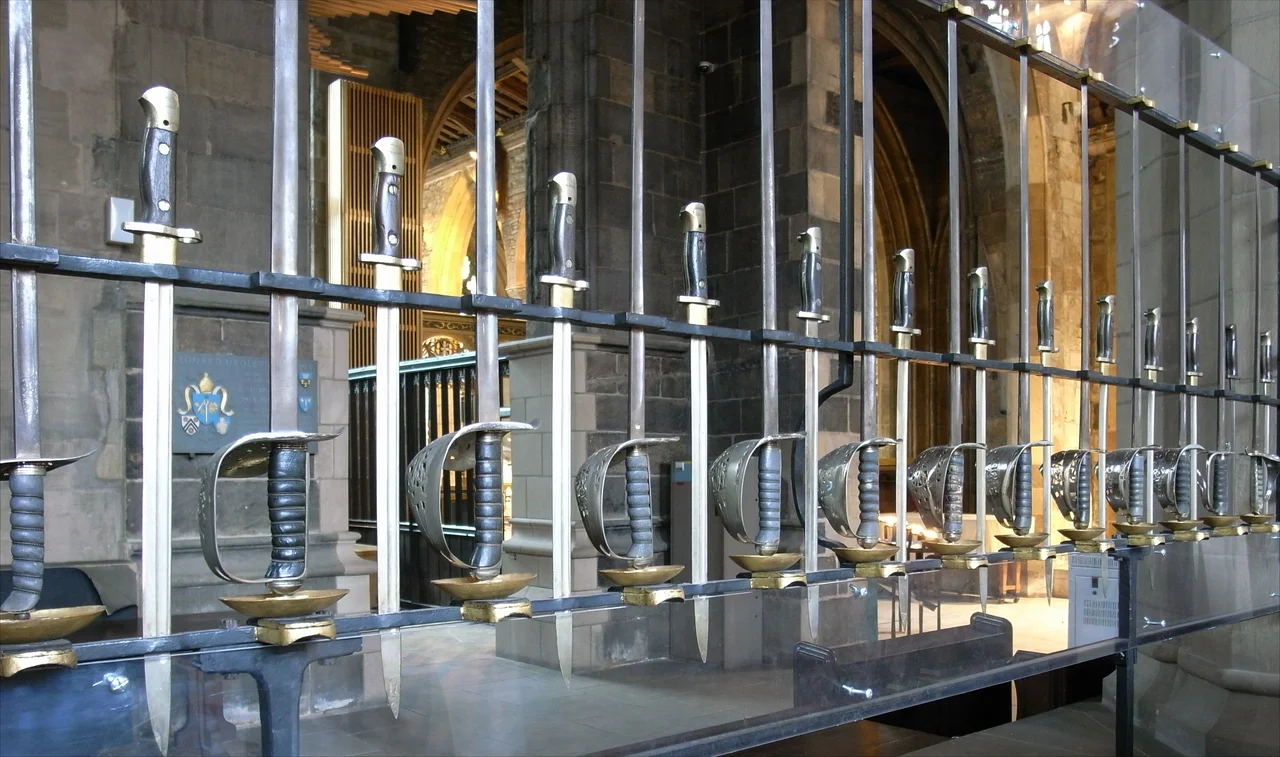
Walk into the chapel of St George at Sheffield Cathedral and look up at the screen. It is not made of carved oak or wrought iron. It is made of bayonets and swords - the actual fighting weapons of the first battalions of the York and Lancaster Regiment, arranged in a tight metal grid as a memorial to the men of Sheffield who carried them. The swords point upwards, signifying readiness to serve; the bayonets point downwards, representing the laying aside of weapons. Beneath, in the crypt chapel of All Saints, light filters through Christopher Webb's Te Deum window. Above, the gilded angels of a 16th-century hammerbeam roof spread their wings - those particular outstretched wings being a modern gift from 1960s craftsman George Bailey. Sheffield Cathedral is medieval, Victorian, modern and unfinished, all at once. It is exactly the building you would expect from a steel city that did not know it was becoming a cathedral city until 1914.
From Lovetot to Cathedral
The site has been holy ground for longer than the city it now serves. The shaft of the 9th-century Sheffield Cross, now in the British Museum, is believed to have stood here before any church was built. A parish church was almost certainly raised in the 12th century by William de Lovetot, the Norman lord of Hallamshire, at the opposite end of his small town to Sheffield Castle. The church burned in 1266 during the Second Barons' War against Henry III. A replacement was finished in 1280, then mostly demolished and rebuilt around 1430 in a cruciform plan that still defines the building's heart. The Shrewsbury Chapel was added in the 16th century. The vestry chapel - now St Katherine's - in 1777. The nave walls were rebuilt in the 1790s, the transepts added in 1880 by Flockton & Gibbs. When the Diocese of Sheffield was created in 1914, this old parish church was elevated, mostly because nothing grander existed.
The Cathedral That Was Going to Be Different
Sir Charles Nicholson's original 1900s design called for a radical rotation of the church's axis by 90 degrees - a dramatic re-orientation that would have remade the cathedral entirely. The World Wars came. Funds collapsed. Materials were rationed. Nicholson's vision was scaled back to whatever could be paid for and built between the bombings. The bulk of the changes ended up affecting the northern half of the building, with new chapels and the lantern tower added piece by piece through the 20th century. The result is an awkward plan - the cathedral does not quite fit the shape any architect would have chosen for it - but a magnificent south elevation, and a building that is honestly itself. The main west entrance was added in 1966 when the church was rededicated. The lantern tower's clear panes were replaced in 1998-99 by an abstract design by glass artist Amber Hiscott.
Fire and Arson
Twice the cathedral has burned. On 17 July 1979, a fire began inside the belfry in the early hours of the morning, spreading down to the ground floor and up to the clockroom. At least 35 firefighters from Division Street station fought to save the spire, narrowly winning. The 1970 bells survived. The Ringing Room did not - and with it burned every record of the cathedral's bellringers stretching back six hundred years. Two anonymous phone calls to the Sheffield Star the previous evening had warned of the attack. The cause was confirmed as arson; no perpetrator was ever found. On 14 May 2020, in the middle of the COVID pandemic, a second fire broke out, this time in the section used by the Cathedral Archer Project - a homelessness charity that, before the fire, had been serving around 180 free meals a day. A 40-year-old woman was arrested and charged with arson. Donations poured in. The Archer Project was working again, from temporary premises, within weeks.
What the Walls Still Show
The east end is the oldest, with stones from the 13th-century church still visible in the sanctuary wall. The 15th-century cruciform church once had lofts and a rood chapel - Elizabeth I ordered them removed in the 1560s as part of the Protestant settlement, and you can still see the scars on the walls where they were torn out. During restoration work in 2013, the cathedral discovered something stranger: many of the Shrewsbury family coffins were missing from the crypt, despite generations of tombs ostensibly resting there. The chancel roof's gilded angels still look down. The Sheffield Supertram now stops at Cathedral, opened in 1995 and served by all four lines - bringing each day a flow of commuters, shoppers and visitors past a parish church that was Norman, then medieval, then Victorian, then a cathedral, and is still, somehow, a parish church too.
From the Air
Coordinates 53.38315°N, 1.46928°W. Best viewed from 1,500-2,500 feet AGL. Sheffield Cathedral sits on Church Street in the city centre, at the head of Fargate, surrounded by the densely packed commercial heart of Sheffield. Nearby airports: Sheffield/Doncaster (EGCN) 19 nm east, Manchester (EGCC) 34 nm west. The cathedral's spire and lantern tower are visible against the city skyline; the modern abstract glass of the lantern is best caught when lit from inside at dusk. The Sheffield Supertram Cathedral stop is directly in front of the building.
Nearby Stories
- Rochdale Pioneers Museum 3.4 km away
- Adlington Hall 4 km away
- National Coal Mining Museum for England 4.2 km away
- Sneyd Colliery Disaster 6.6 km away
- Southwell Minster 6.8 km away
- Belper North Mill 9 km away
- Selby Rail Crash 13 km away
- RAF Finningley 15 km away