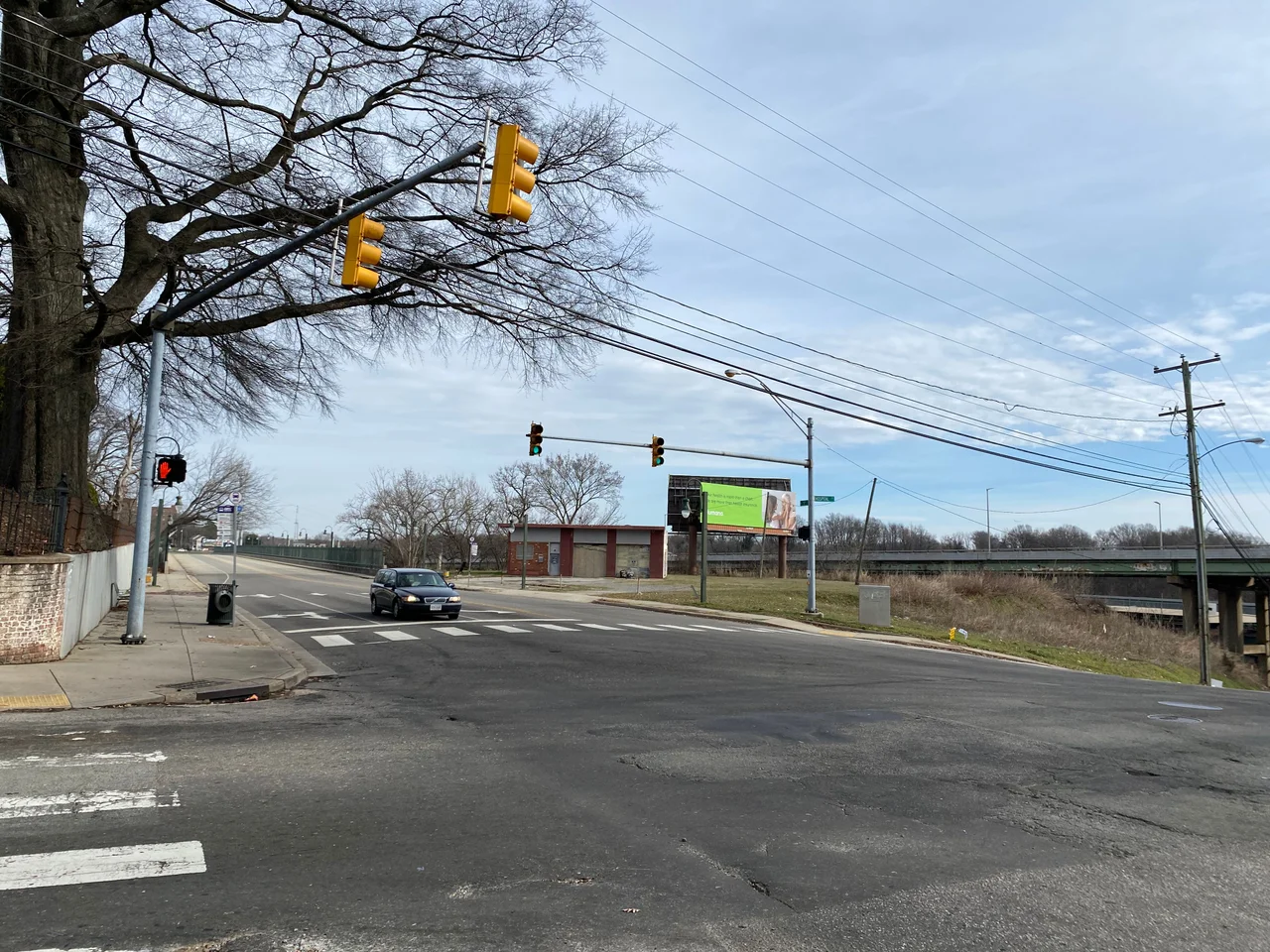

Shockoe Hill African Burying Ground
An old Sunoco station sits on part of it. A billboard advertises VCU Health. Four-lane Interstate 64 cuts across the rest. There is nothing on the surface of this corner at Fifth and Hospital Streets to tell you that more than twenty-two thousand people are buried beneath your feet - making this likely the largest burial ground of free Black people and enslaved Africans in the United States. The grave markers were removed. The land was sold off. The maps stopped showing it. For more than a century, the Shockoe Hill African Burying Ground was, by design, invisible. A descendant named Lenora McQueen would not let it stay that way.
Twenty-Two Thousand People
The Shockoe Hill African Burying Ground opened in February 1816 as a replacement for the older, overcrowded Burial Ground for Negroes down in Shockoe Bottom. The city designated two adjacent one-acre plots at the northeastern corner of Fifth and Hospital Streets - one labeled 'Burying Ground for Free People of Colour,' the other labeled 'Burying Ground for Negroes' for the enslaved. By 1850 the grounds had expanded to fifteen acres. Later maps show further expansion to slightly over thirty-one acres. Reports of interments were filed regularly with the Richmond City Council by the Superintendent. The most conservative estimate puts the total at more than twenty-two thousand burials before the city closed the ground in June 1879 due to overcrowding. Every one of those twenty-two thousand was a person - mostly enslaved, some free; some old, some children; some named in church records, most never named at all in any document that has survived.
The People Buried Here
These were Richmonders. Domestic workers in the houses on Shockoe Hill. Iron workers at the Tredegar foundry. Dock laborers at the falls of the James. Cooks and seamstresses and bricklayers and washerwomen. Free Black tradespeople who built and ran their own businesses despite Virginia's increasingly restrictive antebellum laws. Children who died of cholera and yellow fever. Women who died in childbirth. Men sold from Lumpkin's Jail in Shockoe Bottom and worked to death. People who were brought to Richmond as cargo and who would die in this city without ever seeing the country, or the continent, they came from. During the Civil War the ground also received more than five hundred Union Army prisoners of war, mostly soldiers who died at the City Hospital from smallpox. The Union dead were exhumed in 1866 and moved to Richmond National Cemetery. The Black dead were left in place.
Body Snatchers and Powder Magazines
Even during its active years the burial ground was treated with the contempt of its era. Body snatchers worked it for the Medical College of Virginia and the University of Virginia, who needed cadavers for anatomy classes and considered Black graves the safest source. On April 3, 1865 - the night Richmond fell - a city gunpowder magazine on the grounds exploded. Two new powder magazines were built on top of the burial ground in 1867. After the ground closed in 1879 the city walked away from it. Grave markers were removed. Parcels were sold or given away. Roads were cut through it: Fourth Street, Fifth Street, Seventh Street, Hospital Street. A rail line went through. Then in the 1950s Interstate 64 was driven across the northern portion. A Sunoco station and a billboard now sit on a piece of the original two acres. By the late twentieth century the burial ground was effectively erased from the city's surface and its memory.
Lenora McQueen
In 2017 Lenora McQueen, a Texas resident researching her family's Richmond roots, discovered that her own ancestors were buried in the Shockoe Hill African Burying Ground. She traveled to Richmond expecting a cemetery. She found a parking lot, a gas station, and a billboard. What followed was a years-long campaign that brought historians, archaeologists, descendants, and finally the city government to the table. In 2020, Mayor Levar Stoney's administration sponsored two ordinances adding 1305 N. Fifth Street - the heart of the original 1816 burial ground - to the Richmond Slave Trail and authorizing its purchase. The Richmond City Council passed both unanimously. On April 16, 2021, the city completed the acquisition. On May 11, 2021, Preservation Virginia named the burying ground one of Virginia's Most Endangered Historic Places. On March 17, 2022, it was added to the Virginia Landmarks Register, and on June 16, 2022, to the National Register of Historic Places as part of the Shockoe Hill Burying Ground Historic District.
Still Threatened, Still Sacred
The burying ground is recognized now, but it is not safe. The DC2RVA passenger rail project would route high-speed rail through it. The proposed Commonwealth Corridor east-west rail link would cross it. The widening of Interstate 64 threatens more of it. In early 2022, underground cables were run through the burial ground at Hospital and Seventh Streets, apparently without consultation. In 2024 the city's plans for further infrastructure work at the same intersection drew renewed opposition. The Cultural Landscape Foundation has campaigned to remove the billboard that still desecrates the site. A 2024 Washington Post report announced that excavations had found intact graves still beneath the surface. The twenty-two thousand remain. McQueen's work continues. Every layer of road, rail, fuel pump, and ad copy that was laid over them is being asked, finally, to account for itself.
From the Air
The Shockoe Hill African Burying Ground sits at 37.5518 N, 77.4284 W, in northern downtown Richmond, just north of the historic Shockoe Hill Cemetery and east of I-95. From the air, look for the Hebrew Cemetery walls at the corner of Hospital and Fifth Streets; the burial ground extends north and east from there, cut through by I-64 and the CSX rail line. The nearest major airport is Richmond International (KRIC), about 6 nm to the east. Recommended viewing altitude is 1,000-2,000 ft AGL to see the cemetery cluster and the highway cuts that scar the ground.
Nearby Stories
- Kings Dominion 8.4 km away
- Battle of Hatcher's Run 9.7 km away
- Francisco's Fight 14 km away
- Piney Grove at Southall's Plantation 17 km away
- Jamestown Settlement 19 km away
- Battle of Amelia Springs 22 km away
- Menokin 29 km away
- Highland (James Monroe House) 42 km away