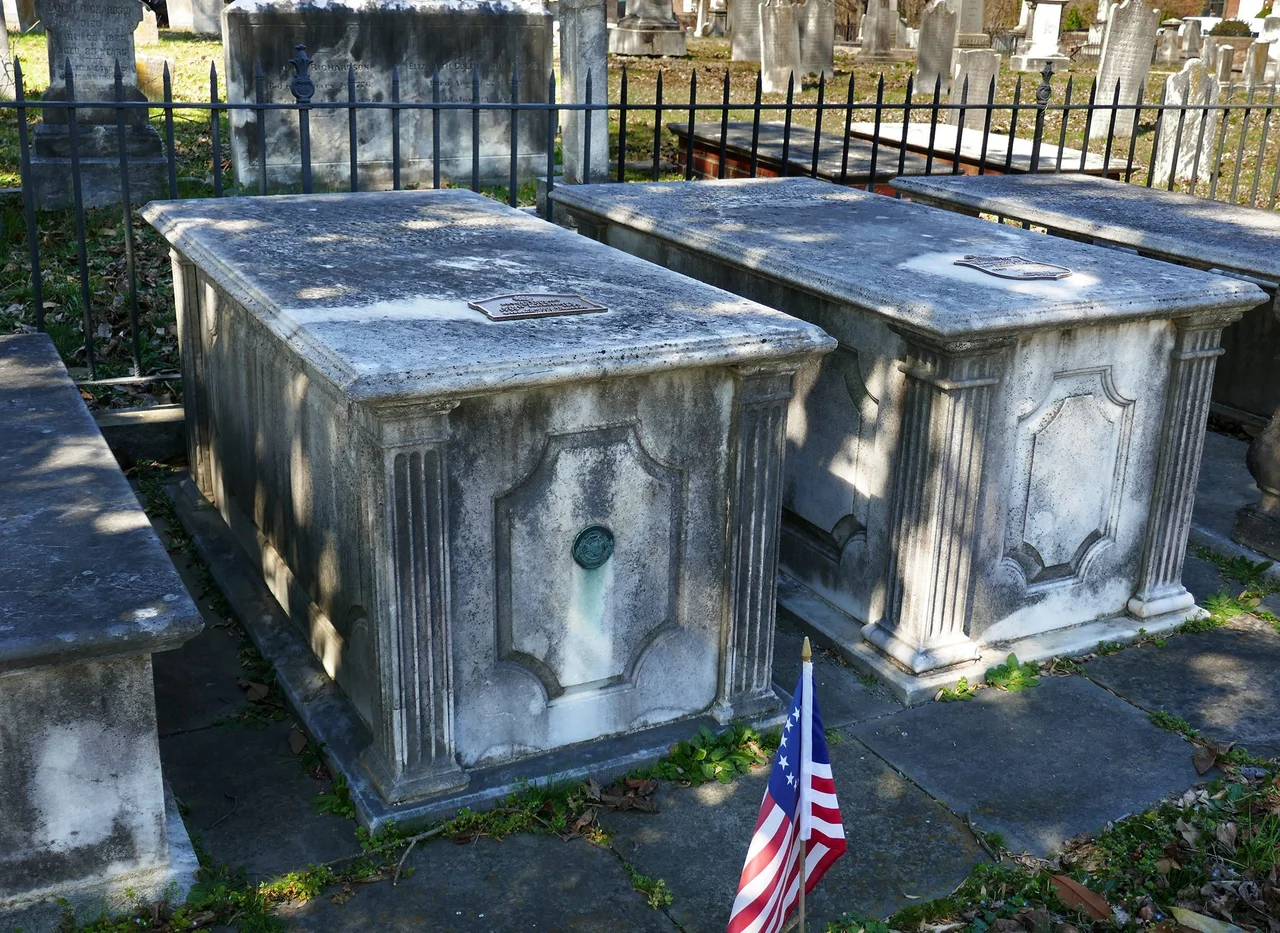

Shockoe Hill Cemetery
Inside a quiet walled enclosure on the north edge of old Richmond, Chief Justice John Marshall lies a few yards from Elizabeth Van Lew, the Union spymaster who fed intelligence out of the Confederate capital while pretending to be a harmless eccentric. Peter Francisco, the giant of the Revolution who fought at Brandywine and Camden, is here. So is Frances Allan, the foster mother Edgar Allan Poe came home to visit on the hill. So are at least four hundred veterans of the War of 1812 - believed to be the largest such assemblage in any American cemetery. The graves go quiet under old oaks. And right across the wall, across Hospital Street, lies an unmarked field where more than twenty-two thousand free and enslaved Black Richmonders are buried with no stones at all.
Richmond's First Municipal Cemetery
The City of Richmond bought 28 and a half acres on its northern edge in 1799 for several purposes: a poorhouse, and a burying ground for white residents. The cemetery section opened in 1820 - then called the New Burying Ground, later the Shockoe Hill Burying Ground - with the first burial in 1822. It was Richmond's first cemetery designed and operated as a true municipal facility, with detailed record-keeping and named lots. Before 1820 the city had already opened and operated two burial grounds for free Black Richmonders and enslaved Africans: the Shockoe Bottom African Burial Ground in 1799, and in 1816 the burial ground on Shockoe Hill that became the largest such cemetery in the United States. Shockoe Hill Cemetery expanded in 1833, 1850, and 1871, when it reached its present 12.7 acres. The walls have held since then.
John Marshall and the Federalist Generation
Chief Justice John Marshall, the fourth Chief Justice of the United States and the man who shaped the Supreme Court's role in American constitutional law, lies here with his wife Mary Willis Ambler Marshall. The crypts are simple. Marshall lived most of his adult life in Richmond and is buried close to his fellow Federalists. John Wickham - the attorney who defended Aaron Burr in his 1807 treason trial - is here. So is Virginia Governor William H. Cabell. Acting Virginia governors John Mercer Patton, John Rutherfoord, and John Munford Gregory; Judge Dabney Carr; United States Senators Powhatan Ellis and Benjamin W. Leigh; and Dr. Daniel Norborne Norton, who developed the Norton grape that became Virginia's signature wine. Richmond distiller Franklin Stearns. Congressman John Minor Botts, the lifelong Unionist who tried to lead Virginia away from secession and was imprisoned by the Confederacy for the effort.
Elizabeth Van Lew's Network
Of all the graves here, the one that puzzles outsiders most is Elizabeth Van Lew's. Van Lew was a Richmond-born abolitionist who never left the city - and who, throughout the Civil War, ran one of the most effective Union intelligence networks in the Confederacy from her family's mansion on Church Hill. She helped Union prisoners escape from Libby Prison. She passed coded messages north via couriers. She placed a former enslaved member of her household, Mary Bowser, into Confederate President Jefferson Davis's home as a servant, where Bowser - who had been freed and educated by the Van Lew family - could observe documents and conversation. After the war, Ulysses S. Grant named Van Lew Postmaster of Richmond. After her death she was buried at Shockoe Hill, where many of the network she ran are also interred. The grave is unmarked by anything that announces what she did. The people who knew, knew.
Peter Francisco and the War of 1812
Peter Francisco arrived in Virginia as a small child, dropped on a wharf at City Point with no English and no family, in 1765. He grew to six and a half feet tall and weighed over 260 pounds. He fought in the Continental Army at Brandywine, Germantown, Monmouth, Stony Point, Camden, Guilford Courthouse, and Yorktown, taking wounds at almost every one. Washington reportedly called him the only man, save himself, who could have won the war alone — a quote long celebrated but never fully sourced. Francisco is buried at Shockoe Hill. Beside him are more than twenty other Revolutionary War veterans, hundreds of Confederate soldiers, and at least 400 veterans of the War of 1812 - believed by members of the General Society of the War of 1812 to be the largest such assemblage in any cemetery in the country. More than thirteen hundred servicemen in total are known to be buried here. During the Civil War, more than five hundred Union prisoners of war were buried in the cemetery's adjoining African Burying Ground; their remains were moved in 1866 to Richmond National Cemetery three miles east.
Poe Visited Here
Edgar Allan Poe grew up in Richmond, the foster son of the merchant John Allan and his wife Frances. Frances Allan - the beloved foster mother who raised him - is buried here. So is John Allan. So is Sarah Elmira Royster Shelton, the woman Poe loved as a teenager, returned to as an adult, and was reportedly engaged to at the time of his mysterious death in Baltimore in 1849. So is Jane Stith Craig Stanard, the kind judge's wife who befriended a teenaged Poe and became the inspiration for his poem 'To Helen.' Poe visited Shockoe Hill many times throughout his life. He walked the same paths visitors walk today, paying respects to people who had shaped him. Across the wall, in the unmarked African Burying Ground, the bodies of people whose stories he could have heard if he had chosen to listen lay then as they lie now - without stones, without names in the public record. The cemetery on this hill is the story Richmond chose to tell about itself. The ground next to it is the story the city tried not to tell. Both belong to the place.
From the Air
Shockoe Hill Cemetery sits at 37.5514 N, 77.4322 W, in northern downtown Richmond, just south of I-64 and east of I-95. From the air, look for the walled green rectangle of the cemetery on the bluff at Hospital and Fourth Streets, with the Hebrew Cemetery directly across Hospital and the African Burying Ground extending east. The nearest major airport is Richmond International (KRIC), about 6 nm to the east. Recommended viewing altitude is 1,000-2,000 ft AGL to take in the cemetery cluster and the highway grid around it.
Nearby Stories
- Kings Dominion 8.4 km away
- Battle of Hatcher's Run 9.7 km away
- Francisco's Fight 14 km away
- Piney Grove at Southall's Plantation 17 km away
- Jamestown Settlement 19 km away
- Battle of Amelia Springs 22 km away
- Menokin 29 km away
- Highland (James Monroe House) 42 km away