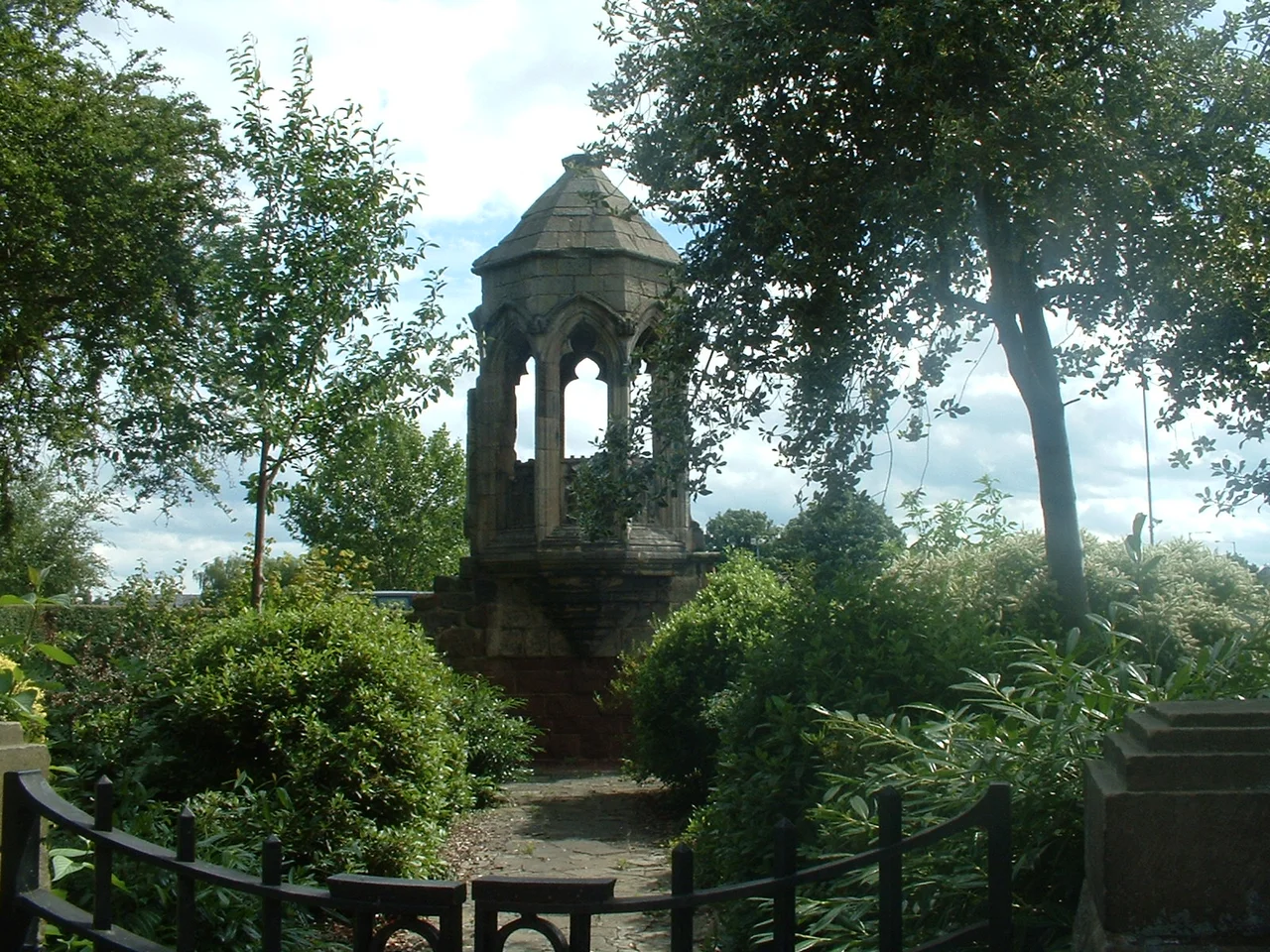

Shrewsbury Abbey
On 25 February 1083, Roger de Montgomery walked to the altar of a small Saxon church outside the east gate of Shrewsbury, laid his gloves upon it, and pledged to build an abbey. The gloves were the legal instrument - a public bond witnessed by Warin the Sheriff and the senior men of Shropshire. Two monks from Saint-Martin-de-Séez in Normandy came across to begin the work. Roger himself eventually became a monk at his own foundation in 1094 and was buried in the abbey he had made. Nearly a thousand years later, much of what he built is rubble - but the western nave still rings with bells on Sunday mornings, and the parish goes on.
A Welsh Saint Arrives
An abbey needed relics. In 1137 or 1138, Prior Robert led a small expedition into north Wales, to Gwytherin, where Saint Winifred had been buried for nearly five hundred years. The saint - a young noblewoman whose head had been struck off by a thwarted suitor and miraculously rejoined to her body by her uncle, Saint Beuno - was a Welsh devotion of modest local fame. Robert came home with her bones. He wrote her life, which became one of the most popular hagiographies of medieval England, and the cult of Winifred grew under Shrewsbury's patronage until pilgrims streamed in from across the country. Years later the abbey's monks went back and stole the relics of her uncle Beuno from Rhewl, were fined for it, and were allowed to keep them anyway.
The Battle at the Door
On 21 July 1403, the Battle of Shrewsbury was fought a few miles north of the abbey. Abbot Thomas Prestbury tried to mediate before the fighting and failed; the armies of Henry IV and Henry Percy joined battle, Hotspur died, and the king won. The chronicler Adam of Usk records that some years later Henry V walked from Shrewsbury to Saint Winifred's well in north Wales on pilgrimage - a king's gesture of thanksgiving, made on foot through the country his father had pacified by force. Henry proposed a chantry to Winifred at the abbey itself. It took fifty years and the patronage of a later abbot, Thomas Mynde, to make it real.
The Lead Comes Off the Roof
Thomas Cromwell's commissioners arrived in January 1540. The abbey was one of the last to surrender, not from resistance but because it lay at the end of the circuit. Thomas Boteler, the last abbot, took an £80 pension. The seventeen monks shared £87 6s 8d between them. Henry VIII briefly considered making Shrewsbury one of his new cathedrals - Bristol, Gloucester, Oxford, Peterborough and Chester all got cathedrals out of dissolved abbeys - but Shrewsbury, Leicester and Waltham missed the cut. The lead came off the roof. The eastern parts of the church collapsed by stages. Then in about 1836 Thomas Telford ran his new London-to-Holyhead road straight through the abbey precincts, sweeping away most of the monastic buildings and leaving only the nave, the west tower, and a fragment of the refectory pulpit stranded across the road, still standing alone in the middle of Abbey Foregate like a stone lectern preaching to traffic.
Brother Cadfael's World
In 1977 the novelist Edith Pargeter - who lived only a few miles away in Shropshire and wrote as Ellis Peters - published A Morbid Taste for Bones, the first of twenty Brother Cadfael mysteries set at Shrewsbury Abbey in the years around the Anarchy. Her Cadfael was a fictional Welsh monk turned crusader turned herbalist turned amateur detective. The novels drew directly on the abbey's own history - the translation of Saint Winifred opens the first book, the 1138 siege of Shrewsbury Castle supplies the plot of the second - and they made the abbey familiar to readers in dozens of languages. The Cadfael television series filmed at Shrewsbury between 1994 and 1998. A small herb garden was planted at the church door in honour of the fictional monk; pilgrims who never heard of Saint Winifred now come to find it.
Wilfred Owen's Tablet
Inside the west end of the church, on facing walls, are two stone tablets carrying the names of parishioners who died in the First and Second World Wars. Among the First World War names is Lieutenant W. E. S. Owen MC of the Manchester Regiment - the poet Wilfred Owen, killed in the final week of the war at the Sambre-Oise Canal in November 1918. He had grown up in Shrewsbury. His parents lived in Monkmoor. In 1993, on the centenary of his birth, the Wilfred Owen Association erected a sculpture in the churchyard called Symmetry, by Paul de Monchaux, inscribed with a line from Owen's poem Strange Meeting: "I am the enemy you killed, my friend." The bells in the tower - the oldest cast in 1713 by Abraham Rudhall of Gloucester - are still rung by a single ringer using an Ellacombe apparatus, the result of safety concerns about the tower in 1909. A Norman foundation, a Tudor ruin, a Victorian patchwork, a working church, a literary destination, a war memorial. The abbey holds them all at once.
From the Air
Shrewsbury Abbey lies at 52.708°N, 2.747°W, on the east bank of the River Severn just outside the medieval town, at the foot of Abbey Foregate near the English Bridge. The square Norman west tower is a recognisable landmark from the air. The fragment of monastic refectory pulpit stands alone in the central reservation of the A458 road. Nearest airfields are RAF Shawbury (EGOS) 10 km northeast and Wolverhampton Halfpenny Green (EGBO) 35 km southeast. The Wrekin (407 m) is 16 km southeast as the most prominent visual reference.
Nearby Stories
- Ludlow 5.7 km away
- Llangollen 6.7 km away
- Murder of Shawn Seesahai 8 km away
- Avoncroft Museum of Historic Buildings 8.1 km away
- Caverswall Castle 8.4 km away
- Combermere Abbey 9.4 km away
- Battle of Maes Moydog 11 km away
- Cwmhir Abbey 16 km away