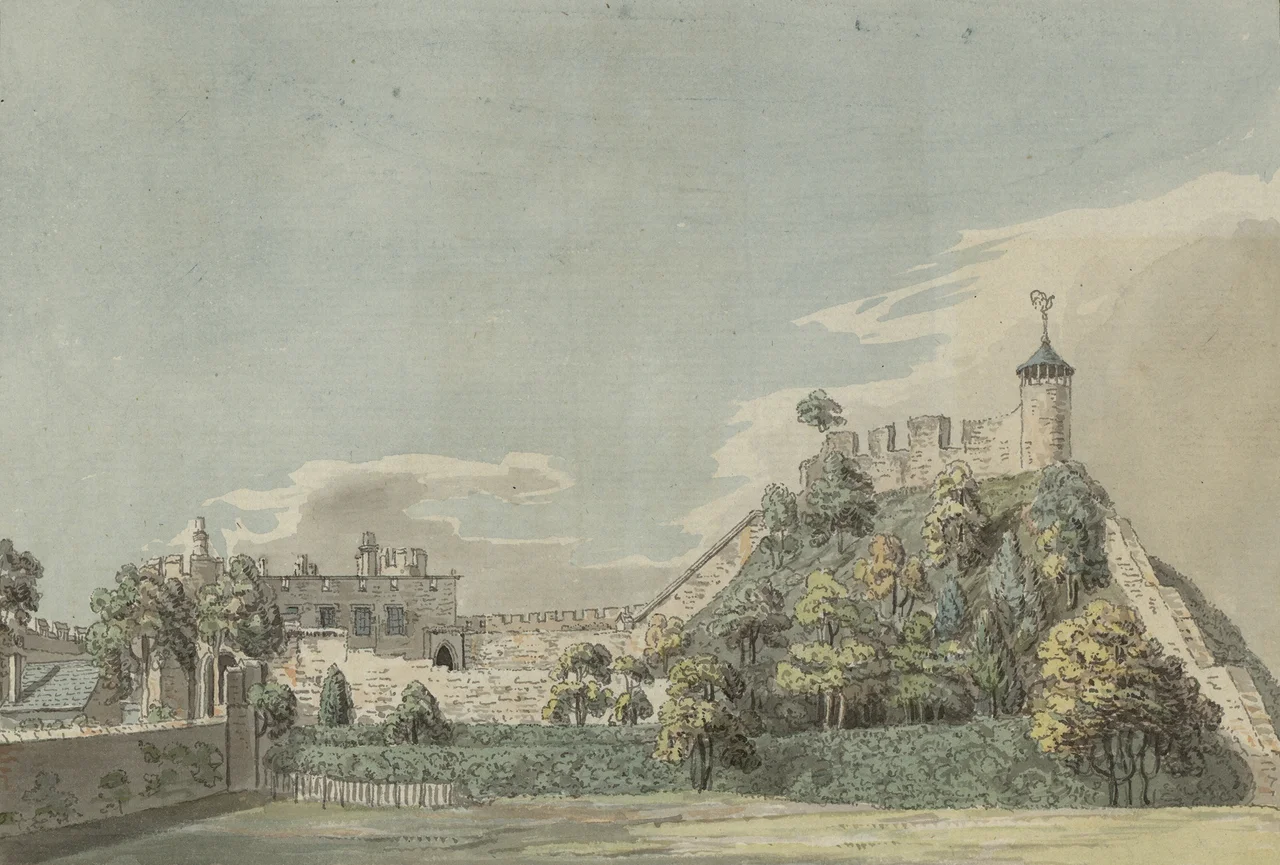

Shrewsbury Castle
There is only one way into Shrewsbury that does not require crossing a bridge - a thin neck of high ground at the top of the meander, where the Severn comes within a few hundred metres of meeting itself. The Normans saw the obvious. In about 1067, William the Conqueror's men ordered a castle on that hill. By 1074 Roger de Montgomery, the new Earl of Shrewsbury, was building in earnest, demolishing fifty-one homes to clear the ground. The result was a red sandstone gate-stop, an administrative seat, and a launching pad for raids into Wales - all in one bristling package. Nearly a thousand years later, it still does the job of dominating the skyline above the railway station.
A Hill That Chose Itself
Recent excavations funded by the Castle Studies Trust have uncovered something the Normans probably already knew: this hill was fortified before they got there. The 2019 dig revealed the massive defensive ditch around the original motte of about 1067, along with medieval pottery and two arrow heads - or perhaps crossbow bolts, the archaeologists are not sure. Beneath that lies older ground, hints of an Anglo-Saxon presence that the Norman builders simply reinforced. Geography, more than any single decision, made this spot a castle. Walk around the inner bailey today and the logic is still legible: red sandstone walls on a hump of red sandstone bedrock, the river curling away in every direction below.
Hanging from the Battlements
In 1138, with England torn between King Stephen and Empress Matilda, William FitzAlan held the castle for Matilda. Stephen besieged it. The siege was not long - chroniclers call it short - but its ending was a study in twelfth-century mercy. Stephen took the castle, and then he had the surviving garrison hanged from the battlements as a message to everyone watching from the town below. Llywelyn the Great briefly held the place in 1215. Edward I rebuilt and expanded it as a base for his Welsh wars. By the time the medieval frontier with Wales had settled, the castle had done its main work and slid into a quieter centuries-long retirement as a property of various lords and antiquarians.
Laura's Tower and a Horticultural Society
Thomas Telford - the great Scottish engineer who would later route his London-to-Holyhead road through Shrewsbury - converted the castle into a private house in the 1780s. He built Laura's Tower, a small folly named for the daughter of his client Sir William Pulteney, on the bailey wall. From there the whole curl of the Severn opens out, the town spread inside it like something arranged on a table. In 1924 the Shropshire Horticultural Society - the same body that runs the Shrewsbury Flower Show down in the Quarry every August - bought the castle from Lord Barnard and gave it to the town. It has belonged to Shrewsbury ever since.
Soldiers of Shropshire
The castle is now the Soldiers of Shropshire Museum, renamed in 2019 from its earlier title of Shropshire Regimental Museum. Inside are the combined collections of the King's Shropshire Light Infantry and the Shropshire Yeomanry, including three Victoria Crosses - those of Captain Alfred Kirke Ffrench, Private Charles Irwin, and Sergeant Major Harold Whitfield. There is also the Grand Admiral's Baton of Karl Dönitz, the German naval commander and Hitler's brief successor as head of state. In August 1992 an IRA firebomb caused around £250,000 of damage to the museum and destroyed many artefacts; the building has since been restored. Excavations in 2020 went looking for the lost St Michael's Chapel and instead turned up evidence of medieval feasting - bones of pike, and possibly swan.
The View from the Walk
Climb up to Laura's Tower at dusk, when the trains slide in and out of Shrewsbury station directly below, and the castle's whole reason for existing becomes clear in a single sweep. The Severn loops away on three sides, glinting between the Welsh Bridge and the English Bridge. Lord Hill's Column - at 133 feet, the tallest Doric column in England - rises away to the east, commemorating the man who led the charge against the Imperial Guard at Waterloo. Beyond that, on a good day, the high ridge of Wenlock Edge breaks the southern horizon. The view costs nothing. The castle, which once cost fifty-one homes and however many lives the building took, now hosts weddings in its tower and lets visitors picnic on the bailey lawn.
From the Air
Shrewsbury Castle is at 52.711°N, 2.749°W on the narrow northern neck of the Severn meander that surrounds the town, directly above Shrewsbury railway station. The red sandstone walls and Laura's Tower are visible from low altitudes as a small fortified hump on the skyline. Nearest airfields are RAF Shawbury (EGOS) 10 km northeast, Wolverhampton Halfpenny Green (EGBO) 35 km southeast, and RAF Cosford (EGOC) 30 km east. The Wrekin (407 m) lies 16 km to the southeast as the most prominent local landmark.
Nearby Stories
- Ludlow 5.7 km away
- Llangollen 6.7 km away
- Murder of Shawn Seesahai 8 km away
- Avoncroft Museum of Historic Buildings 8.1 km away
- Caverswall Castle 8.4 km away
- Combermere Abbey 9.4 km away
- Battle of Maes Moydog 11 km away
- Cwmhir Abbey 16 km away