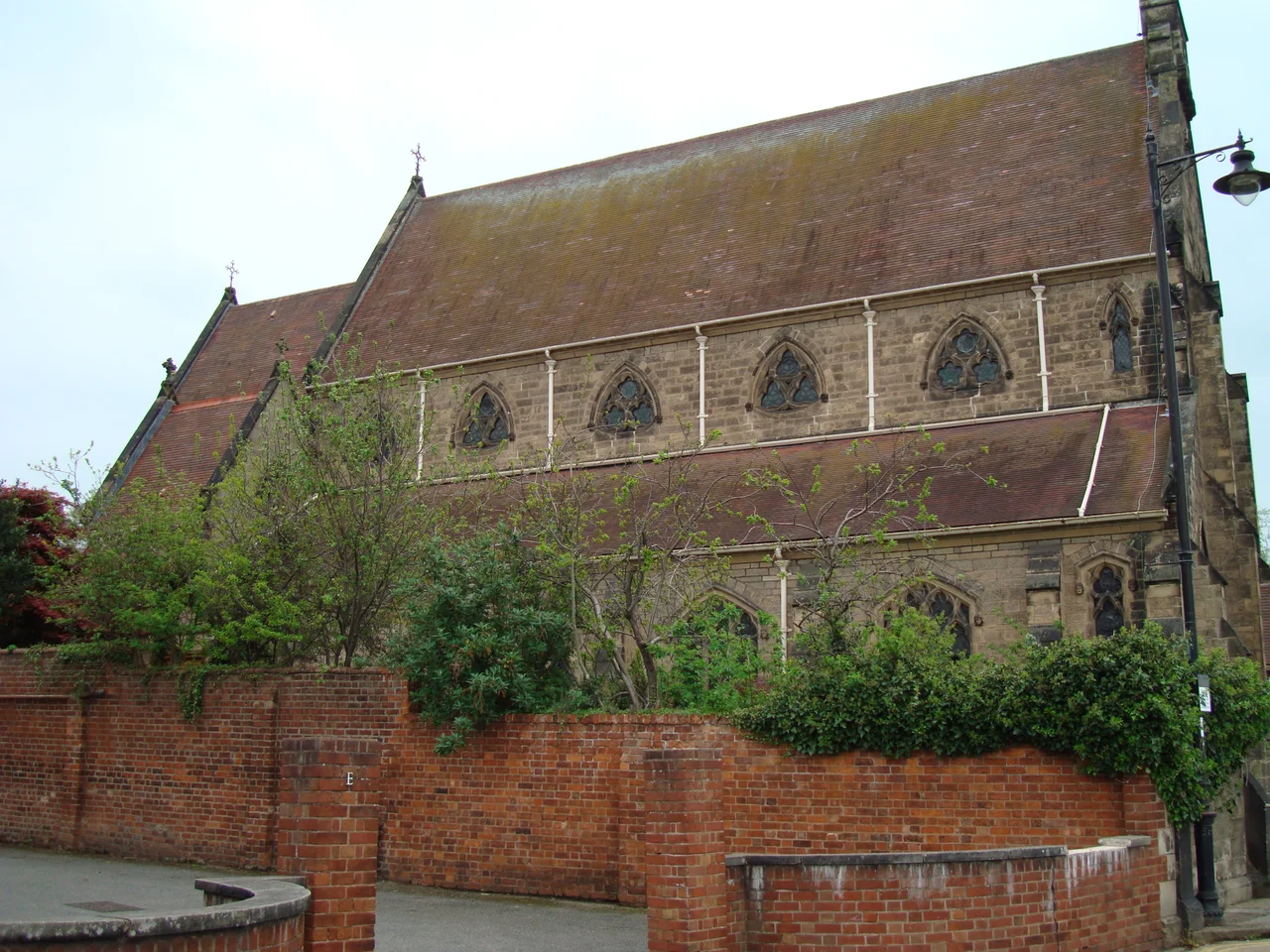

Shrewsbury Cathedral
Shropshire is one of the few English counties that never quite got an Anglican cathedral. The 1922 bill that would have made one out of Shrewsbury Abbey was defeated in the House of Lords four years later by a single vote. So when locals say "the cathedral," they mean the Roman Catholic building on Town Walls - a Gothic Revival church by Edward Pugin, consecrated in 1856, with a story of fathers and sons, of money running out, and of saints painted on walls before being hidden under decades of beige emulsion.
The Earl Who Died Too Soon
John Talbot, sixteenth Earl of Shrewsbury, commissioned the cathedral. He wanted Augustus Welby Pugin - the master of the English Gothic Revival who had drawn the Houses of Parliament - to design it. Both men were Catholic converts at the high tide of nineteenth-century Catholic emancipation, and Talbot's money had been quietly bankrolling Pugin for years. Then in 1852, before construction could begin, both Earl and architect died within months of each other. The Earl's nephew, Bertram, became the seventeenth Earl and offered to fund a smaller church. Pugin's son Edward took over the drawings. The cathedral was completed at a cost of £4,000 - a fraction of the original ambition. Bertram Talbot died three months before its opening. Cardinal Wiseman, the first archbishop of Westminster since the Reformation, performed the ceremony.
An Edward Pugin Building
Edward Welby Pugin was eighteen when his father died, and he spent the rest of his short life - he died at thirty-nine - completing and reinterpreting the work. His Shrewsbury cathedral is recognisably a Pugin building: pointed arches, polychrome stonework, a steep gabled west front facing the medieval town walls. But it is smaller and quieter than his father would have built. The cathedral has a seating capacity of 300, which makes it one of the smallest Catholic cathedrals in England. It sits on a street called Town Walls, adjacent to the surviving fragment of Shrewsbury's medieval defences, inside the great loop of the Severn that wraps the historic town centre. Historic England lists the building as Grade II*.
Margaret Rope's Windows
The cathedral's stained glass is some of the most striking Arts and Crafts work in the English Catholic Church. Most of it is by Margaret Agnes Rope, a Shrewsbury woman who later became a Carmelite nun first at Woodbridge in Suffolk and then at Quidenham in Norfolk. Rope was extraordinary - one of the very few women working in stained glass at her level in the early twentieth century, with a sister and a cousin also in the trade. She designed the cathedral's First World War memorial in the west porch as well: a carved Pietà above a wooden plaque bearing the badge of the King's Shropshire Light Infantry and the arms of the county. Below it are the names of the sixty-three men of the cathedral congregation who did not come home.
The Paintings Beneath the Paint
In the 1970s and 1980s, two successive refurbishments painted over the walls of the cathedral. The work was called "unsympathetic" by Sophie Andreae of the Catholic Bishops' Conference of England and Wales - a tactful word for whitewashing a Pugin interior. When restoration work started in 2019, the conservators found something underneath: a complete scheme of late-nineteenth-century wall paintings by Joseph Aloysius Pippet, of the Pippet family of Solihull, hidden under two layers of paint. The restoration is ongoing. Bit by bit, saints and angels and the Latin tags of devotion are coming back into view, after nearly half a century of being literally papered over.
Inside the Severn Loop
Stand outside the cathedral on Town Walls and you are on what was once Shrewsbury's southern defensive perimeter, looking down through the trees toward the river. Behind you the buttressed west front of the cathedral rises against the sky. The medieval Town Walls Tower is just along the street - the last remaining tower of the old town defences, now a one-bedroom National Trust holiday cottage. The Anglican parish churches of Shrewsbury - St Mary's, St Chad's, the abbey - dominate the medieval skyline. The Catholic cathedral, smaller and later, took its place humbly enough on the southern walls. But it is the only cathedral in Shropshire. In a town that boasts of medieval continuity, this is the building Catholics built when the law finally let them build openly again.
From the Air
Shrewsbury Cathedral lies at 52.705°N, 2.754°W on Town Walls, just inside the southern arc of the Severn meander that wraps central Shrewsbury. The Gothic Revival west front and steep gable are visible at low altitudes. Nearest airfields are RAF Shawbury (EGOS) 10 km northeast, Wolverhampton Halfpenny Green (EGBO) 35 km southeast, and RAF Cosford (EGOC) 30 km east. The Wrekin (407 m) is 16 km southeast as the most prominent visual reference.
Nearby Stories
- Ludlow 5.7 km away
- Llangollen 6.7 km away
- Murder of Shawn Seesahai 8 km away
- Avoncroft Museum of Historic Buildings 8.1 km away
- Caverswall Castle 8.4 km away
- Combermere Abbey 9.4 km away
- Battle of Maes Moydog 11 km away
- Cwmhir Abbey 16 km away