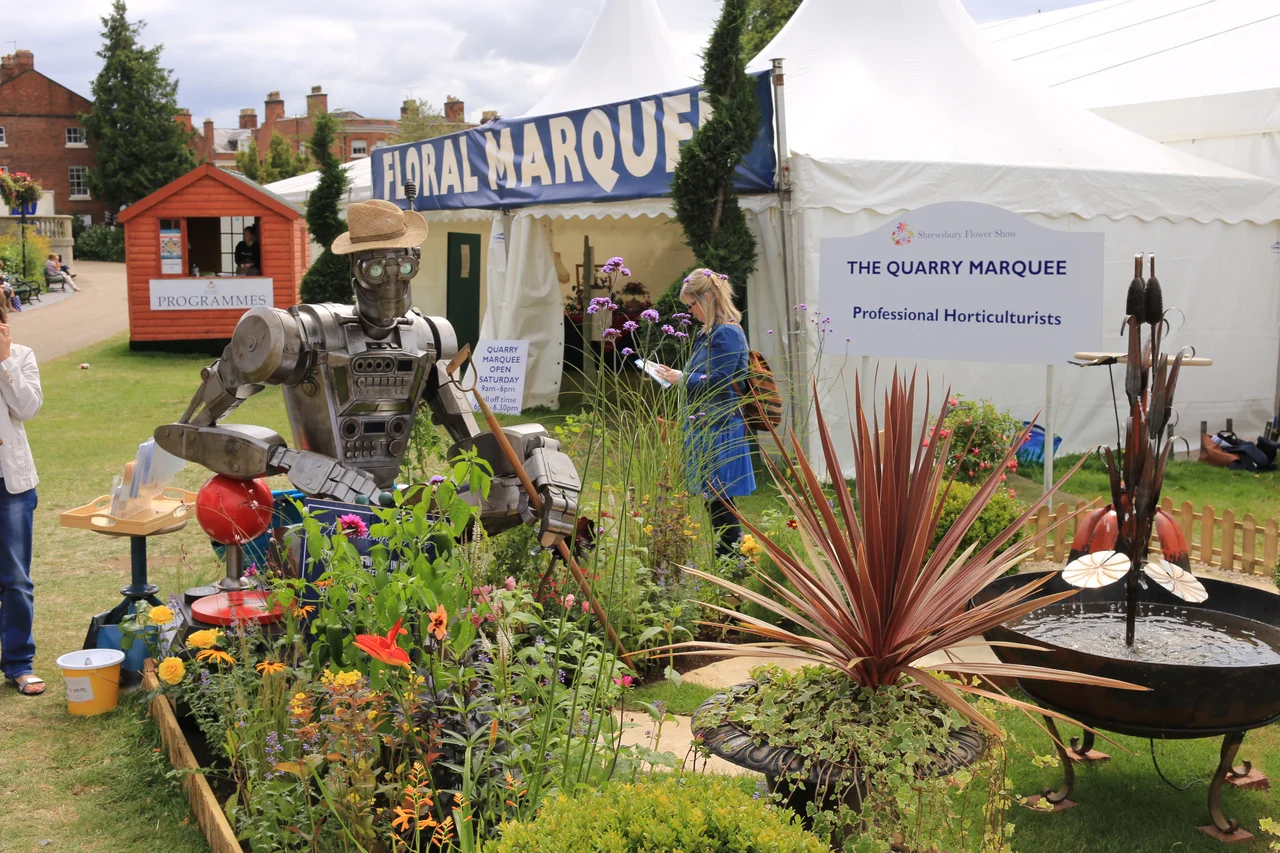

Shrewsbury Flower Show
The Royal Horticultural Society's Chelsea Flower Show is the one everybody knows, but it is not the oldest. That title belongs to Shrewsbury, where the Shropshire Horticultural Society has been arranging marquees on the lawns of the Quarry Park since 1875 - thirty-eight years before Chelsea was first held in 1913. The 2005 Guinness Book of Records made it official: the longest-running flower show in the world. Until 2024 it ran every August in mid-month, drawing about sixty thousand visitors to the riverside park to admire chrysanthemums and watch military bands and stand back, twice on each show evening, for one of the biggest fireworks displays in the West Midlands.
An Amphitheatre in the Quarry
The Quarry is the obvious place. Twenty-nine acres of green lawn tucked inside the great loop of the Severn, descending in terraces toward the river, surrounded on three sides by Edwardian villas and ancient bridges, with the spire of St Chad's church rising over the cricket pitch at the top - it is the natural amphitheatre of Shrewsbury. Religious mystery plays were performed here before the Reformation. The Renaissance brought elaborate guild arbours; some, like the Shoemakers' Arbour, still survive. By 1875, when the Shropshire Horticultural Society decided to mount a competitive flower show in mid-August, the Quarry had been a place of public gathering for at least four centuries. The 1880s show was already drawing crowds from across the Midlands. The 1890s added show jumping. By the 1920s, military bands were a fixture.
Percy Thrower's Show
After the Second World War the show needed reviving. The man who did it was Percy Thrower, Britain's first television gardener and arguably the most famous horticulturist of the postwar generation. Thrower became Shrewsbury's Parks Superintendent in 1946 and held the post until 1975, doubling as horticultural advisor to the Shropshire Horticultural Society and eventually as its chairman. He rebuilt the show after 1946 and made it a national event. When the 1970 show lost money in bad weather, Thrower and Doug Whittingham personally stood as financial guarantors so it could run again in 1971. That year it made a profit. Without Thrower, the show would probably have died sometime in the late 1960s. Instead it ran for another half century after he retired.
Sixty Thousand on the Lawn
At its peak, in the early decades of the twenty-first century, the show drew about sixty thousand visitors across its two days. Marquees stretched across the Quarry. There were classes for chrysanthemums, dahlias, sweet peas, vegetables, dressed eggs, cut flowers, and elaborate floral arrangements built to themes. There were show gardens that drew Chelsea-quality designers. There were three military bands, an arena for show jumping, demonstrations by the celebrity chefs James Martin and the Hairy Bikers, and craft stalls selling pottery and screen-printed scarves. Both evenings ended with fireworks fired from the Quarry's lower lawn out across the Severn, reflected in the river. Visitors walked back to the town centre under sodium streetlights with a programme rolled in one hand and a sausage roll in the other.
When the Numbers Stopped Working
Even institutions that last 150 years can stop being financially viable. In April 2025 the Shropshire Horticultural Society announced that the 2025 show would not be held, citing the rising costs of staging an event of that scale: insurance, security, marquees, fireworks, public liability. In January 2026, with no immediate path to a sustainable model, they confirmed the 2026 show was also cancelled. It was a quiet ending for a quietly proud institution. The lawns of the Quarry are still there. So is the bandstand. So are the children's swings, the bowling green, and the long avenue of lime trees that ran past Percy Thrower's old gardens. What is missing, for the first time in any August since 1946, is the wide white wall of the great marquee, the smell of cut chrysanthemums, and the bang of the eight o'clock fireworks at the end of the second evening.
A Tradition Looking for a Future
Whether the show comes back depends on what the Shropshire Horticultural Society can negotiate over the next few seasons - on whether new sponsors emerge, on whether costs can be brought back into line with what visitors will pay, on whether some scaled-down version can fill the gap. Other long-running flower shows have made similar transitions: Tatton Park is sponsored by the RHS, Chelsea by the BBC. Smaller events have come and gone. For now, Shrewsbury sits in the strange position of being the holder of a Guinness record for the longest-running flower show in the world, which is currently not running. The Quarry, in mid-August, is just a park again. Locals walk their dogs there. Tourists peer through the railings at Percy Thrower's gardens. The amphitheatre waits to see if the show will come back.
From the Air
The Shrewsbury Flower Show site is The Quarry park, at 52.707°N, 2.762°W, on the western inside curve of the Severn meander that wraps central Shrewsbury. The 29-acre park is a clearly visible green oval from cruising altitudes. Nearest airfields are RAF Shawbury (EGOS) 10 km northeast, Wolverhampton Halfpenny Green (EGBO) 35 km southeast, and RAF Cosford (EGOC) 30 km east. Note that the show was cancelled in 2025 and 2026 - the marquees will not be visible in August during those years.
Nearby Stories
- Ludlow 5.7 km away
- Llangollen 6.7 km away
- Murder of Shawn Seesahai 8 km away
- Avoncroft Museum of Historic Buildings 8.1 km away
- Caverswall Castle 8.4 km away
- Combermere Abbey 9.4 km away
- Battle of Maes Moydog 11 km away
- Cwmhir Abbey 16 km away