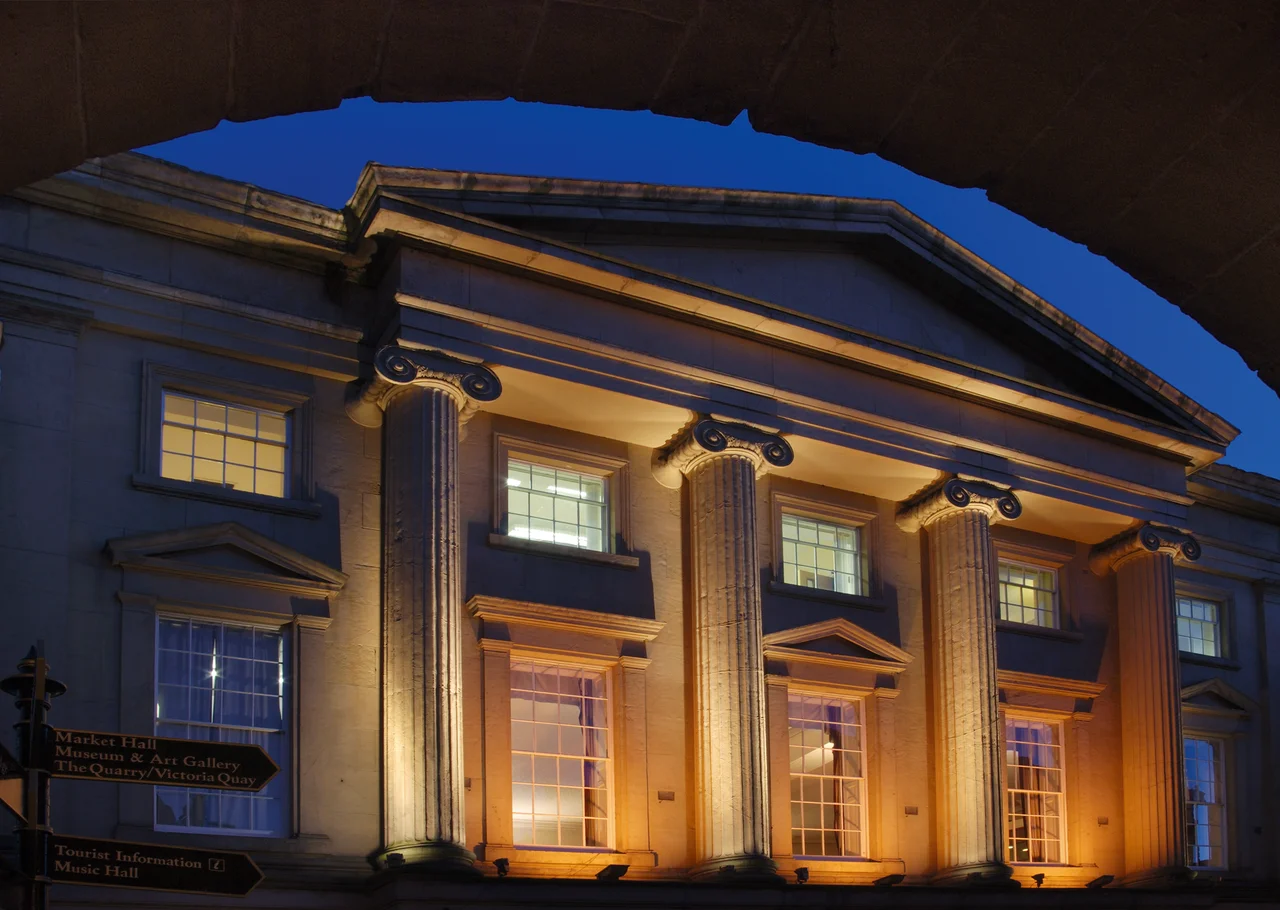
Shrewsbury Museum and Art Gallery
The building has been at least six things in its long life: a thirteenth-century defensive hall house, a Victorian music hall, a town theatre, a fire station, a police holding cell, and a Cold War civil defence bunker. In 2014 it opened as the new home of Shrewsbury Museum and Art Gallery, an institution that has wandered the town since 1835 collecting Roman mirrors and mammoth bones and great auks. The result is a museum whose building is itself one of its largest exhibits - a microcosm of seven centuries of Shrewsbury, with the collections layered on top.
A Society for Natural History
On 26 June 1835, a group of Shropshire gentry, nobility, and clergy met at Shrewsbury to found a museum and scientific library. Their purpose was nineteenth-century in the best sense: "to raise the character and increase the intellectual resources of a District." The first home was a building on Dogpole. The early donors included Sir Baldwin Leighton, Lord Berwick, Sir Rowland Hill, and a young naturalist who had grown up just across the river - Charles Darwin, son of Robert and Susannah, then twenty-six and not yet on the Beagle. The museum also received material from Sir Roderick Murchison, who would go on to define the Silurian period named after the Welsh borderlands. Shrewsbury was a serious place for serious science at the start of the Victorian age.
Mammoths in Condover, Romans at Wroxeter
The collections grew. Two of the most famous pieces tell stories about Shropshire's deep past. The Condover Mammoths - skeletons of a juvenile mammoth and its companions found in a kettle hole at Condover Quarry in the 1980s - are the youngest known mammoth remains in Britain, dating to about 12,800 years ago. Then there is the Wroxeter Roman Mirror, an exquisite first-century bronze hand mirror from Viroconium Cornoviorum, the Roman city four miles east of Shrewsbury that was once the fourth-largest in Roman Britain. The Hadrianic Forum Inscription, also from Wroxeter, carries the largest surviving piece of Roman lettering in Britain. The museum holds them all. It also holds the Shrewsbury Hoard - more than 9,000 Roman coins discovered by a metal detectorist in a field near the town in 2009.
George Holt's Rules
In 1894 the museum's curator, George Holt, published the Rules of the Shrewsbury Free Museum. They are a small Victorian gem. No children under fourteen unless accompanied by a responsible person. No leaning on cases. No touching the exhibits. No intoxicated or unclean persons. No smoking. No refreshments. No playing, gaming, betting, swearing, or spitting. No dogs. Offenders "shall be liable to immediate expulsion." The rules are still funny, and they reflect the moment when civic museums were trying to civilise the urban working class one display case at a time. The institution survived, became known as Shrewsbury Museum and Free Library, and over the next century moved several more times - to Rowley's House in 1931, to Rowley's Mansion in 1981.
Returning to Vaughan's Mansion
In 2009, with Theatre Severn opening in Frankwell as the town's new venue for plays and concerts, the old Music Hall on the Square came free. Shropshire Council decided to bring the museum back to where it had been in 1853 - to Vaughan's Mansion, the Grade II* listed thirteenth-century hall house that occupies a corner of the Music Hall complex. The redevelopment was sensitive. The Victorian music hall designed by Edward Haycock Snr in 1835 was preserved. The medieval shut - one of Shrewsbury's typical narrow passages between buildings - was kept open. So were the police holding cells used for prisoners awaiting trial across the street at the Old Market Hall, and the twentieth-century civil defence bunker. The museum opened in 2014 and was officially opened by the Duke of Gloucester on 17 September 2015.
What You Find Inside
Walk through the building today and you encounter the layered history at every turn. A medieval undercroft. A Georgian staircase. A Victorian theatre balcony. Above and around them sit Shrewsbury's stories: the Caughley porcelain collection that is one of the finest in Britain, two mid-eighteenth-century views of Coalbrookdale by William Williams that show the Industrial Revolution catching fire across the gorge, the Guilsfield Bronze Age Hoard, the Grinshill Rhynchosaur from 240 million years ago, and a great auk specimen prepared by Henry Shaw - one of fewer than eighty mounted specimens of a bird the Victorians hunted to extinction in 1844. In 2019 a new stained glass window by local artist Nathalie Hildegarde Liege went up, drawing on the museum's mineral collection and on Margaret Agnes Rope. A museum about Shrewsbury inside a building that is itself a piece of Shrewsbury.
From the Air
Shrewsbury Museum and Art Gallery occupies the Music Hall complex at 52.707°N, 2.755°W in The Square at the centre of Shrewsbury, inside the Severn meander. The Victorian Music Hall facade and the older Vaughan's Mansion are visible only at very low altitudes within the dense medieval street pattern. Nearest airfields are RAF Shawbury (EGOS) 10 km northeast, Wolverhampton Halfpenny Green (EGBO) 35 km southeast, and RAF Cosford (EGOC) 30 km east. The Wrekin (407 m) is 16 km southeast.
Nearby Stories
- Ludlow 5.7 km away
- Llangollen 6.7 km away
- Murder of Shawn Seesahai 8 km away
- Avoncroft Museum of Historic Buildings 8.1 km away
- Caverswall Castle 8.4 km away
- Combermere Abbey 9.4 km away
- Battle of Maes Moydog 11 km away
- Cwmhir Abbey 16 km away