.jpg)
Shrewsbury School
Charles Darwin hated the place. He arrived in 1818 at the age of nine, a day boy taking the short walk from his father's house at The Mount across the river to the old Tudor buildings on Castle Street. Years later, looking back, he wrote that nothing could have been worse for the development of his mind than Dr Butler's school: "as it was strictly classical, nothing else being taught, except a little ancient geography and history." His true education happened on Wenlock Edge, hammering at fossils, and in his father's garden hatching beetles from a jar. The school, of course, has not stopped reminding everyone that Darwin was a pupil. There is a bronze statue of him outside the main building. There is a Darwin Society. There are two boarding houses named after his wife Emma. Schools, like nations, choose which sons to remember.
Edward VI's Charter
On 10 February 1552, the boy king Edward VI signed the royal charter that founded Shrewsbury School. The townspeople had been petitioning since 1542, ever since the dissolution of Shrewsbury Abbey broke up the older church-run education in the town. They wanted some of the abbey's confiscated wealth diverted back into a grammar school. Eventually, with bribes - twenty pence to the Lord Chancellor's servant in 1548 to win his ear, the record shows - they got their charter. The first head master was Thomas Ashton, a Cambridge man from St John's. By the time he resigned in 1568 he had built a Calvinist powerhouse, and by 1581 the school had 360 boys on its rolls. William Camden in 1582 called it "the best filled in all England."
Sidney, Greville, and a Tudor Court
Sir Philip Sidney boarded with a former mayor in the castle ward, where his lifelong friend Fulke Greville joined him at lessons. Out of that pairing came one of the strangest literary partnerships of the Elizabethan age: Sidney the soldier-poet who would die at the Battle of Zutphen in 1586, Greville the courtier-biographer who outlived him by decades. A statue of Sidney stands in front of the main school building today, gazing down a long avenue of linden trees toward the war memorial. The boys still know him. His sister Mary Sidney - Countess of Pembroke and one of the great patrons of Elizabethan literature - gives her name to a girls' boarding house added in 2006.
Across the River
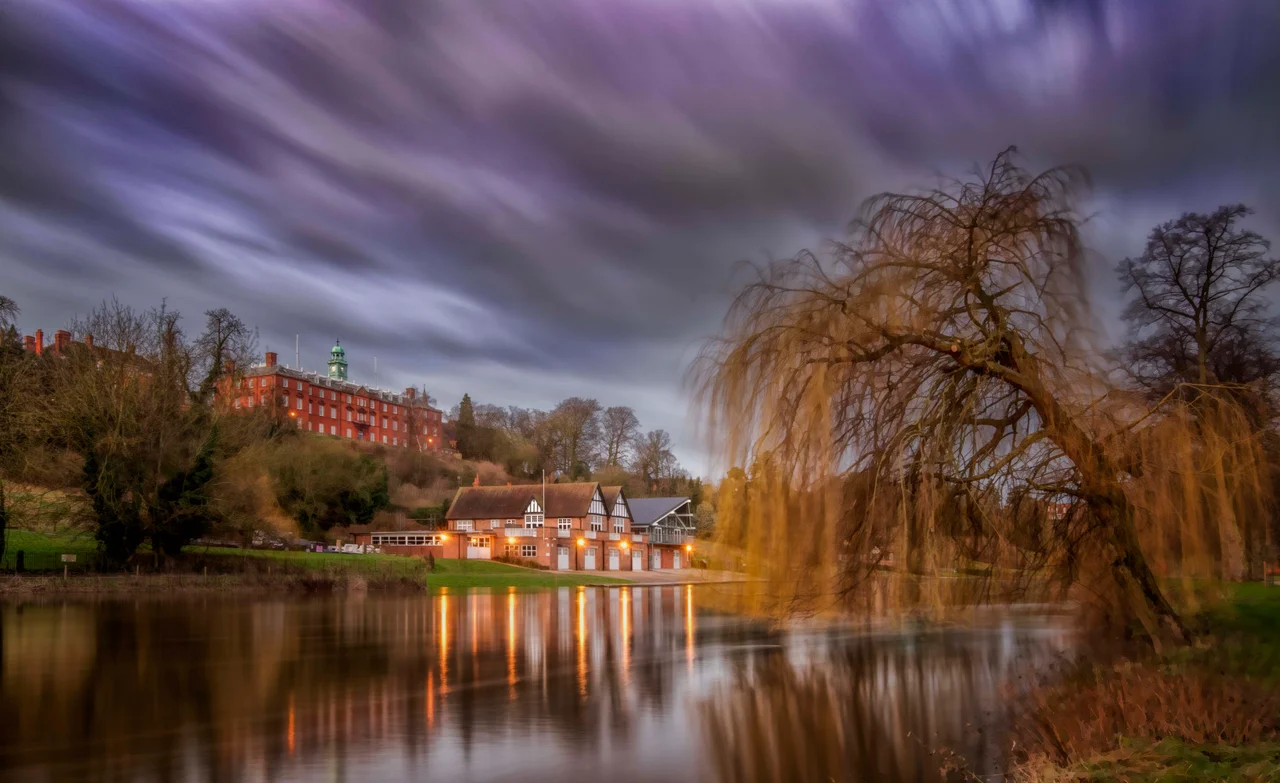
By the 1870s the school had outgrown its town-centre buildings, and in 1882 it moved south across the Severn to Kingsland, a 150-acre site on land granted to the town before 1180. The headmaster who managed the move, Henry Whitehead Moss, called it "The Site," and the name has stuck. From the school's terrace you look down across the river to the town and the spire of St Alkmund's Church. The old buildings on Castle Street became the town library. The chained library that Head Master Meighen founded in 1606 came across to the new site, with a globe by the first English globe-maker Emery Molineux that was the school's first acquisition in 1596. Newton's Principia, bought on publication in 1687, is still in the collection. So is Darwin's school atlas.
Football, the Hunt, and the Long Mile
Shrewsbury was one of the schools whose own version of football fed into the modern game. The Salopian version - called douling, from the Greek word for slave - had no crossbar and rewarded dribbling. Old Salopians went up to Cambridge in the 1840s and helped found Cambridge University Football Club, which produced the first written rules of association football. The school's 1856 copy of those Cambridge rules predates the 1863 rules of the FA. Then there is the Royal Shrewsbury School Hunt, founded by 1819 - the oldest cross-country running club in the world, where boys still chase paper trails laid by two "foxes" and the captain blows a 200-year-old bugle to start a race. The Annual Steeplechase, first definitely recorded in 1834, is the oldest continuing cross-country race in modern athletics.
Private Eye on a School Magazine
In the 1950s a quiet revolution stirred in the school magazine. Four boys - Richard Ingrams, Willie Rushton, Christopher Booker and Paul Foot - were editing a satirical broadsheet called The Salopian. When they left Shrewsbury for university and then London, they carried the form with them. In 1961 they founded Private Eye. Michael Heseltine was at the school just before them. Michael Palin came through in the 1960s and won the Bentley Elocution Prize, an honour he has never quite stopped being amused by. The school went co-educational in 2015. As of late 2023 it had 842 pupils, more than half boys, more than a third girls. In 2024 its football team won the English Schools FA National Championship. Darwin, who hated the place, would have been most surprised to find himself - or his statue - still pointing the way to the chemistry block.
From the Air
Shrewsbury School lies at 52.700°N, 2.760°W on the south bank of the River Severn, opposite Shrewsbury town centre, in the Kingsland area. The main school building, a Georgian-fronted complex completed around 1882, sits on high ground above the river and is visible from low altitudes. Sports fields fill the centre of the 150-acre site. Nearest airfields are RAF Shawbury (EGOS) 11 km northeast, Wolverhampton Halfpenny Green (EGBO) 36 km southeast, and RAF Cosford (EGOC) 31 km east. The Wrekin (407 m) lies 17 km southeast.
Nearby Stories
- Ludlow 5.7 km away
- Llangollen 6.7 km away
- Murder of Shawn Seesahai 8 km away
- Avoncroft Museum of Historic Buildings 8.1 km away
- Caverswall Castle 8.4 km away
- Combermere Abbey 9.4 km away
- Battle of Maes Moydog 11 km away
- Cwmhir Abbey 16 km away