
Siege of Berwick (1333)
Edward III had Thomas Seton hanged within sight of his parents on the walls of Berwick. The boy was a hostage to a truce his father had agreed: surrender the town by 11 July 1333 unless relieved, or your son dies. When the Scottish relief force from Sir William Keith arrived from the wrong direction - approaching from England rather than from Scotland, as the indenture required - Edward declared the truce breached. A gallows went up outside the walls. Each day the town held out, two more hostages would hang. The medieval world contained a great deal of cruelty, but it also contained law, and Edward III, twenty years old, was a sharp lawyer when it suited him.
Why Berwick
In the fourteenth century, Berwick was not a backwater. According to William Edington, bishop and chancellor of England, it was 'so populous and of such commercial importance that it might rightly be called another Alexandria, whose riches were the sea and the water its walls.' The duty on wool passing through its port was the single largest source of revenue for the Scottish Crown. The town sat astride the main invasion route in either direction, the eastern gateway between two kingdoms. Richard I of England had sold it to the Scots in the twelfth century to fund his crusade. Edward I had sacked it in 1296 to start the First War of Scottish Independence. Robert Bruce had retaken it in 1318 by bribing an English guard. By 1333, the town had changed hands more times than most people could count, and its walls - two miles long, 22 feet high, studded with 60-foot towers - had been steadily improved by every successive owner.
The Pretext
Edward Balliol was the son of a Scottish king Edward I had deposed forty years before. In 1332 he sailed from Yorkshire with around 2,000 men, crushed a Scottish army of 12,000 to 15,000 at Dupplin Moor, and had himself crowned at Scone. Within six months his support collapsed. He was ambushed at Annan and fled to England 'half-dressed and riding bareback,' as the chroniclers put it. He appealed to Edward III for help. The young English king had been waiting for exactly this. He recognised Balliol as king of Scotland, dropped all pretence of neutrality, and made ready for war. The justification was the Scots' minor border raids into Cumberland - raids small enough that the English chroniclers had to work to portray them as a casus belli, but work they did.
The Siege
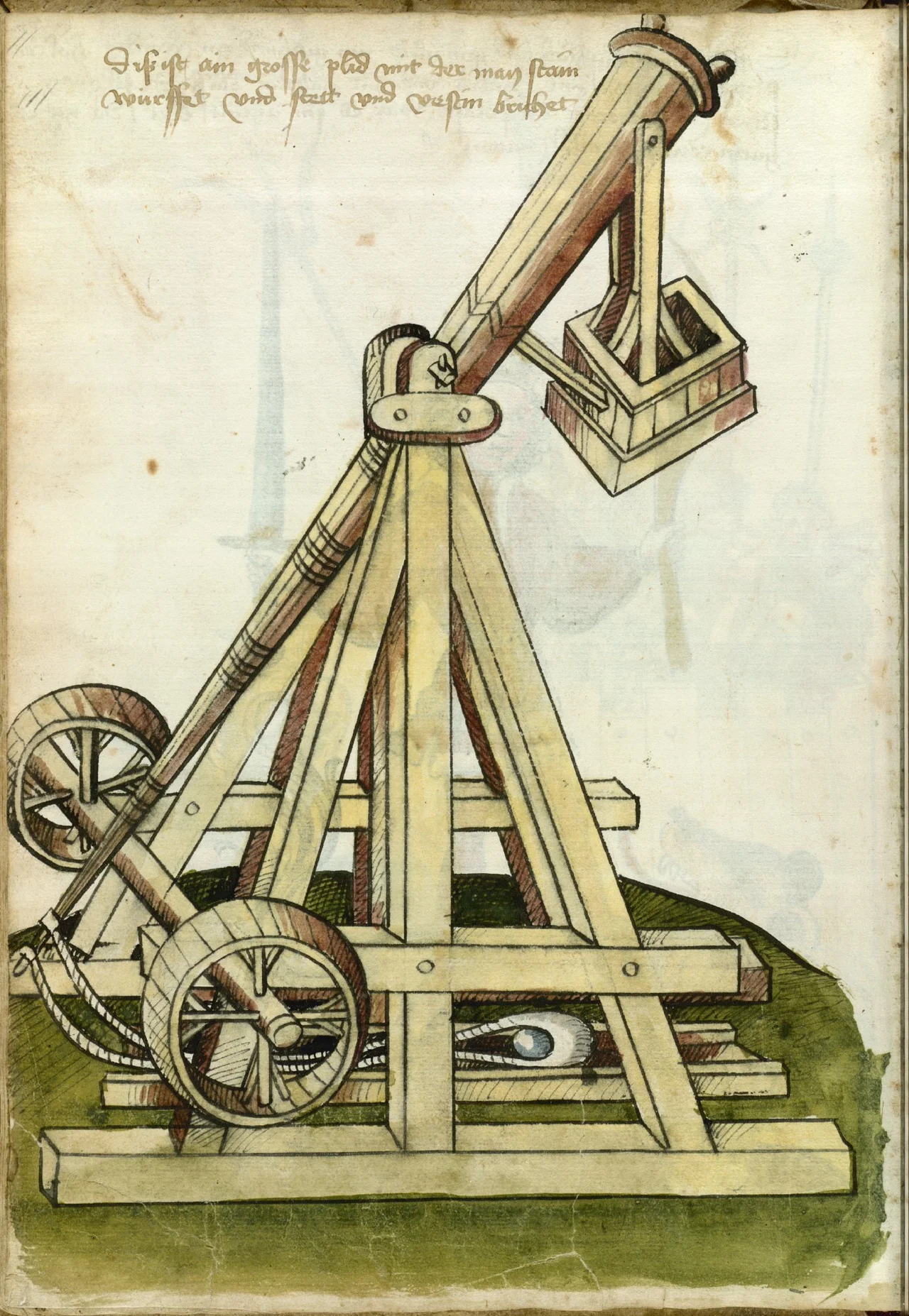
Balliol crossed the border on 10 March 1333 and reached Berwick by late month, cutting the town off by land. The English navy had already isolated it by sea. Edward III joined the main army on 9 May, after leaving his queen Philippa at Bamburgh Castle fifteen miles south. The English brought catapults and trebuchets. Thirty-seven masons prepared nearly 700 stone missiles, shipped in by sea from Hull. According to the historian Ranald Nicholson, Berwick was 'probably the first town in the British Isles to be bombarded by cannon.' By late June the bombardment had reduced parts of the town to ruin. The defenders set burning brushwood adrift to repel a naval assault - and accidentally set fire to their own town. Sir Alexander Seton, the governor, asked for a truce. Edward granted it, on terms: surrender by 11 July if no relief came, with Seton's own son Thomas as one of twelve hostages.
The Hanging
Archibald Douglas, Guardian of Scotland for the underage David II, had spent months gathering an army instead of using the one he already had to mount diversionary raids - a contrast, the chroniclers noted, with Robert Bruce's swift response to the 1319 siege. When Douglas finally crossed into England on 11 July, the last day of the truce, he advanced to Tweedmouth and burned it in plain sight of the English camp. Edward did not move. Sir William Keith led 200 Scottish cavalry across the broken bridge into Berwick from the south bank. The defenders argued this was the relief required by the truce. Edward ruled it was not - they had to come from the direction of Scotland, not the direction of England. Thomas Seton was hanged. His parents watched from the walls. Edward issued instructions that two more hostages would die each day Berwick held.
Halidon Hill
Keith negotiated a new truce on 15 July: surrender by sunset on 19 July unless relieved. Relief was now defined precisely - 200 Scottish men-at-arms breaking through, the army forcing a specified river crossing, or defeat of the English in open battle on Scottish soil. Douglas marched south, besieged Bamburgh briefly to threaten Queen Philippa, was ignored, and finally accepted he would have to fight on ground Edward had chosen. The English positioned themselves on Halidon Hill, a 600-foot rise two miles north-west of Berwick. To attack, the Scots had to march downhill, cross marshy ground, and climb the northern slope into English arrow-fire. They came anyway. The Lanercost Chronicle records the arrows falling 'as thick as motes in a sun beam.' Douglas died on the field with five Scottish earls. About a hundred prisoners were beheaded the next morning - 20 July, the date Berwick's truce expired. The town surrendered the same day. English casualties were reported as fourteen, perhaps as few as seven. Berwick would remain English military headquarters on the border until 1461, when Henry VI returned it to the Scots, and finally English again after Richard, Duke of Gloucester - the future Richard III - retook it in 1482.
From the Air
55.77N, 2.01W on the River Tweed at Berwick-upon-Tweed, Northumberland. The 1333 siege site is the medieval walled town on the north bank of the Tweed; Halidon Hill (where the battle was fought) lies 2 mi northwest at approximately 55.78N, 2.04W, a 600-ft rise still clearly visible. From altitude, look for the Tweed estuary, the Elizabethan ramparts (built later in the 16th century, partly replacing the medieval walls), and the long arcade of the Royal Border Bridge. Nearest ICAO: Newcastle (EGNT) 50 mi south, Edinburgh (EGPH) 55 mi northwest. Best viewed at 2,000-3,000 ft AGL.
Nearby Stories
- Chillingham Castle 3 km away
- Battle of Ancrum Moor 9.3 km away
- Bass Rock 11 km away
- HMS Nottingham (1913) 12 km away
- HMS Pathfinder (1904) 15 km away
- Yester Castle 18 km away
- German submarine U-1274 23 km away
- Alexander L. Kielland (Platform) 282 km away