
Siege of Derry
On 7 December 1688, with a regiment of Catholic soldiers waiting outside the Ferryquay Gate to take possession of the city, thirteen apprentice boys seized the keys from a frightened guard and locked the gates of Derry. The act was, by any reasonable measure, illegal. James II was still King of England, Scotland, and Ireland; the soldiers had every legal right to enter. But James was already in exile in France, William of Orange had landed at Torbay a month earlier, and the apprentices had decided where their loyalty lay. Four months later King James himself rode up to within three hundred yards of the Bishop's Gate and summoned his city to surrender. From the walls came the shout that has echoed in Ulster Loyalist memory for more than three centuries: 'No Surrender!' The siege of Derry had begun.
The Closing of the Gates
The crisis was built on small movements of regiments. James doubted the loyalty of his English troops once the Dutch invasion threatened, so he asked his viceroy in Ireland, the Catholic Earl of Tyrconnell, to send him reliable Irish ones. To replace them Tyrconnell ordered four new regiments raised, one for each Irish province. Alexander MacDonnell, third Earl of Antrim, hired 1,200 Scottish mercenaries called redshanks - all Catholic - to fill the Ulster regiment. They were meant to relieve the garrison at Derry on 20 November 1688 but were late. Tyrconnell had already withdrawn the existing Protestant garrison, leaving the city undefended. When MacDonnell's men finally appeared at Ferryquay Gate on 7 December, the city was unguarded but also, by then, well-warned. Colonel George Philips had sent word from Newtown Limavady. The apprentices acted. The gates closed. MacDonnell, with only 1,200 men, could not storm the walls. He retreated to Coleraine. Between then and April 1689, six largely peaceful months passed - what later generations would conflate into a single dramatic moment of defiance was, in reality, a slow buildup over a long Irish winter.
Lundy's Blunder
When James landed at Kinsale on 12 March 1689 with money, French officers, and the diplomatic backing of Louis XIV, Tyrconnell sent Lieutenant-General Richard Hamilton north with 2,500 men to bring Ulster back under control. Hamilton smashed the Protestant Army of the North at the Break of Dromore on 14 March. By mid-April Jacobite cavalry was at Derry's outer defences. Lundy - Robert Lundy, the Williamite governor of Derry - made the decision that would brand his name forever. After Jacobite forces broke through the river crossings at Castlefin, Clady and Lifford on 15 April, Lundy convinced himself the city could not be held. The same day, Colonels Cunningham and Richards arrived in Lough Foyle with two regiments of English reinforcements - about 1,600 men - aboard nine transport ships. In a secret council of war that excluded most local commanders, Lundy persuaded them not to land, claiming there were insufficient provisions to feed the new arrivals. The ships sailed back to England on 19 April. Lundy then slipped out of the city disguised as a common soldier and took a boat to Scotland. Each year on the first Saturday of December, the Apprentice Boys of Derry still burn his effigy from the city wall.
Roaring Meg
Hamilton's army reached the walls on 18 April. The defenders agreed to a two-day delay before talks. But when James himself rode up to Bishop's Gate on the second day, the men on the walls saw it as a breach of agreement. Cannons fired at the king. According to a later account, one of his aides-de-camp was killed by a shot from Derry's largest gun, the famous 'Roaring Meg'. James rode back to Dublin in fury. The siege began in earnest. New leaders emerged: Adam Murray, who broke through the loose besieging ring on his horse to reach the city; Henry Baker, appointed governor on 19 April; George Walker, put in charge of the stores. The besieged sallied repeatedly, killing the French general Maumont on 21 April in the so-called Battle of Pennyburn, wounding the Duke of Berwick and the engineer de Pointis on 25 April, and killing Brigadier Ramsay when they retook Windmill Hill on 7 May. But on 30 May the besiegers received heavy mortars. Almost six hundred explosive shells were fired into the town. Disease spread. Food ran short. The defenders ate horses, dogs, rats, and reportedly tallow candles.
The Boom on the Foyle
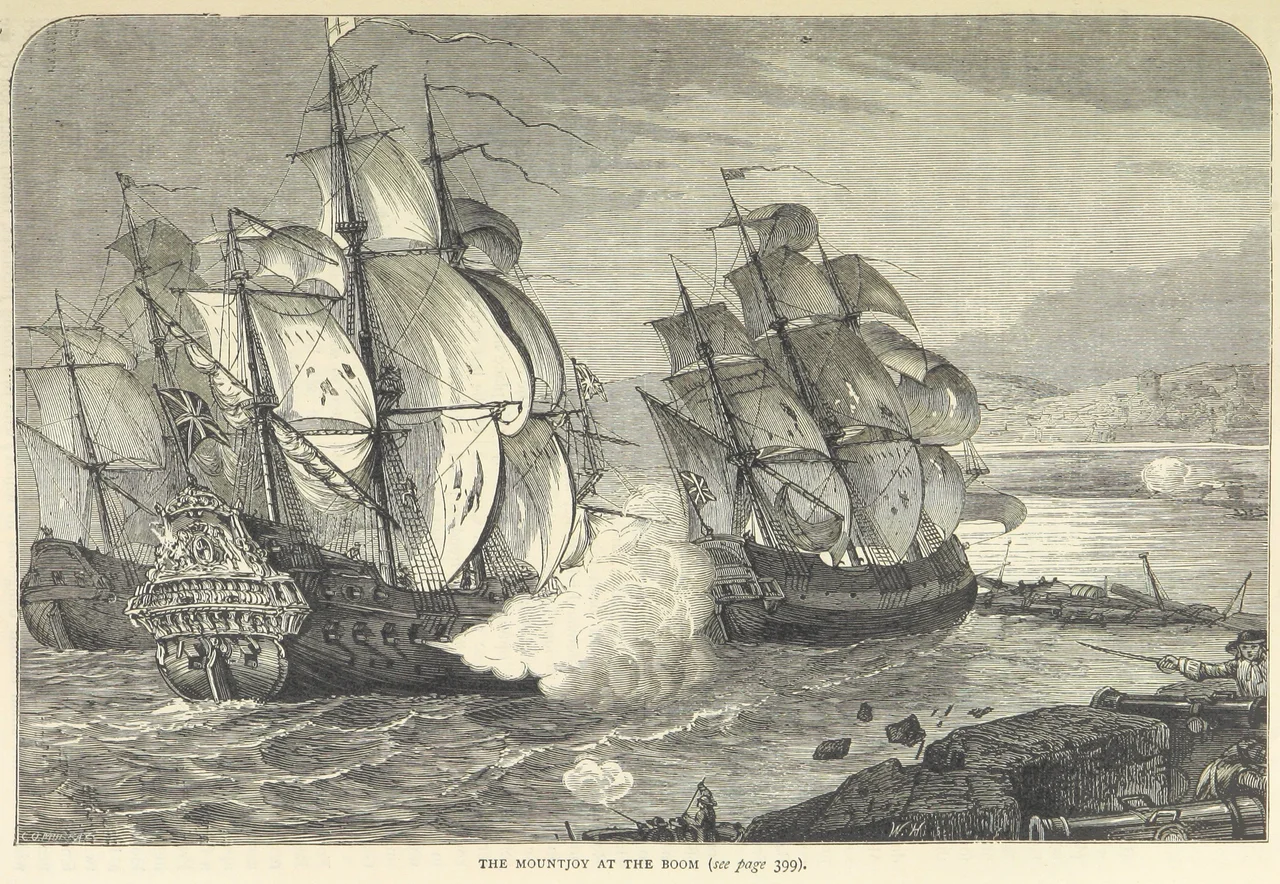
On 3 June 1689 the besiegers stretched a heavy wooden boom across the River Foyle about halfway between Derry and Fort Culmore, to block any relief ships from reaching the city. On 17 May Major-General Percy Kirke had sailed from Liverpool with three men-of-war and 24 transport ships carrying about 3,000 men. The fleet reached Lough Foyle in early June. The besieged could see it from the cathedral tower on 13 June. But Kirke's frigate HMS Greyhound had been run aground and shot at Fort Culmore in an earlier reconnaissance, and Kirke judged the river approach too dangerous to risk. For weeks the relief fleet sat in the lough while the city starved. On 2 July the French general Rosen drove Protestants from the surrounding countryside up to the walls in a deliberate attempt to overwhelm the city's food supply - a tactic so brutal that even James called him 'a barbarous Muscovite' when he heard. The Browning Memorial Plaque on the city wall remembers what happened next.
The Mountjoy
On 28 July, on the orders of Frederick de Schomberg, Kirke finally sent four ships up the Foyle. HMS Dartmouth, under Captain John Leake, engaged the shore batteries. Three merchant ships - the Mountjoy from Derry, the Phoenix from Coleraine, and the Jerusalem - sailed for the boom. The Mountjoy's master, Michael Browning, drove his ship at full sail into the wooden barrier. The boom broke. The Mountjoy struck a sandbank but was lifted free on the next tide. Browning himself was killed by a musket shot from the bank as his ship surged through. Macaulay's History of England, written 150 years later, called his death 'the most enviable of all deaths'. The Phoenix and Mountjoy reached Derry on the evening of 28 July with tons of food. On 1 August the city woke to find the besiegers gone. The siege had lasted 105 days. Of a garrison reported as 8,000 men, some 4,000 are said to have died. Today the Apprentice Boys of Derry hold two annual parades - the Shutting of the Gates in December and the Relief of Derry in August - and the cry 'No Surrender' has become Loyalist Ulster's defining political slogan. Whatever else those 105 days meant, they ended in the Mountjoy and a broken boom. The river still flows past Culmore where the boom once stood.
From the Air
The Siege of Derry was fought in and around the walled city on the west bank of the River Foyle at 54.994 N, 7.326 W. The wooden boom across the river stood roughly halfway between the city walls and Fort Culmore, three miles downriver. The nearest airport is City of Derry Airport (EGAE), itself near the historic Fort Culmore site; Belfast International (EGAA) lies sixty miles east-southeast. From altitude, the seventeenth-century walls remain visible as a tight circuit around the city's old quarter, and the Foyle widens northward toward Lough Foyle where Kirke's relief fleet waited for forty days.
Nearby Stories
- Portrush Lifeboat Station 1.9 km away
- Main Street, Letterkenny 2.1 km away
- Inishowen 6 km away
- Rosguill 6.3 km away
- County Tyrone 7.1 km away
- St Patrick's College, Maghera 9.6 km away
- St Patrick's Purgatory 11 km away
- Coalisland Canal 17 km away