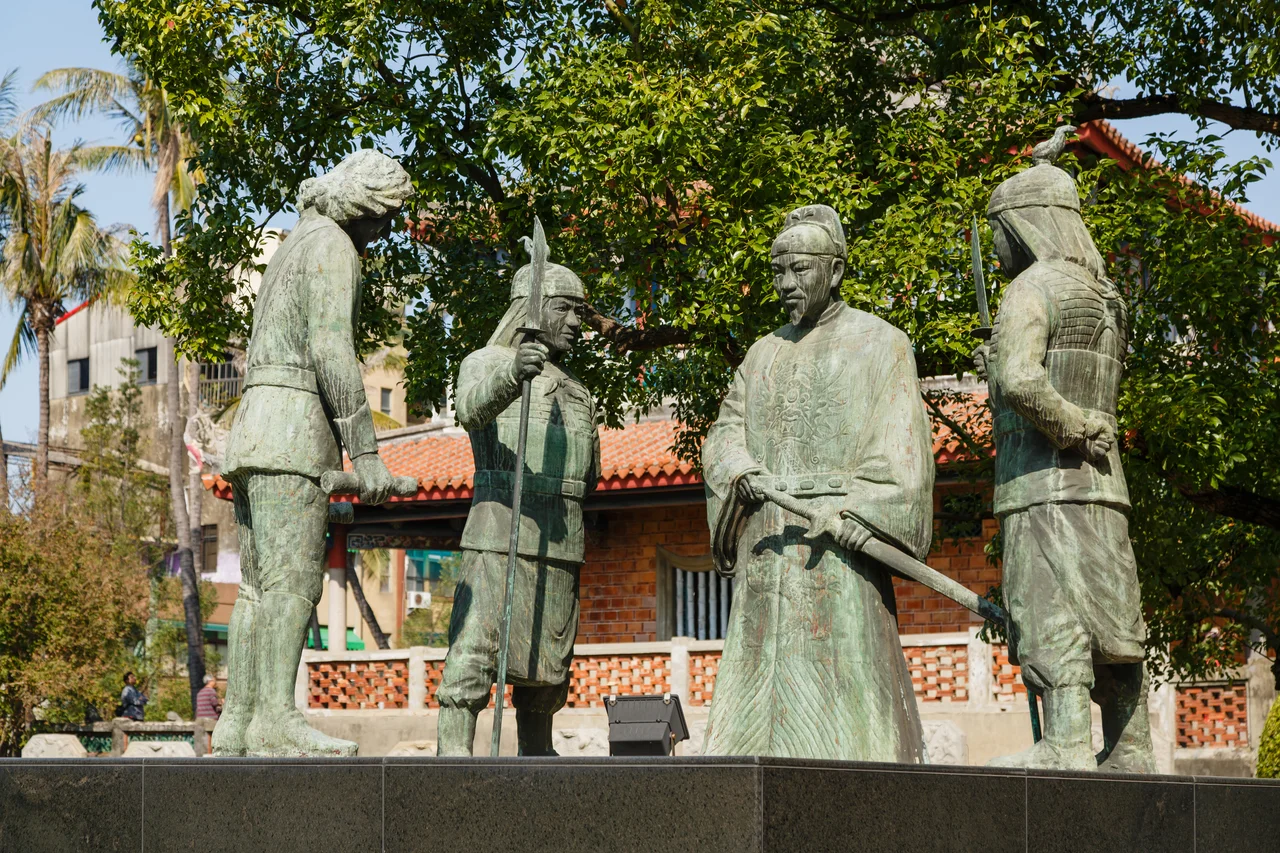

Siege of Fort Zeelandia
The Dutch warship Hector exploded before the battle even began. A cannon had fired too close to the gunpowder magazine, and the VOC's most powerful vessel in Formosan waters blew apart as Koxinga's fleet of hundreds of junks threaded through a shallow waterway the Dutch had believed impassable. It was April 2, 1661. By the time the smoke cleared, the Ming loyalist commander controlled the seas around Taiwan, and the 905 soldiers inside Fort Zeelandia were staring at a force that outnumbered them twenty to one. What followed was a nine-month siege that would end Dutch colonial rule, establish the first Chinese government on Taiwan, and leave behind a legacy of courage, cruelty, and competing historical narratives that the island is still sorting through.
A Map and a Grudge
Koxinga, born Zheng Chenggong, was the son of the pirate-admiral Zheng Zhilong and a Japanese mother. After a failed attempt to capture Nanjing from the Qing in 1659, he needed a new base. Taiwan offered a defensible island with agricultural potential and a garrison weakened by distance from its colonial headquarters in Batavia. The critical intelligence came from a Chinese man working for the Dutch East India Company who fled to Koxinga's base in Xiamen carrying a map of the island's defenses. On March 23, 1661, the fleet of several hundred junks carrying roughly 25,000 soldiers set sail from Kinmen. They reached Penghu the next day, left a small garrison, and arrived at Tayoan on April 2. Governor Frederick Coyett commanded Fort Zeelandia with 1,733 people total, including 547 enslaved workers and 218 women and children. His subordinate Valentyn held Fort Provintia with 140 soldiers.
The Fortress Holds, Then Breaks
Valentyn surrendered Fort Provintia on April 4 after just two days. Fort Zeelandia proved harder. Koxinga sent the captured Dutch missionary Antonius Hambroek as an emissary to demand surrender. Hambroek entered the fort, urged the garrison to resist, then walked back to the Chinese camp knowing it meant his execution. He was beheaded. Koxinga then turned 28 cannons on the fort and launched a night bombardment that demolished the governor's house roof. But the Dutch repositioned their guns using the bastion corners as vantage points and drove back the assault, killing hundreds of Koxinga's best troops. Shocked, Koxinga abandoned direct assault in favor of starvation. A Dutch relief fleet of 12 ships and 700 sailors arrived from Jakarta but failed to break the blockade. Chinese junks lured smaller Dutch vessels into narrow straits where the wind died, then massacred the crews. The flagship Koukercken ran aground before an enemy cannon emplacement and was sunk.
Betrayal and Surrender
By December 1661, morale inside the fort was collapsing. German mercenaries deserted to Koxinga, bringing intelligence about the garrison's weakness. In January 1662, a German sergeant named Hans Jurgen Radis allegedly defected and revealed the strategic importance of a redoubt the Chinese had overlooked. Koxinga acted on the advice, and the position fell within a day. Scholars note this account comes from Frederick Coyett's own memoir, written to shift blame for the defeat. Ming-era Chinese records make no mention of any defector. Whatever the cause, on January 12, 1662, Koxinga launched a final bombardment. Coyett raised the white flag. The surrender was formalized on February 1. The Dutch were allowed to leave with personal belongings and provisions. On February 9, they sailed for Batavia, ending 38 years of VOC rule over western Formosa.
The Human Toll
The siege's aftermath was brutal for everyone caught in it. Koxinga ordered the mass execution of many Dutch male prisoners, mostly by crucifixion and decapitation. Dutch and part-Dutch women and children were enslaved. Koxinga took Hambroek's teenage daughter as a concubine; other women were sold to Chinese soldiers. Some of these women were reported still living in captivity as late as 1684. Both sides had committed atrocities during the fighting: a Dutch physician performed a vivisection on a Chinese prisoner, while Chinese forces mutilated living Dutch captives. The indigenous peoples of Taiwan, meanwhile, fought on multiple sides. In the Kingdom of Middag, natives killed 1,500 of Koxinga's soldiers in their sleep after welcoming them warmly. Elsewhere, indigenous groups who had chafed under Dutch-imposed schooling hunted down colonists and destroyed Christian textbooks. The siege was not a simple story of liberation or conquest. It was a collision of empires in which the people who suffered most had the least say in the outcome.
From the Air
The siege took place at Fort Zeelandia, located at 23.0017N, 120.1608E on the coast of what is now Anping District, Tainan. From the air, the fort's rectangular remains and watchtower are visible near the waterfront. The harbor entrance where the Dutch ships were blocked is identifiable by the narrow channel between sandbars. Tainan Airport (RCNN) is approximately 5nm southeast. Fort Provintia (now Chihkan Tower) is visible inland at approximately 22.997N, 120.203E. Best viewed below 3,000 feet for detail.
Nearby Stories
- Chung Li-ho Museum 0.7 km away
- Jingzaijiao Tile-paved Salt Fields 8 km away
- Wanchin Basilica of the Immaculate Conception 9.3 km away
- Namasia District 16 km away
- Battle of Penghu 21 km away
- Shoushan (Kaohsiung) 21 km away
- Penghu Air Raids 62 km away
- Daya Bay 512 km away