
Siege of Haddington
On 9 July 1548, Mary of Guise rode up to the Scottish trenches outside Haddington to watch the siege guns work. A cannon shot from the English garrison landed close enough to her party to injure several of her companions, and the Queen Mother of Scotland fainted dead away in her saddle. On the other side of the country that same week, her five-year-old daughter Mary, Queen of Scots was at Dumbarton Castle, boarding the French galley that would take her to France and away from this war. The two events bracket what was happening at Haddington: a foreign queen besieging her own kingdom's market town to drive out an occupying English garrison that included Albanian cavalry, Spanish arquebusiers, German gunners, and Italian mercenaries. It was the longest siege in Scottish history, and it would last until the English finally walked out, sick and broken, eighteen months later.
The Rough Wooing
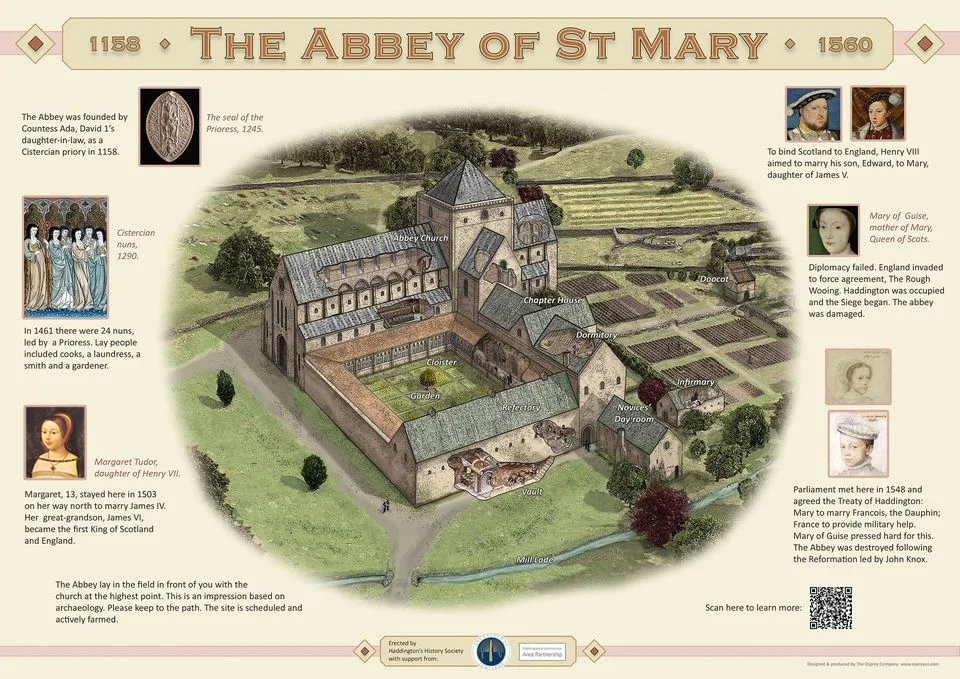
The war that brought English troops to East Lothian was nominally a marriage proposal. Henry VIII wanted Mary, Queen of Scots, then an infant, to marry his son Edward to unite the kingdoms. The Scots refused. After Henry's death his successor Edward Seymour, Duke of Somerset, kept pressing the suit at sword-point in what became known as the Rough Wooing. The English victory at Pinkie Cleugh on 10 September 1547 left Scotland's military shattered. Somerset's strategy was to plant a network of garrisoned forts across the Lowlands, supplied from the sea, and hold them until the Scots accepted his terms. Haddington, the wealthiest royal burgh between Edinburgh and Berwick, was the key fortress in that chain. By 23 February 1548 Lord Grey of Wilton had captured and garrisoned it.
An International Garrison
What followed reveals how much of sixteenth-century warfare was already privatised. Grey's garrison included 200 Albanian Stratioti who had previously fought for the French. As reinforcements arrived through the summer he added 100 Spanish arquebusiers under Pedro de Negro, an Italian mercenary company under Francisco Tiberio, and English military engineers under Thomas Pettit, Surveyor of Calais. The fortifications they built were admired by an Italian observer as nearly as strong as Turin's. Four bastions named Bowes, Wyndham, Taylor, and Tiberio anchored a rampart that enclosed all of Haddington's 'fair houses,' and the medieval tollbooth was filled with earth to become a gun platform. The French ambassador in London reported back to Paris that the works rivalled Calais. The Scots and French who came to break them in faced not an English garrison but a multinational corporation with stockholders in five capitals.
A Queen at the Guns
Mary of Guise, regent for her absent daughter, was determined to take Haddington back. By July 1548 French reinforcements under Andre de Montalembert, Sieur d'Esse, had arrived. The Master of the Scottish Artillery, Lord Methven, brought guns up from the siege of Broughty Castle, shipped them to Aberlady, and added the great Scottish cannon 'thrawinmouth' from Dunbar. Highland soldiers from the Earl of Argyll arrived wearing dyed shirts and wool covers in mixed colours, an early reference to tartan plaids that the French chronicler Jean de Beauge would write down. Mary herself came to inspect the works, and was nearly killed by the round that knocked her companions over. On 16 July the French and Scots stormed the town, and were driven back by cannon fire. D'Esse pulled the heavy guns out on 17 July, complaining to Regent Arran that an earlier, decisive assault would have worked.
Plague, Powder, and Withdrawal
What broke the English garrison was not assault but attrition. Throughout 1548 and 1549 Scots raided at night, the watch shouting 'Bows and Bills' as the alarm, while plague swept the cramped quarters within the walls. On 1 November 1548 Sir James Wilford, the garrison commander, wrote to Somerset that of the 1,000 men he had to man the ramparts, most were sick or dead. Spanish cavalry under Pedro de Negro had once relieved the powder shortage by riding through enemy lines from Linton bridge with bags of gunpowder, slaughtering their own horses outside the town gates rather than risk the return trip; Pedro de Negro then buried the horses in three pits beside the wall. But heroics could not fix the larger problem. More French troops arrived under Paul de Thermes. England was running out of money. On 19 September 1549, the garrison and its international hangers-on evacuated overland to Berwick. Mary of Guise was triumphant, and Haddington, scarred but Scottish again, began to rebuild.
From the Air
The siege site lies at 55.95N, 2.78W centred on the town of Haddington in East Lothian. From the air the town sits in a meander of the River Tyne, which formed the south and west boundaries of the English fortified position. St Mary's Collegiate Church, the Scottish siege headquarters, is visible just east of the town centre. Edinburgh Airport (EGPH) is 17nm west; Dundee Airport (EGPN) sits 22nm north across the Firth of Forth. North Berwick Law and the Garleton Hills rise to the north; the Lammermuir Hills extend southward. Best viewed at 2,000-3,500ft in clear conditions.
Nearby Stories
- Leith 0.8 km away
- Crail 1.4 km away
- Falkland Palace 2.8 km away
- Peebles 8 km away
- Mellerstain House 9.9 km away
- Eyemouth Disaster 11 km away
- Battle of Homildon Hill 19 km away
- River Dee Ferryboat Disaster 99 km away