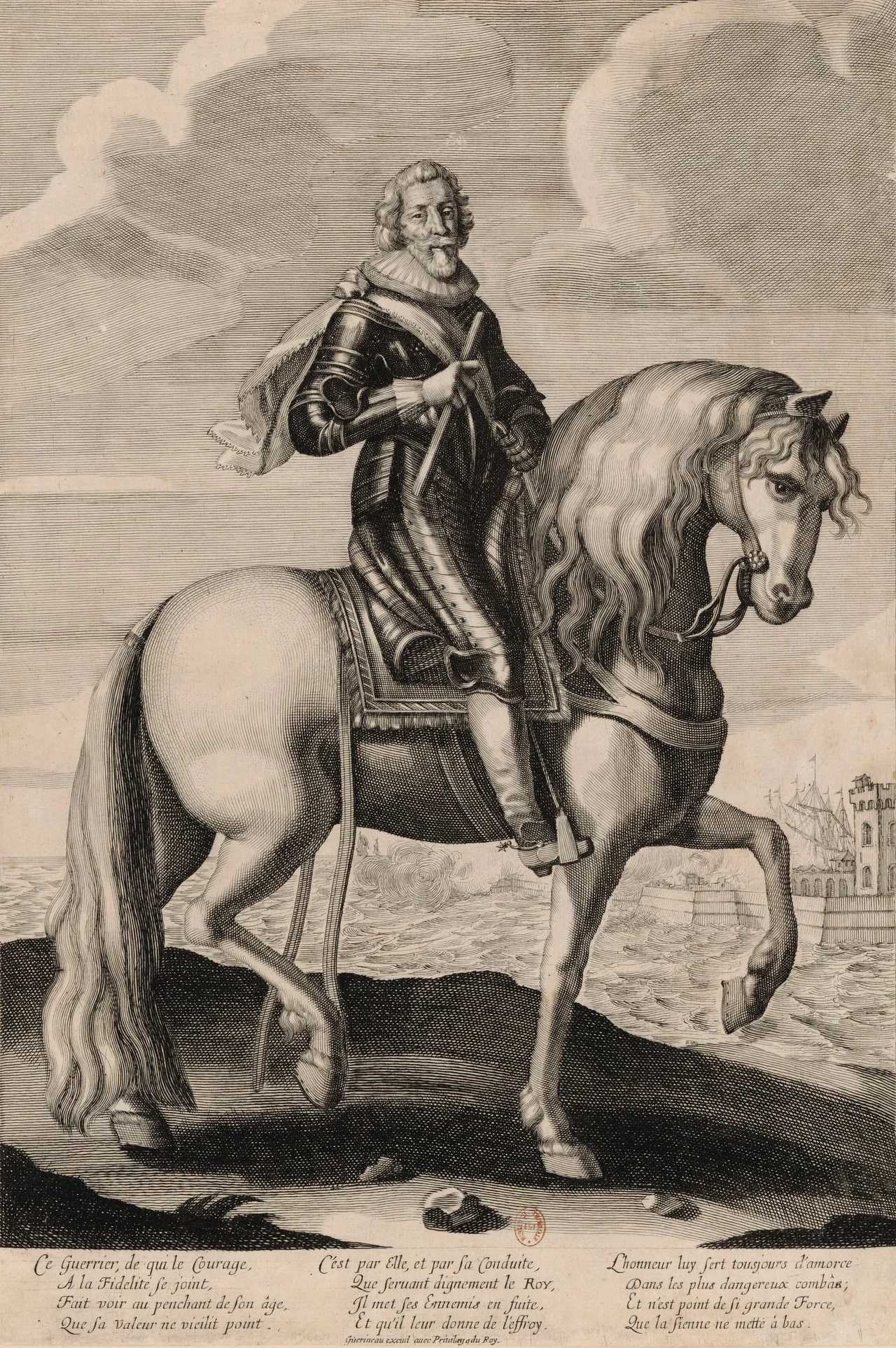

Siege of Saint-Omer
Marechal de Chatillon had a thousand Spanish defenders to his front and a kingdom's hopes on his shoulders. He had promised Louis XIII that he would take Saint-Omer, the great fortified town that anchored the Spanish Netherlands' western frontier, and on 24 May 1638 his army closed in. The garrison was preposterously small - barely 1,300 men in a town that needed three times that to hold its walls. The siege should have ended in three weeks. Instead it lasted fifty-three days, ground through nighttime artillery assaults in the rain, the suspected betrayal of townspeople, the death of an Imperial general from his wounds in a captured fort, and finally a Spanish relief operation that came up through the marshes of the Aa and broke the French siege from inside its own lines. When Chatillon left on 16 July, he left burning bridges, abandoned supplies, and a career in ruins.
The Frontier of Two Empires
By 1638 the Thirty Years' War had ground on for two decades and France had finally joined openly, fighting Spain along the long northern frontier of Flanders and Artois. Saint-Omer was a Spanish town - it had been Habsburg since the sixteenth century - and it sat on the road from Calais to Lille like a cork in a bottle. Cardinal Richelieu wanted that cork pulled. Two summers earlier, a Spanish army under the Cardinal-Infante Ferdinand of Austria had come within a hundred miles of Paris and caused panic in the capital. Now France wanted Saint-Omer in exchange. Chatillon - Gaspard III de Coligny, a Huguenot marshal from one of France's great Protestant houses - was given the army. By 26 May his siege lines surrounded the city. Three days later he took Arques, the outpost three kilometres east, after a brief bombardment forced its fifty Walloon defenders to surrender. The Frenchmen lost one captain who had his arm shot off.
A War Fought in a Marsh
Saint-Omer is surrounded by marshes - the Audomarois - and any seventeenth-century siege of the town meant fighting in water. Chatillon cut the canals, captured the small forts that ringed the marshes, and built his own forts to seal them up. The Spanish defenders were a polyglot rabble - Spanish tercios, Irish Catholics under Owen Roe O'Neill (who would later fight the English at home in Ulster), Walloons under the Baron of Wezemaal, and Croatian cavalry under a colonel known only as Ludovico. The relief army was even more international: Spaniards, Italians, Imperials under the Florentine general Ottavio Piccolomini, all under the overall command of Thomas Francis, Prince of Carignano. On the night of 8 June, the Spanish slipped between Chatillon's siegeworks and built a fort - Fort Saint Jean - directly inside the French lines. Chatillon spent the next month trying to take it back.
The Rain and the Storm
On 2 July a Spanish sortie under Captain Rodrigo de Rojas tried to assault the French works and ran straight into the Scottish Regiment of Colonel Lord James Douglas - one more reminder of how many nations were tangled together on this small piece of ground. Days later, with rain coming down and visibility almost zero, the Spanish stormed Fort Saint Jean itself. Three groups of two hundred men, each with a scaling ladder and timber to fill the moat, climbed the parapet under heavy fire. Captain Diego de Bohorquez, leading the first column, took a musket ball but kept going. The fort fell. By the Spanish count, the French lost eight hundred men dead and wounded; the Spanish lost twenty-seven. Piccolomini, meanwhile, had pushed through the village of Saint-Momelin to the north, and the Irishman O'Neill had captured a French outpost on the river, opening a supply route into Saint-Omer itself. The siege was breaking. On 12 July a second Spanish-Imperial cavalry force tried to slip down the levee of Hennin to link up with Piccolomini, and Marechal de La Force's French cavalry crushed them. Nine hundred Imperial cavalrymen drowned in the canals or were captured. The Imperial commander, General Girolamo Colloredo, died of his wounds in the fort the Spanish had just captured from the French.
Surrender of Fort Bacq
By 16 July the French were holding only the great Fort Bacq on the southern side of the siege ring, and it was defended by two thousand men under the Sieur de Manican. Piccolomini's troops rejected three assaults. On the fourth, as the Spanish tercios were leaping into the moat with their ladders, Manican surrendered on terms - safe passage back to France. The Spanish honoured the terms. When Manican reached Metz, the French Crown arrested him and threw him in prison at Amiens for surrendering. Chatillon abandoned his camp on the night of 16 July and retreated to Fervaques, leaving behind cannons, baggage, and the bodies of perhaps four thousand of his men - many of them not killed in the fighting but dead of dysentery, exhaustion, and the marsh fever that had stalked his army for two months. Prince Thomas of Carignano marched his troops through Therouanne and went on to Brussels to report the relief of Saint-Omer to the Cardinal-Infante. Saint-Omer would remain Spanish for another forty years, until Vauban's siege under Louis XIV finally took it for France in 1677.
From the Air
50.7483 N, 2.2608 E, centered on Saint-Omer. The siege ring would have extended into what are now the suburbs of Arques, Tilques, and Saint-Momelin to the north - all clearly visible from low altitude. The Audomarois marshes north of the town are still wetland and convey the impossible geography Chatillon faced. Recommended viewing altitude: 2,000 to 4,000 feet. Nearest airport: Saint-Omer Air Base (LFQN), 3 km southwest of the town center.
Nearby Stories
- Battle of Armentières 5.6 km away
- Yser Towers 6.8 km away
- Courrieres Mine Disaster 7.1 km away
- Battle of Dunkirk 9.1 km away
- Chateau de Boulogne-sur-Mer 10 km away
- Battle of Dover Strait (1916) 14 km away
- Cléon 136 km away
- Royaumont Abbey 145 km away