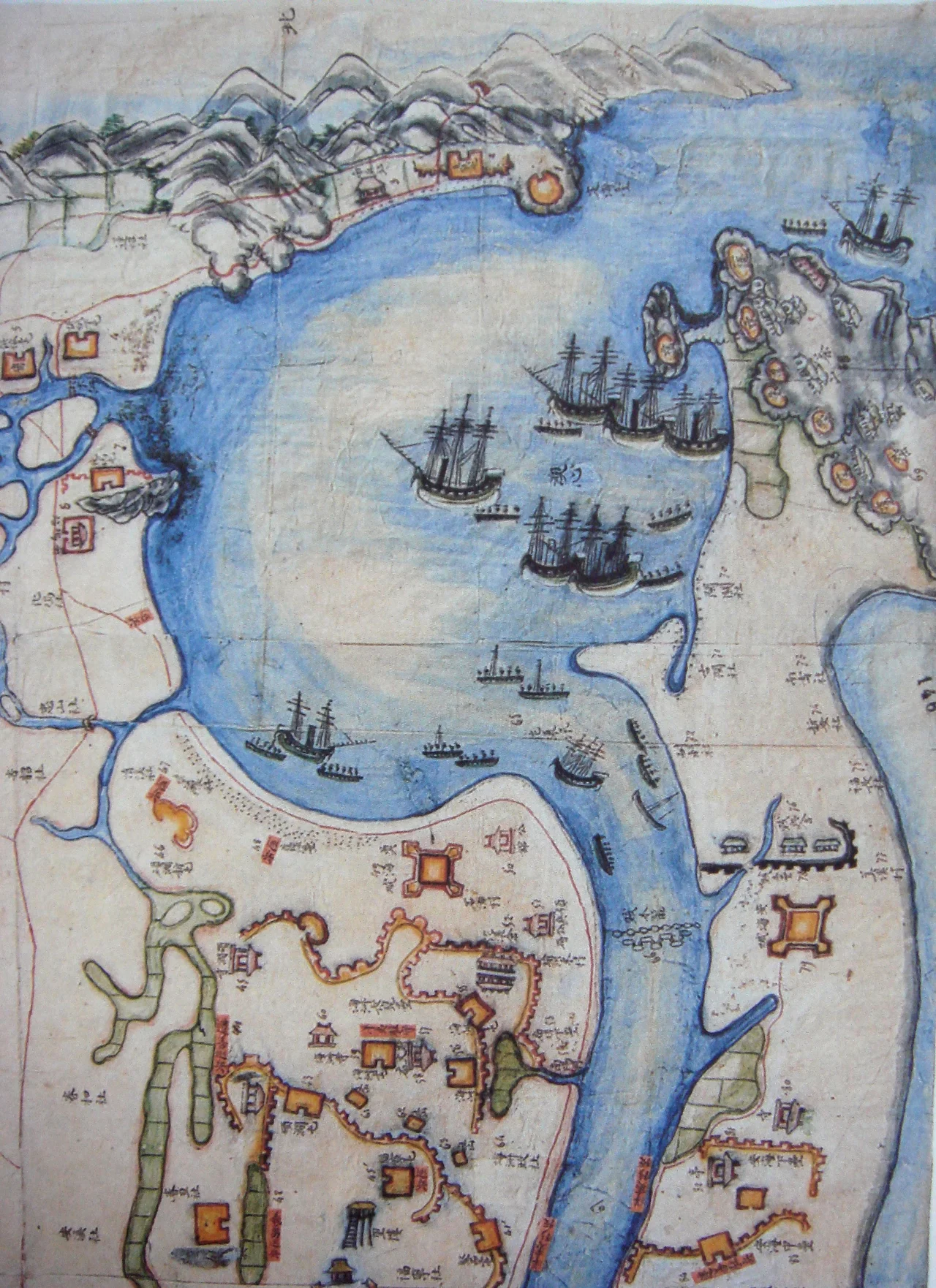

Siege of Tourane
The French admiral's surrender demand was carried ashore by a staff officer and laid at the gate of Fort de l'Aiguade. No response came within the stipulated two hours. Rigault de Genouilly ordered the fleet to open fire, raising the Tricolor at his flagship's mainmast and a Spanish flag at the mizzenmast. By nightfall on 1 September 1858, the Tiên Sa peninsula was in allied hands. It was an overwhelming tactical success. It was also the beginning of an eighteen-month humiliation.
Why Tourane
The road to Tourane began with an execution. In 1857, Vietnamese emperor Tự Đức had two Spanish Catholic missionaries put to death — neither the first nor the last such incident in a country where the Nguyễn court viewed missionary activity as a destabilizing foreign intrusion. France and Spain had been looking for a pretext, and this served as one. Napoleon III authorized Admiral Charles Rigault de Genouilly to mount a punitive expedition. Tourane — the sheltered bay at modern Da Nang — was selected as the landing site because its harbor was excellent and because it sat within reasonable striking distance of Huế, the imperial capital. The Vietnamese had understood this logic themselves and built accordingly: five major forts on the Tiên Sa peninsula, shore batteries between them, British powder, Belgian and French rifles, and 4,000 troops — 2,000 provincial soldiers and 2,000 elite center soldiers sent down from Huế — under capable commanders.
The Capture and the Trap
The allied fleet arrived off Tourane Bay at nightfall on 31 August 1858. At dawn the next morning, the warships — the 50-gun frigate Némésis, two corvettes, five steam gunboats, and a Spanish dispatch vessel — took up positions facing the Vietnamese forts. When no response came to the surrender demand, the bombardment began. The Vietnamese gunners returned fire but inflicted no damage on the allied ships. Landing parties stormed the forts one by one; the defenders of Observatory Fort, unable to retreat in time, were killed or captured where they stood. Tourane fell in a day. Then the French discovered what the city was worth to them without the surrounding countryside. Nguyen Tri Phuong, the Vietnamese commander, did not attempt to retake the forts directly. Instead, he laid siege. His forces cut off the supply lines, laid waste to the farms and villages around Tourane, and waited. The Vietnamese strategy was patient, systematic, and devastating.
Disease as the True Adversary
Rigault de Genouilly could win battles but could not break the siege. He left for Saigon in February 1859 with the bulk of his forces, leaving only a small garrison at Tourane under Capitaine de Vaisseau Thoyon. He returned in April, mounted two successful assaults on Vietnamese positions — at the trenches in May and at Cẩm Lệ in September, capturing 40 cannon and inflicting heavy casualties — and still the siege held. What the Vietnamese could not accomplish with arms, disease accomplished for them. Cholera swept through the allied landing force and the warships alike. Between 1 and 20 June 1859, 200 French troops died from cholera in Tourane alone. One battalion that arrived in April 1859 lost a third of its strength within two months. The Vietnamese commander Lê Đình Lý was mortally wounded at Cẩm Lệ — but he was replaced. The French had no equivalent reserves of manpower to draw on within the theater.
Evacuation and Its Consequences
By autumn 1859, Rigault de Genouilly's conduct of the campaign had drawn criticism and he was recalled to France. His replacement, Rear Admiral François Page, disembarked at Tourane in October and immediately offered peace terms to the Vietnamese: protection for Christians, French consuls in Vietnam, commercial privileges. The terms were refused. The Vietnamese stalled, confident the French would eventually leave. They were right. In February 1860, French engineers began systematically dismantling and demolishing the forts they had held for eighteen months — blowing up the Vietnamese defenses, burning their own barracks — and on 22 March 1860, the last allied soldiers re-embarked without interference. Emperor Tự Đức had the news proclaimed across Vietnam. The only trace of twenty months of occupation was a cemetery holding the allied dead. The siege of Tourane had ended as a Vietnamese victory. What followed, however, was different: with the end of the Second Opium War freeing French resources from China, the military balance in Vietnam shifted. By April 1862, the Vietnamese were forced to sue for peace and cede three southern provinces — the territory that became French Cochinchina. The harbor whose forts had resisted Europe for eighteen months became, in time, the harbor through which French colonialism entered Vietnam for good.
From the Air
The siege took place at and around the Bay of Tourane, now Da Nang Bay, centered at approximately 16.07°N, 108.23°E. The Tiên Sa peninsula — where the Vietnamese forts stood and the initial assault took place — forms the eastern arm of Da Nang Bay and is clearly visible from the air. The modern container port and cruise terminal at Tiên Sa occupy the same peninsula. Da Nang International Airport (VVDN) lies 8 km to the southwest. At 4,000–6,000 feet, the entire bay, peninsula, and city are visible in a single view. The mountains to the west mark the terrain that limited the French to their coastal enclave; the flat coastal plain to the south shows the agricultural land the Vietnamese scorched to deny the invaders supply.
Nearby Stories
- Mỹ Sơn 6.7 km away
- Tomb of Tự Đức 9.5 km away
- Chàm Islands 16 km away
- Thiên Mụ Temple 41 km away
- Chu Lai Air Base 47 km away
- Tomb of Gia Long 54 km away
- Dong Ampham National Biodiversity Conservation Area 81 km away
- Battle of the Paracel Islands 321 km away