
Six Bells Colliery
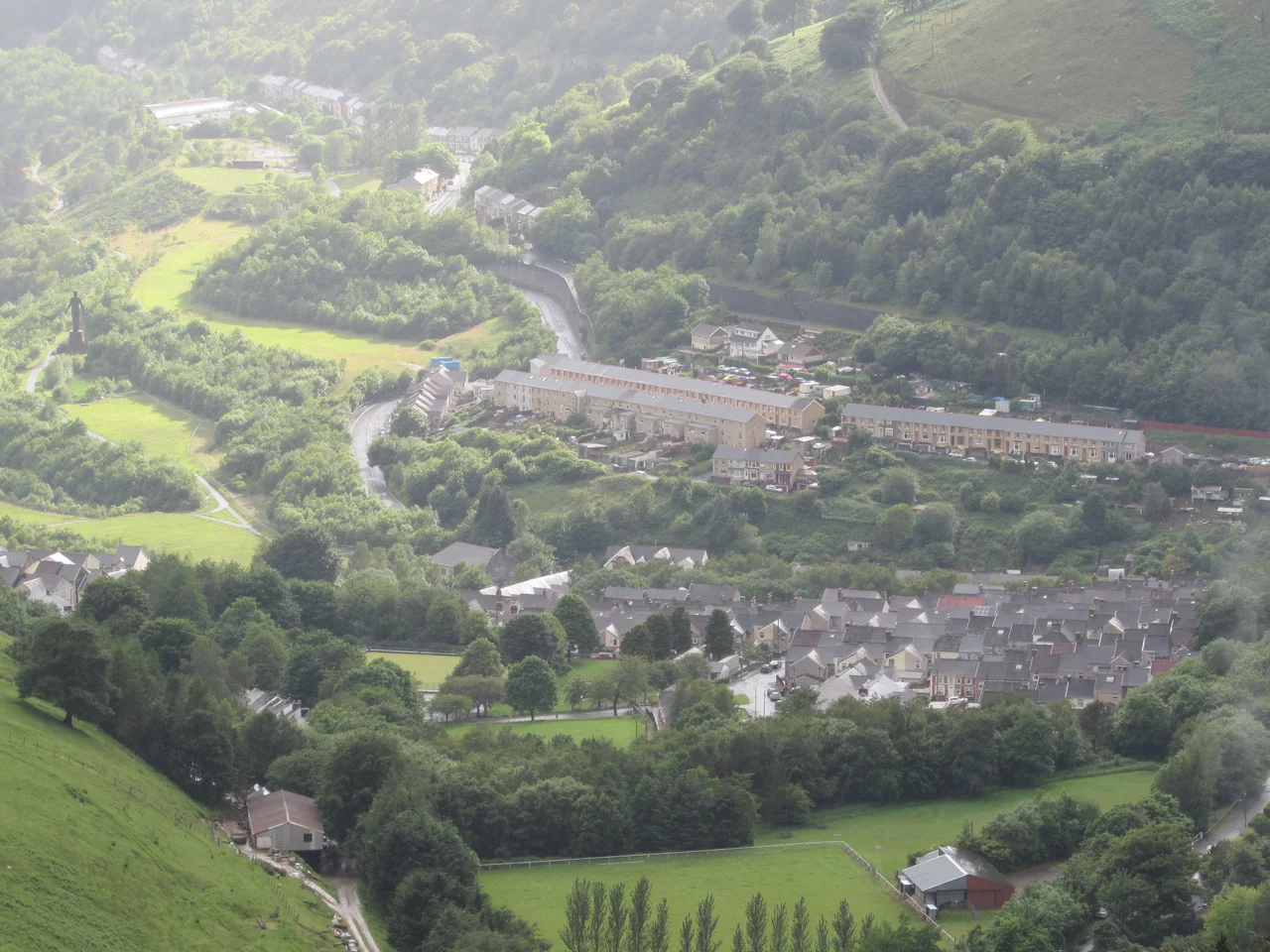
On 28 June 1960, at approximately 10:45 in the morning, an explosion tore through the West District of the Old Coal Seam at Six Bells Colliery in Abertillery. Forty-five of the 48 men working that section died. Lethal carbon monoxide had filled the workings within minutes. The Inspector of Mines later concluded that the most likely cause was firedamp, the methane that haunts every deep coal mine, ignited by a single spark from a stone falling onto a steel girder. A single spark. Fifty years later, on the same day in 2010, the Archbishop of Canterbury Rowan Williams stood at the site and unveiled a 20-metre tall steel figure called the Guardian. Sebastian Boyesen designed it from thousands of steel ribbons. It looks across the Ebbw Fach valley, at the ground where the colliery once stood, at the houses where the families still live.
Before the Pit Had a Name
Mining at this site began in 1863, when Thomas Phillips Price sank a balance shaft at Hafod Van on the eastern side of the Ebbw Fach River. That early operation was modest. The real colliery began in 1892 when John Lancaster and Co. started sinking two new 352-yard shafts on the opposite bank, in what was then known as the Arael Griffin Colliery. The work was dangerous from the start. On 9 February 1895, four men died during the sinking when the bowk, the large barrel that lowered them down the shaft, capsized and dropped them to the bottom. Their names are part of the long tally of South Wales coal that the official histories tend to compress into single numbers. By 1896 the colliery was owned by Partridge Jones and Co. and employed 173 men, 101 of them on the surface. Coal winding began in 1898. The coal went south to Newport on the Newport and Pontypool Railway, later part of the Great Western.
Boom, Bust, Boom
The colliery's workforce reflected the larger swings of the Welsh coal industry. By 1914 it employed 2,857 men. Through the 1920s, 859 men worked the Big Vein and Three Quarter seams at No. 4 pit; 1,529 worked the Black Vein and Meadow Vein seams at No. 5. The economic downturn of 1930 mothballed the pit for years, an early casualty of the industry's interwar collapse. John Paton took it over in 1936 and ran it until nationalisation in 1947, by which time it employed 1,534 men. The neighbouring Vivian Colliery closed in 1958, and for some years Vivian's shaft was repurposed as a downcast ventilation route for Six Bells. By the start of 1960 the colliery was producing 338,000 tonnes of coal a year and employed 1,291 men. That was the state of things when the morning of 28 June arrived.
What Happened That Morning
The shift had been working in the West District of the Old Coal Seam for hours when the explosion came. Firedamp, the colourless methane that seeps from coal seams into mine air, had ignited somehow. The fire spread along the coal dust suspended in the air, and the dust itself ignited, and the flame ran through almost the entire district. Forty-five of the 48 men in that section of the mine died. The tragedy would have been worse, much worse, but for routine maintenance taking place on the O.10 face, where on any normal day 125 men would have been working. The men who died were not numbers. They were husbands and brothers and fathers; they were South Wales coal miners doing the work that coal mining had always demanded. Lethal carbon monoxide concentrations meant most lost consciousness within seconds and died within minutes. A public inquiry sat at Court Room No. 2 of Newport Civic Centre between 19 and 28 September 1960. The Inspector of Mines concluded that the probable cause was firedamp ignited by a spark from a stone striking a steel girder. A small, ordinary chain of physics with a catastrophic end.
After the Disaster
Six Bells kept working. In a mining town there was little choice. As part of the National Coal Board's 1970s strategy of consolidating into super-pits, the colliery was integrated with Marine Colliery at Cwm; coal from the Six Bells workings was raised through Marine after that, and the surface plant at Six Bells gradually fell silent. British Coal closed the whole complex in 1988. Among the men who had worked there over the years were figures who shaped wider Welsh life: Ness Edwards, the trade unionist and later Labour MP, who came up through the South Wales Miners' Federation; George Silverthorne, an early recruit of the Communist Party of Great Britain. They are reminders that a colliery is not only an industrial site, but a political and cultural one too, shaping the men who worked it and being shaped by them in turn.
The Guardian
The former colliery site was landscaped and renamed Parc Arael Griffin, with a visitor centre at Ty Ebbw Fach that includes a restaurant and a Valleys Mining Town Experience room. The park is now a point on the Ebbw Fach Trail. In 2010, on the 50th anniversary of the disaster, the Welsh sculptor Sebastian Boyesen completed the Guardian, a 20-metre tall steel figure standing on the hillside above where the colliery used to be. He built it from thousands of steel ribbons, each one curving away into the wind. From a distance the figure looks solid. Up close it is open, almost transparent, the sky visible through the ribbons. Critics have called it a Welsh answer to Antony Gormley's Angel of the North, but it is not really a counterpart. The Angel watches the motorway. The Guardian watches the valley where 45 men died one June morning, and looks toward every coalfield community that ever lost its own. The Archbishop of Canterbury, Rowan Williams, unveiled it on 28 June 2010, exactly half a century after the explosion. The memorial commemorates the men of Six Bells. It is dedicated to all mining communities, wherever they may be.
From the Air
51.720°N, 3.133°W, in the Ebbw Fach valley between Abertillery and Aberbeeg. Recommended viewing altitude 2,500-4,000 ft AGL to see the Guardian sculpture on the hillside above Parc Arael Griffin, the landscaped former colliery site. The narrow valley runs north to south, hemmed by the typical steep South Wales valley slopes. Nearest airports: Cardiff (EGFF) approximately 25 nm south, Bristol (EGGD) 32 nm southeast. Approach the area with respect; this is a place of memory as much as geography.
Nearby Stories
- Ewenny Priory 4.1 km away
- Tower Colliery 5.3 km away
- British Camp 8 km away
- Berkeley Castle 8.8 km away
- Hay Castle 11 km away
- Clevedon Pier 11 km away
- Royal Victoria Park 15 km away
- Strata Florida Abbey 35 km away